
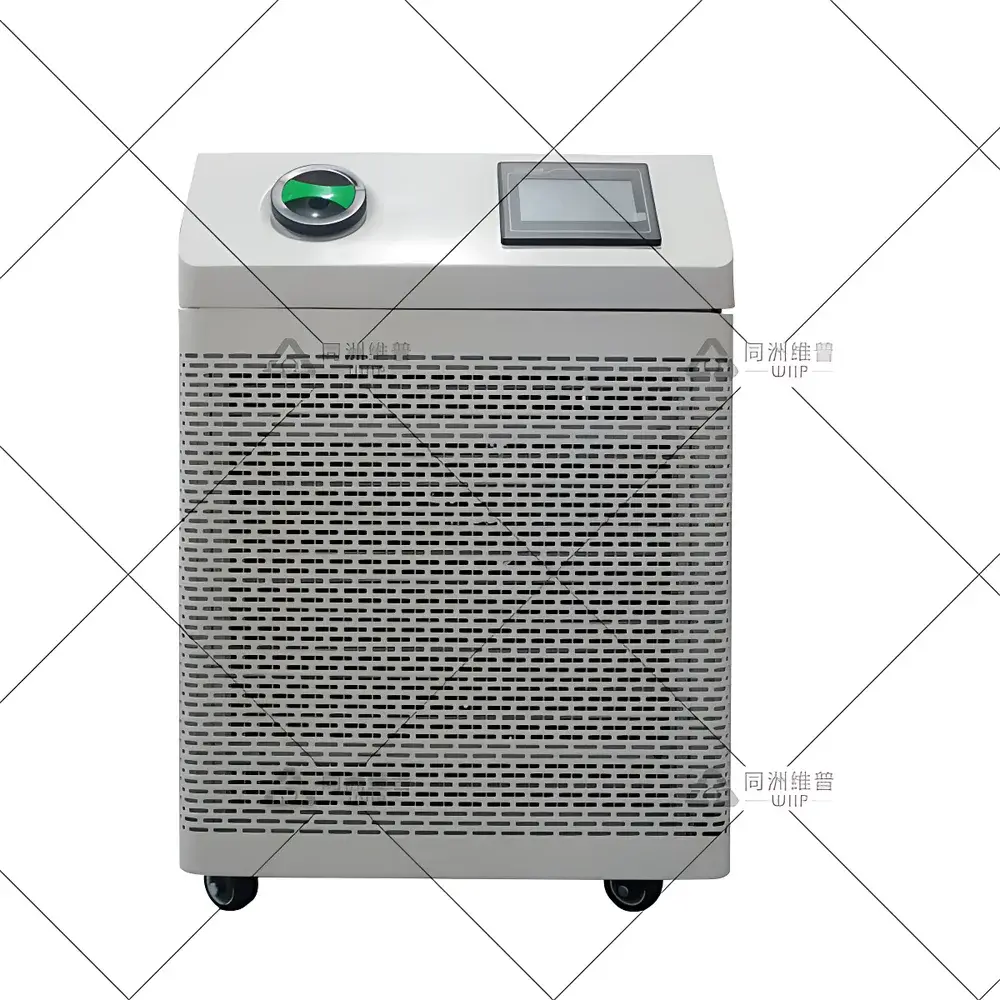
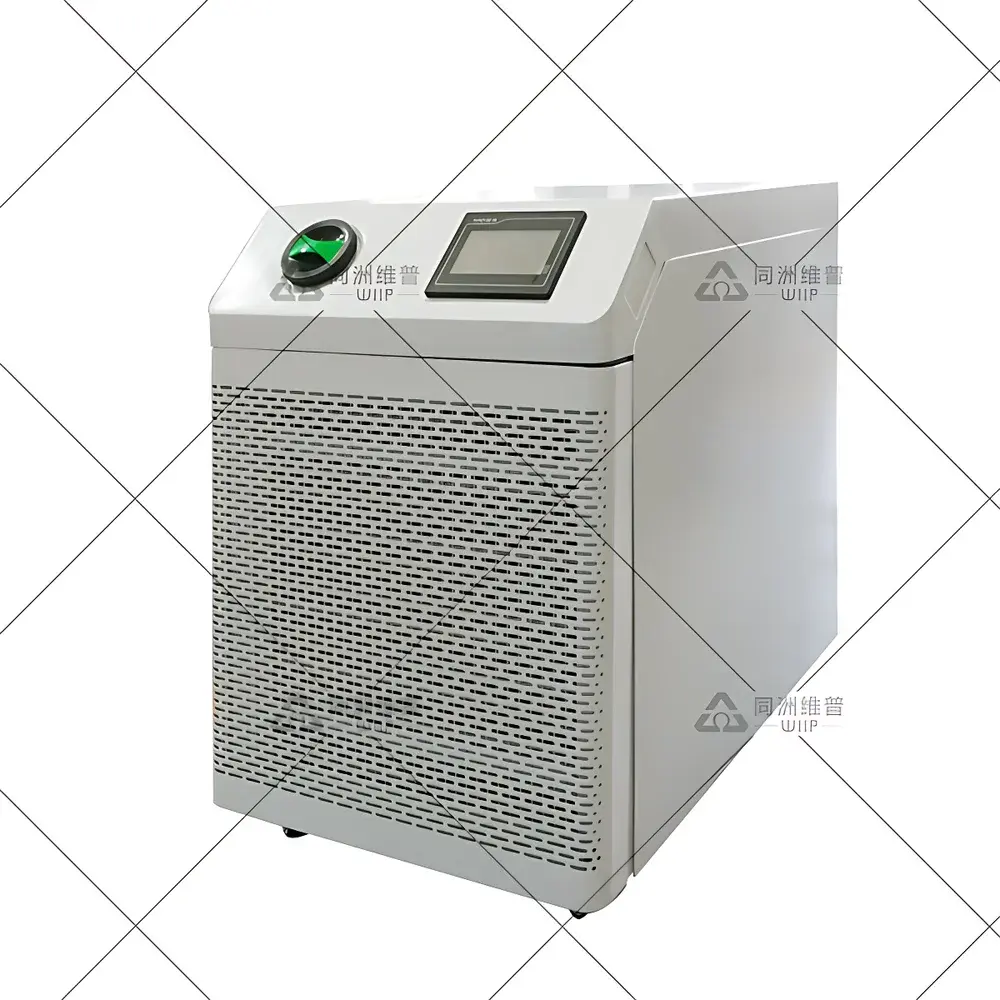
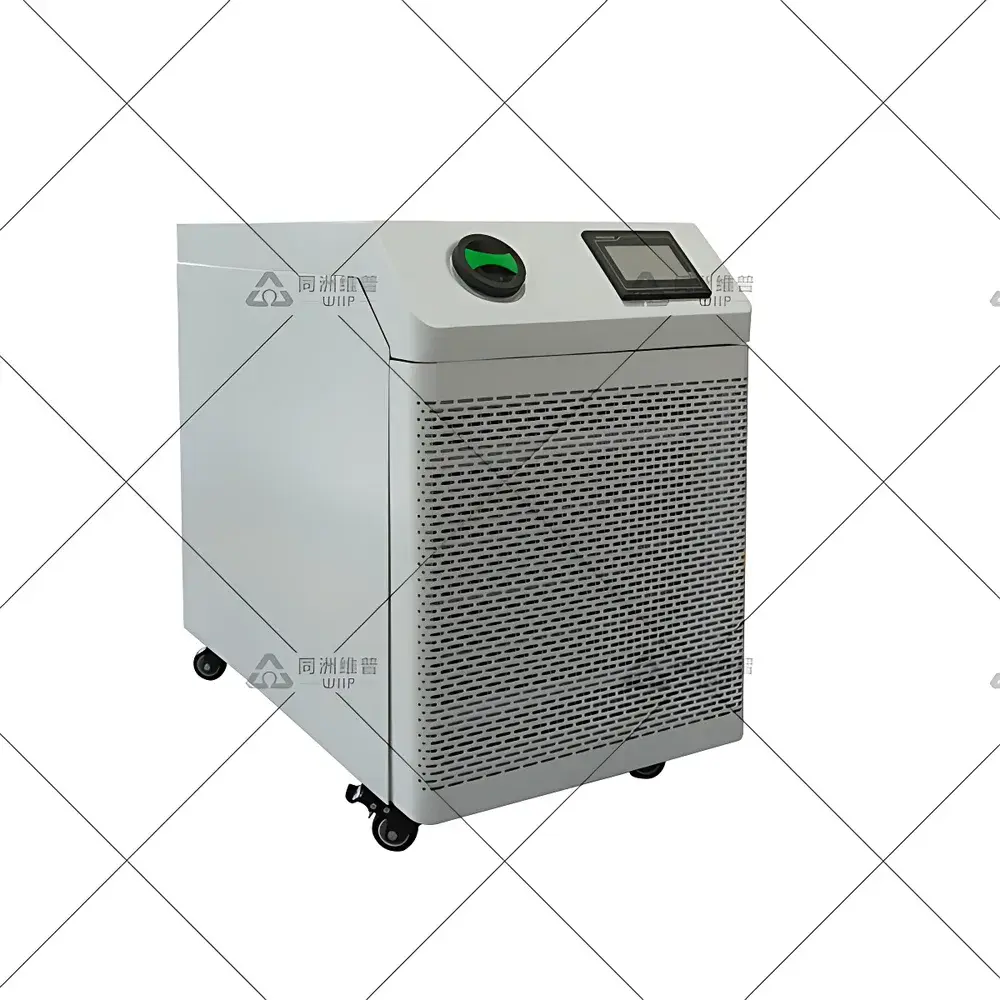
Tongzhou Weipu D3s Compact Horizontal Circulating Chiller
| Brand | Tongzhou Weipu |
|---|---|
| Origin | Beijing, China |
| Manufacturer Type | Direct Manufacturer |
| Instrument Type | Integrated Unit |
| Cooling Method | Water-Cooled |
| Temperature Control Range | 5–35 °C |
| Cooling Capacity | 3600 W |
| Temperature Stability | ±0.1 °C |
| Circulation Pump Pressure | 3.6 bar |
| Circulation Flow Rate | 40 L/min |
| Reservoir Volume | 4 L |
| Operating Principle | Phase-Change Refrigeration |
Overview
The Tongzhou Weipu D3s Compact Horizontal Circulating Chiller is an integrated, water-cooled refrigeration system engineered for precise thermal management of sensitive analytical and materials characterization instruments in research laboratories and quality control environments. It operates on a vapor-compression phase-change refrigeration cycle—utilizing a hermetically sealed compressor, condenser, expansion device, and evaporator—to deliver stable, continuous cooling within a tightly controlled temperature band (5–35 °C). Designed with a low-profile horizontal footprint, the D3s optimizes benchtop or under-bench installation space without compromising thermal performance or operational reliability. Its closed-loop circulation architecture ensures consistent coolant delivery to external devices, minimizing thermal drift in high-precision instrumentation such as atomic absorption spectrometers (AAS), inductively coupled plasma optical emission spectrometers (ICP-OES), and scanning electron microscopes (SEM).
Key Features
- Integrated design with compact horizontal chassis—ideal for space-constrained laboratory setups and modular instrument integration.
- Water-cooled condenser enables stable operation in ambient environments up to 35 °C, eliminating reliance on variable air-cooling performance.
- Precision temperature regulation with ±0.1 °C stability over the full 5–35 °C range, achieved via PID-controlled refrigerant expansion and dual-sensor feedback loop.
- High-flow circulation system delivering up to 40 L/min at 3.6 bar pressure—compatible with long coolant lines and multi-instrument manifolds.
- 4-liter stainless-steel reservoir with level sensor, corrosion-resistant internal wetted parts, and anti-cavitation pump housing.
- Phase-change refrigeration architecture compliant with IEC 61000-6-3 (EMC) and IEC 61000-6-2 (immunity) standards; refrigerant R-410A used per ISO 8502-1 safety guidelines.
Sample Compatibility & Compliance
The D3s chiller is validated for continuous duty cycling with a broad spectrum of laboratory instrumentation requiring active thermal stabilization. It interfaces directly with AAS flame and graphite furnace assemblies, ICP-OES/MS torch cooling jackets, SEM column chillers, glovebox antechamber heat exchangers, RF plasma etching systems, and laser diode mounts. All fluid-path components meet USP Class VI biocompatibility requirements for non-reactive coolant contact. The unit conforms to CE marking directives (2014/30/EU EMC Directive and 2014/35/EU LVD Directive) and supports GLP/GMP workflows through traceable calibration logs and user-accessible service history records. While not FDA 21 CFR Part 11–certified out-of-the-box, its firmware architecture allows audit-trail enablement via optional configuration modules.
Software & Data Management
The D3s features an embedded 3.5-inch TFT LCD interface with real-time display of setpoint, actual bath temperature, flow rate, compressor status, and error codes. Local parameter adjustment—including ramp rate, alarm thresholds, and pump delay timing—is supported without external software. For networked labs, RS-485 Modbus RTU communication enables integration into centralized building management or LIMS platforms. Optional Ethernet-to-Modbus gateways support SNMP polling and SCADA-level monitoring. All temperature and operational data are timestamped and stored in non-volatile memory for ≥30 days, facilitating retrospective analysis during method validation or equipment qualification (IQ/OQ/PQ) protocols.
Applications
- Thermal stabilization of plasma sources in ICP-OES and ICP-MS systems to maintain spectral resolution and reduce oxide interferences.
- Cooling of X-ray detectors and electron optics in SEM and TEM systems to suppress thermal noise and improve signal-to-noise ratio.
- Heat extraction from RF generators and matching networks in plasma etch and deposition tools.
- Temperature control of digestion blocks and distillation condensers in Kjeldahl nitrogen analyzers.
- Stabilization of high-power diode lasers and fiber-coupled optical cavities in spectroscopy and metrology setups.
- Support of inert-atmosphere gloveboxes by maintaining dew point suppression in recirculated purge gas heat exchangers.
FAQ
What is the maximum allowable ambient temperature for continuous operation?
The D3s is rated for continuous operation at ambient temperatures up to 35 °C when supplied with inlet cooling water ≤25 °C at ≥2 L/min flow.
Can the D3s be connected to multiple instruments simultaneously?
Yes—its 3.6 bar pump head and 40 L/min flow capacity support parallel connection via manifold systems; however, total thermal load must remain within 3600 W nominal capacity.
Is the reservoir compatible with glycol-water mixtures?
The stainless-steel tank and EPDM seals are compatible with aqueous solutions containing ≤30% propylene glycol; ethylene glycol is not recommended due to long-term elastomer degradation.
Does the unit include remote start/stop capability?
Standard configuration includes dry-contact terminals for external relay control; optional 0–10 V analog input is available for proportional setpoint modulation.
What maintenance intervals are recommended?
Compressor oil and refrigerant charge require verification every 24 months; water filter replacement and reservoir descaling are recommended quarterly in hard-water environments.



