
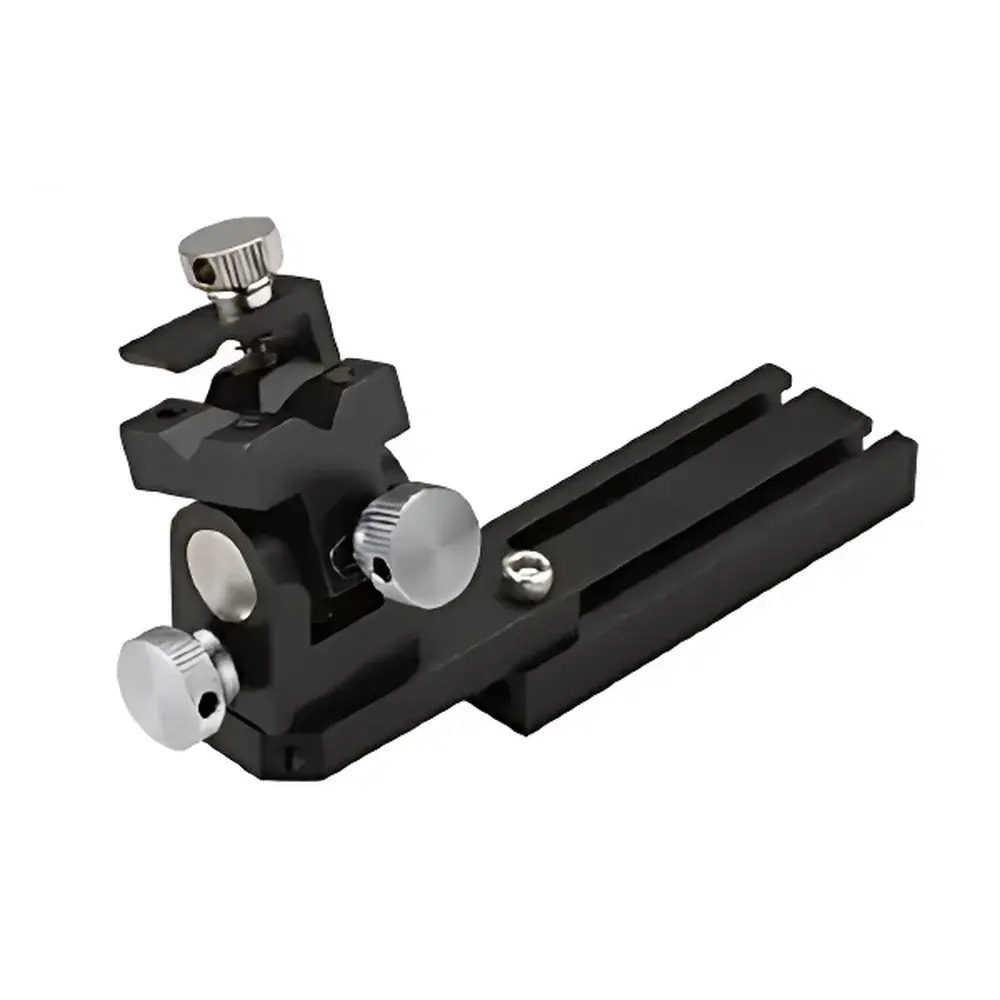
Narishige UST-1 Solid Universal Joint
| Brand | Narishige |
|---|---|
| Origin | Japan |
| Model | UST-1 |
| Dimensions (W×D×H) | 105 × 30 × 55 mm |
| Weight | 130 g |
| Material | High-Precision Stainless Steel & Engineering Polymer |
| Mounting Interface | Standard M4 Threaded Holes (Symmetrical, 4×) |
Overview
The Narishige UST-1 Solid Universal Joint is a precision-engineered mechanical coupling component designed for ultra-stable angular power transmission in space-constrained, contamination-sensitive, and maintenance-critical environments. Unlike conventional lubricated universal joints based on rolling-element kinematics (e.g., Cardan or constant-velocity types), the UST-1 employs a monolithic, solid-state articulation principle—achieving multi-axis flexibility through precisely calibrated elastic deformation of integrated polymer-composite hinges and stainless-steel load-bearing arms. This architecture eliminates sliding interfaces, grease reservoirs, and particulate-generating wear surfaces, making it inherently compatible with cleanroom-grade instrumentation, vacuum-compatible micro-manipulation systems, and ISO 13485-certified medical devices. Its design conforms to fundamental principles of compliant mechanism theory, where controlled strain energy storage replaces mechanical backlash and hysteresis—ensuring sub-microradian repeatability under static and low-frequency dynamic loads up to 0.5 N·m.
Key Features
- Lubrication-free operation: No grease, oil, or periodic re-lubrication required—eliminates outgassing, particle shedding, and maintenance downtime.
- High angular misalignment tolerance: Supports continuous rotational transmission across intersecting axes with up to ±15° static misalignment and ±8° dynamic oscillation without torque loss or hysteresis.
- Compact, symmetrical form factor: 105 mm width × 30 mm depth × 55 mm height; weight of only 130 g enables integration into multi-axis micromanipulator arms and compact optical benches.
- Biocompatible and vacuum-compatible materials: Body constructed from passivated SUS316 stainless steel and FDA-compliant PEEK-reinforced thermoplastic elastomer—validated for Class 7 cleanroom use and bake-out to 80°C.
- Standardized mounting interface: Four symmetrically arranged M4 threaded holes (depth 6 mm, pitch 0.7 mm) allow rigid, co-planar fixation to aluminum breadboards, titanium manipulator bases, or custom PCB-mount adapters.
- Zero-backlash kinematics: Elastic hinge geometry ensures repeatable angular positioning within ±0.02° over >10⁶ cycles under nominal load (0.1–0.3 N·m).
Sample Compatibility & Compliance
The UST-1 is not a standalone analytical instrument but a certified subsystem component intended for OEM integration into regulated equipment platforms. It complies with IEC 61000-6-2 (immunity) and IEC 61000-6-4 (emission) for electromagnetic compatibility when embedded in larger systems. Its material composition satisfies ISO 10993-5 (cytotoxicity) and USP Class VI biological safety requirements—supporting direct integration into Class IIa/IIb medical devices per MDR 2017/745 Annex II. In semiconductor metrology applications, the UST-1 meets SEMI F47-0218 voltage sag immunity criteria for tools operating in 208V/240V AC environments. Documentation includes RoHS 2011/65/EU Declaration of Conformity and REACH SVHC screening report.
Software & Data Management
As a passive mechanical transducer, the UST-1 requires no firmware, drivers, or software integration. Its performance parameters are fully characterized in Narishige’s publicly available Technical Datasheet TN-UST-1-Rev.D (2023), which includes torsional stiffness curves (0.8–1.2 N·m/rad), angular compliance maps, thermal drift coefficients (±0.003°/°C between 15–35°C), and lifetime validation data derived from accelerated life testing per ISO 14727. All calibration and traceability documentation—including dimensional inspection reports (CMM-certified, uncertainty < ±1.2 µm) and material lot traceability—is provided upon request for GMP/GLP audit readiness.
Applications
- Micromanipulation systems for intracytoplasmic sperm injection (ICSI) and oocyte enucleation—mounted between motorized coarse/fine motion stages and glass micropipette holders to decouple vibrational coupling while preserving tip trajectory fidelity.
- Neurophysiology rigs: Integrated into patch-clamp electrode positioning arms to enable simultaneous XYZ translation and θ-φ angular adjustment without introducing mechanical noise above 10 Hz.
- Automated wafer probing stations: Used as a kinematic coupling between piezo-driven probe cards and thermal expansion compensation stages in 300 mm fab environments.
- Confocal and super-resolution microscopy sample stages: Enables tilt-compensated objective alignment while maintaining optical axis stability within λ/20 wavefront error over 24-hour thermal soak.
- Microfluidic device assembly workstations: Provides dexterous, non-magnetic articulation for magnetic bead manipulation tools in MRI-compatible labs.
FAQ
Is the UST-1 suitable for vacuum applications?
Yes—the UST-1 has been tested at 1×10⁻⁵ Pa and exhibits no measurable outgassing per ASTM E595, making it appropriate for high-vacuum optical alignment systems.
Can it be sterilized using autoclaving?
No—autoclaving exceeds the thermal limit of the polymer hinge element (max continuous service temperature: 80°C). Ethylene oxide (EtO) or gamma irradiation (up to 25 kGy) are validated sterilization methods.
Does Narishige provide custom mounting adapters?
Yes—custom M3/M5 thread conversions, anodized aluminum adapter plates, and kinematic baseplates are available under OEM agreement with lead time of 4–6 weeks.
What is the maximum recommended torque load?
Static load limit: 0.5 N·m; dynamic continuous load limit: 0.3 N·m at frequencies ≤5 Hz. Exceeding these values may induce permanent set in the polymer hinge.
Is there a replacement interval or service schedule?
None—under nominal operating conditions, the UST-1 is rated for ≥5 million articulation cycles with no scheduled maintenance or replacement interval per ISO 13849-1 PL e functional safety assessment.



