
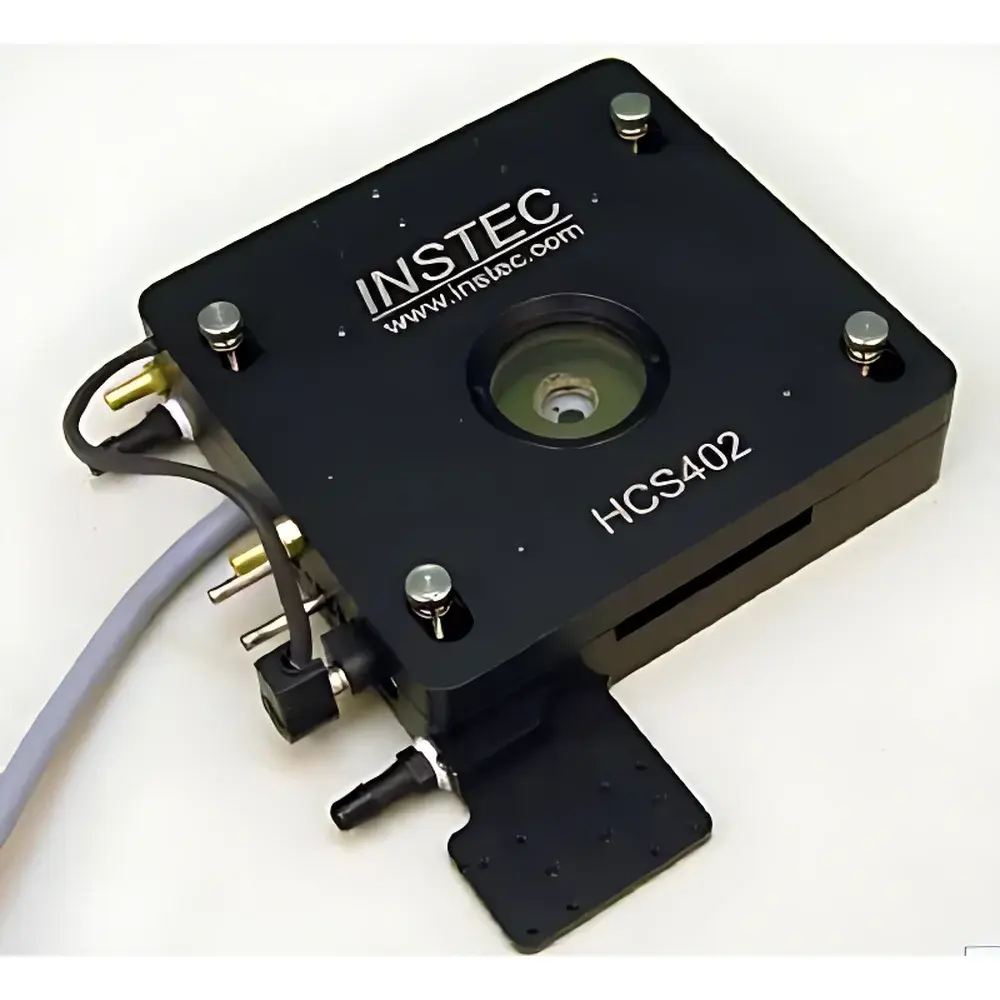
Instec HCS402 Dual-Zone Cryo-Heating Stage for Optical Microscopy
| Brand | Instec |
|---|---|
| Origin | USA |
| Model | HCS402 |
| Temperature Range | -190 °C to 400 °C |
| Cooling Medium | Liquid Nitrogen (LN₂) |
| Heating Configuration | Dual-Zone Resistive Heating |
| Temp. Stability | ±0.5 °C at 100 °C |
| Temp. Accuracy | ±0.1 °C (full range) |
| Min. Temp. Resolution | 0.01 °C |
| Max. Heating Rate | +130 °C/min at 100 °C |
| Max. Cooling Rate | -80 °C/min at 100 °C (with LN2-P4 accessory) |
| Working Distance | ≥7.7 mm (objective), ≥10.0 mm (condenser) |
| Sample Area | 38 × 50 mm |
| Transmission Aperture Options | 2, 5, 8, or 10 mm diameter |
| Controller | STC200 (RS232 interface, 230 V input) |
| Optional Accessories | XY-A-01 Precision Positioner (10 µm resolution), LN2-P2UF2 Cryogenic Kit (2 L dewar + dual-stage pump), WP230C Recirculating Water Pump |
Overview
The Instec HCS402 Dual-Zone Cryo-Heating Stage is a high-precision thermal stage engineered for in situ optical microscopy under controlled temperature conditions. Designed for integration with upright and inverted optical microscopes, it enables real-time observation of thermally induced structural transitions—including crystallization, melting, phase separation, liquid crystal alignment, polymer morphology evolution, and semiconductor domain dynamics—across an exceptionally broad thermal envelope of −190 °C to +400 °C. Its dual-zone resistive heating architecture eliminates radial thermal gradients across the sample plane, ensuring superior temperature uniformity and reproducibility—critical for quantitative analysis of temperature-dependent optical anisotropy, birefringence, and extinction behavior. Unlike single-heater stages, the HCS402’s independently regulated upper and lower heating elements actively compensate for heat loss at cryogenic temperatures and suppress thermal overshoot during rapid ramping, enabling stable dwell conditions even at extreme setpoints.
Key Features
- Dual-zone resistive heating system with independent thermal regulation for enhanced spatial uniformity and reduced edge cooling effects
- Full-range programmable temperature control from −190 °C (using liquid nitrogen cooling) to +400 °C, with resolution down to 0.01 °C and accuracy maintained at ±0.1 °C across the entire span
- High-speed thermal response: up to +130 °C/min heating and −80 °C/min cooling (when paired with the LN2-P4 cryogenic module)
- Optimized optical path design: minimum working distance of ≥7.7 mm (objective side) and ≥10.0 mm (condenser side), compatible with standard long-working-distance and high-NA objectives
- Modular transmission aperture options (2, 5, 8, or 10 mm diameter) to match condenser NA and maximize light throughput for polarized, DIC, or fluorescence imaging
- STC200 digital temperature controller with RS232 serial interface, supporting remote scripting, PID parameter tuning, and time-stamped temperature logging
- Optional XY-A-01 precision mechanical stage with 10 µm positional resolution and standardized mounting interfaces for seamless integration into existing microscope platforms
Sample Compatibility & Compliance
The HCS402 accommodates standard microscope slides (up to 38 × 50 mm) and supports both transmission and reflection-mode observation. Its low-profile design maintains compatibility with Köhler illumination, differential interference contrast (DIC), and confocal configurations. The stage meets ISO/IEC 17025-relevant environmental control requirements for materials characterization laboratories and supports GLP-compliant workflows when used with validated temperature calibration protocols (e.g., NIST-traceable Pt100 sensors). While not FDA-cleared as a medical device, its thermal stability and repeatability align with ASTM E1640 (Dynamic Mechanical Analysis) and ISO 11357 (Thermal Analysis of Plastics) test method prerequisites for morphological correlation studies.
Software & Data Management
The included STC200 controller firmware provides native support for ASCII-based command-line communication over RS232, enabling integration with LabVIEW, Python (pySerial), MATLAB, or custom acquisition software. Temperature profiles can be defined as multi-segment ramps, plateaus, or cyclic sequences—with user-defined dwell times, rate limits, and alarm thresholds. All temperature readings are timestamped with millisecond precision and logged to external storage via serial output. Audit trail functionality (including operator ID, setpoint changes, and error events) can be implemented through host-side logging—meeting foundational requirements for 21 CFR Part 11 compliance when paired with appropriate electronic signature and data integrity controls.
Applications
- In situ monitoring of liquid crystal director reorientation under combined thermal and electric field stimuli (compatible with integrated electrode configurations)
- Quantitative analysis of polymer crystallinity kinetics via polarized light microscopy during controlled cooling/heating cycles
- Phase transition mapping in pharmaceutical co-crystals and amorphous solid dispersions
- Thermally driven defect formation and grain boundary migration in thin-film semiconductors
- Morphological evolution of electrospun nanofibers during solvent evaporation and thermal annealing
- Calorimetric validation of DSC-derived transition temperatures using direct optical correlation
FAQ
What cryogen is required to reach −190 °C?
Liquid nitrogen (LN₂) is required; the LN2-P2UF2 accessory includes a 2 L dewar and dual-stage pump optimized for continuous flow delivery to the HCS402 cold finger.
Is vacuum or inert gas purging supported?
Yes—the stage features dedicated gas inlet/outlet ports compatible with dry nitrogen or argon purge lines to prevent condensation or oxidation during low-temperature operation.
Can the HCS402 be used with laser scanning confocal microscopes?
Yes, provided the objective working distance and transmission aperture are configured to avoid vignetting; users should verify laser power absorption characteristics of the sapphire window at operational wavelengths.
Does the STC200 controller support Ethernet or USB connectivity?
No—communication is exclusively via RS232 serial interface; USB-to-serial adapters are commonly used for modern PC integration.
What calibration documentation is provided?
Each unit ships with a factory calibration certificate referencing ITS-90 traceable Pt100 sensor measurements at five key points (−100 °C, 0 °C, 100 °C, 200 °C, 300 °C); NIST-traceable recalibration services are available upon request.




