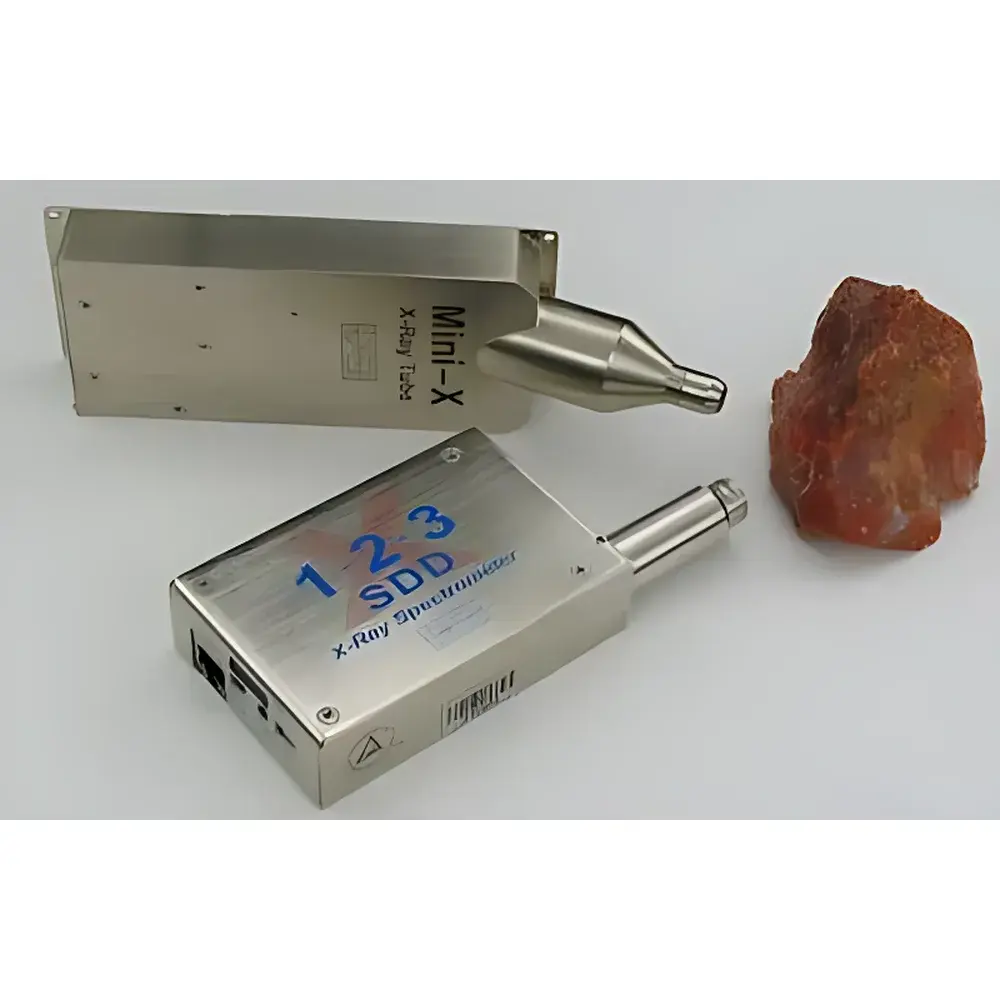
Amptek X-123 Portable XRF Spectrometer
| Brand | Amptek |
|---|---|
| Origin | USA |
| Manufacturer Type | Authorized Distributor |
| Origin Category | Imported |
| Model | X-123 |
| Price | Upon Request |
| Detector Type | Si-PIN |
| Cooling | 2-Stage Thermoelectric Cooler |
| Active Area | 5–25 mm² |
| Thickness | 300–680 µm |
| Energy Resolution | 145–260 eV FWHM @ 5.9 keV |
| Optimal Energy Range | 1–40 keV |
| Max Count Rate | 2 × 10⁵ cps |
| Power Consumption | 1.2 W |
| Dimensions | 70 × 100 × 25 mm (2.7 × 3.9 × 1 in) |
| Weight | 180 g (6.3 oz) |
| Interface | USB & RS-232 |
| Compliance | RoHS/WEEE |
Overview
The Amptek X-123 Portable XRF Spectrometer is a fully integrated, handheld X-ray fluorescence (XRF) detection system engineered for field-deployable elemental analysis. Unlike conventional benchtop spectrometers, the X-123 embeds all core components—Si-PIN semiconductor detector, low-noise preamplifier, digital pulse processor, multi-channel analyzer (MCA), thermoelectric cooling subsystem, and regulated power management—within a compact, self-contained enclosure measuring just 70 × 100 × 25 mm. Its operation relies on energy-dispersive XRF (ED-XRF) principles: incident X-rays excite characteristic fluorescent photons from sample atoms; the Si-PIN detector converts photon energy into proportional charge pulses, which are digitized and histogrammed by the embedded MCA to generate high-fidelity spectra. Designed for rapid qualitative and semi-quantitative elemental identification, the X-123 delivers laboratory-grade spectral fidelity without requiring external cryogens or high-voltage supplies.
Key Features
- Compact monolithic architecture: All signal chain components—including detector, preamp, digital processor, and MCA—are co-located within a single 180 g housing, eliminating inter-cable noise coupling and mechanical misalignment.
- Two-stage thermoelectric cooling maintains detector operating temperature at −20 °C to −35 °C, stabilizing leakage current and enabling consistent energy resolution across ambient temperatures from 0 °C to 40 °C.
- Low-power design (1.2 W typical) supports extended battery operation via USB-powered portable power banks or direct laptop integration—ideal for archaeological site surveys, museum artifact screening, and industrial field inspections.
- Flexible interface compatibility: Native USB 2.0 and RS-232 ports enable seamless integration with Windows, Linux, and macOS hosts; drivers and SDK support real-time spectrum streaming and remote configuration.
- Modular detector compatibility: Supports interchangeable Amptek Si-PIN detectors (e.g., XR-100T, XR-100S) with active areas from 5 mm² to 25 mm² and thicknesses up to 680 µm—allowing optimization for light-element sensitivity (thin detectors) or high-efficiency Kα detection in heavier elements (thicker variants).
Sample Compatibility & Compliance
The X-123 accommodates solid, powdered, and thin-film samples without vacuum or helium purge requirements, operating effectively in ambient air for elements from sodium (Na, Z = 11) through uranium (U, Z = 92). For optimal light-element response (e.g., Mg, Al, Si), optional beryllium window detectors or vacuum-compatible configurations may be specified. The system complies with EU RoHS Directive 2011/65/EU and WEEE Directive 2012/19/EU regarding hazardous substance restrictions and end-of-life electronics handling. While not certified for regulatory compliance testing per ISO 17025 or ASTM E1621, its stable calibration traceability and reproducible peak centroid positioning support GLP-aligned documentation workflows when paired with validated reference materials.
Software & Data Management
Amptek’s X-123 software suite includes PC-based acquisition (X-123 Acquisition), spectral analysis (X-123 Analyzer), and automated reporting modules. Raw spectrum files (.spe) adhere to the IAEA-standard format, ensuring interoperability with third-party tools including PyMCA, AXIL, and commercial QA/QC platforms. The embedded firmware implements full audit trail logging: every parameter change, acquisition start/stop event, and calibration update is timestamped and user-tagged. When deployed in regulated environments, the system can be configured to meet FDA 21 CFR Part 11 requirements for electronic records and signatures—provided host software enforces role-based access control and non-repudiation protocols.
Applications
- Cultural heritage science: Non-invasive analysis of pigments, metal alloys, and ceramic glazes during excavation or in situ museum conservation assessments.
- Geological prospecting: Rapid reconnaissance of ore grade variability, soil contamination mapping (e.g., As, Pb, Cd), and lithological discrimination in outcrop and core samples.
- Recycling & scrap sorting: On-site verification of alloy composition (e.g., stainless steel grades, Cu–Zn brass ratios) and detection of restricted substances in WEEE streams.
- Quality assurance in manufacturing: Incoming raw material verification, plating thickness estimation (Ni/Cr on steel), and coating homogeneity assessment on PCBs or aerospace components.
- Educational laboratories: Hands-on demonstration of X-ray physics, detector response functions, and multivariate spectral deconvolution techniques.
FAQ
Does the X-123 require liquid nitrogen or external cooling?
No—the integrated two-stage Peltier cooler achieves sufficient thermal stabilization for routine operation; no cryogens or auxiliary chillers are needed.
Can it detect light elements such as carbon or oxygen?
In air, detection down to sodium (Na) is reliable; carbon and oxygen require vacuum or helium-purged configurations and specialized thin-window detectors—not standard in the base X-123 package.
Is spectral calibration traceable to NIST standards?
Yes—factory calibration uses NIST-traceable radioactive sources (⁵⁵Fe, ¹⁰⁹Cd, ²⁴¹Am); users may perform secondary calibrations using certified reference materials (CRMs) such as NIST SRM 2711a or BAM BCR-681.
What is the typical measurement time for statistically robust spectra?
For major elemental peaks (>1 wt%), 30–120 seconds yields <5% relative standard deviation; minor/trace elements may require 300+ seconds depending on concentration and matrix absorption effects.
How is data security handled during field deployment?
All acquired spectra are stored locally on the host PC; the device itself retains no persistent memory. Encryption, backup, and access control are managed at the host OS or enterprise data management layer—not by the spectrometer firmware.
Related Products