
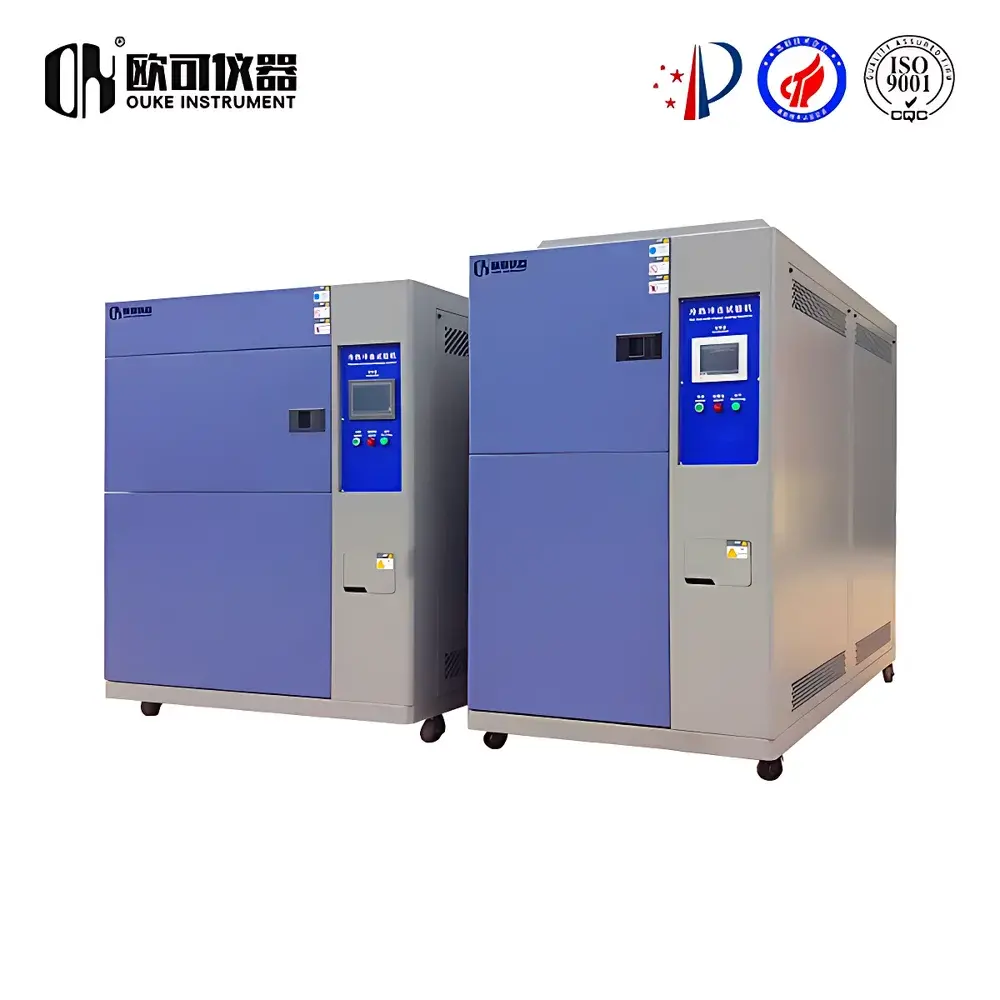
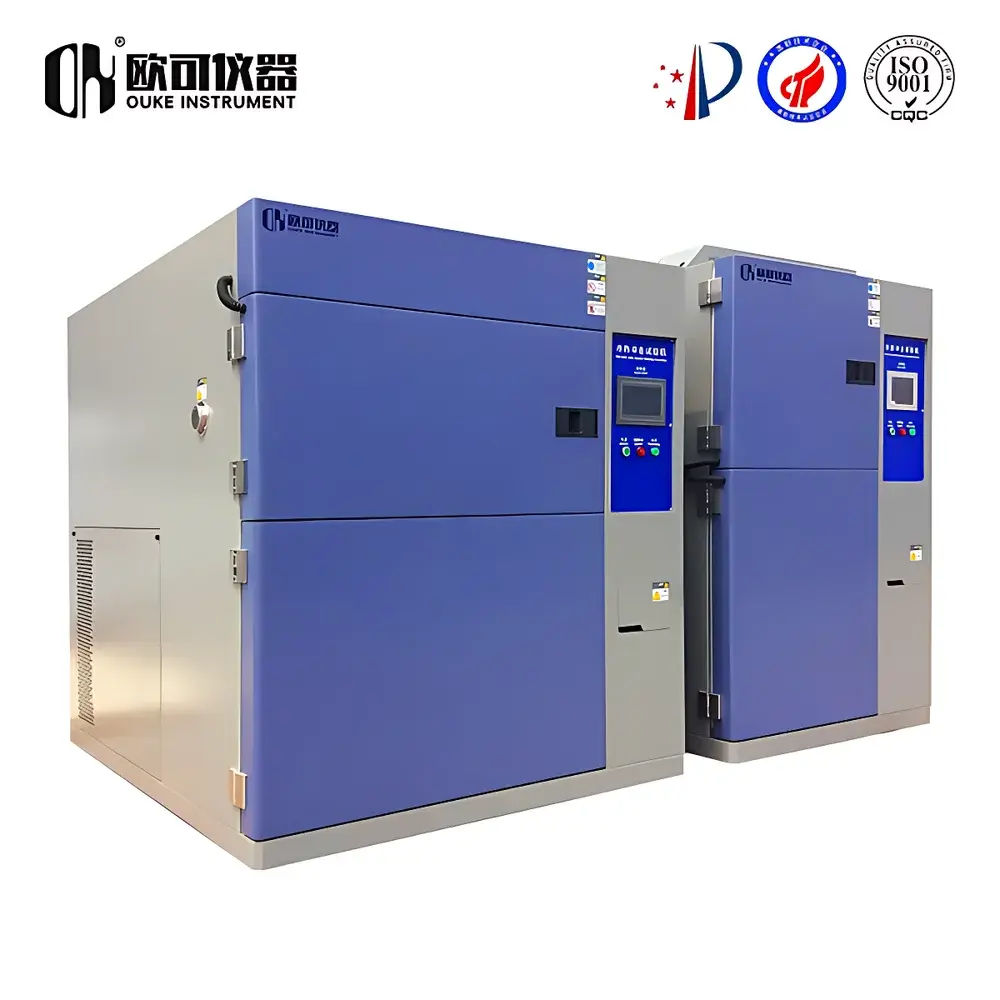
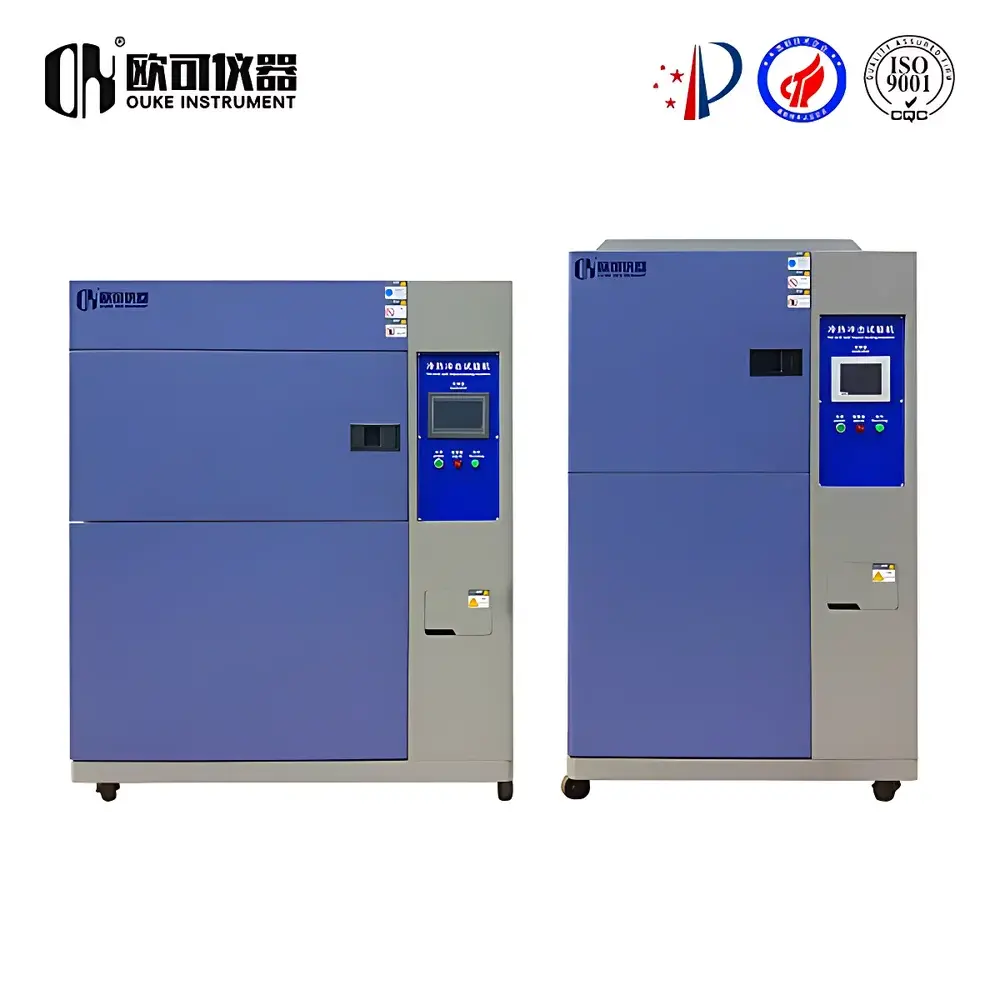
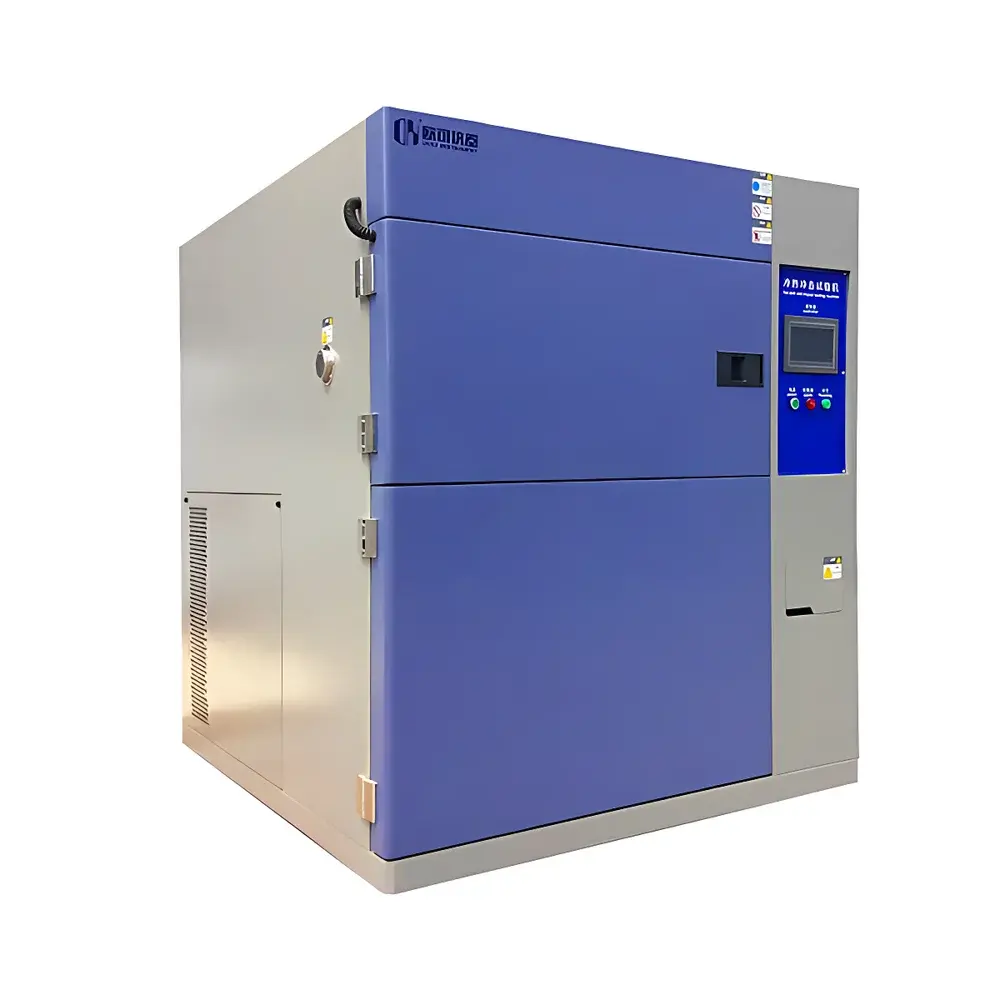
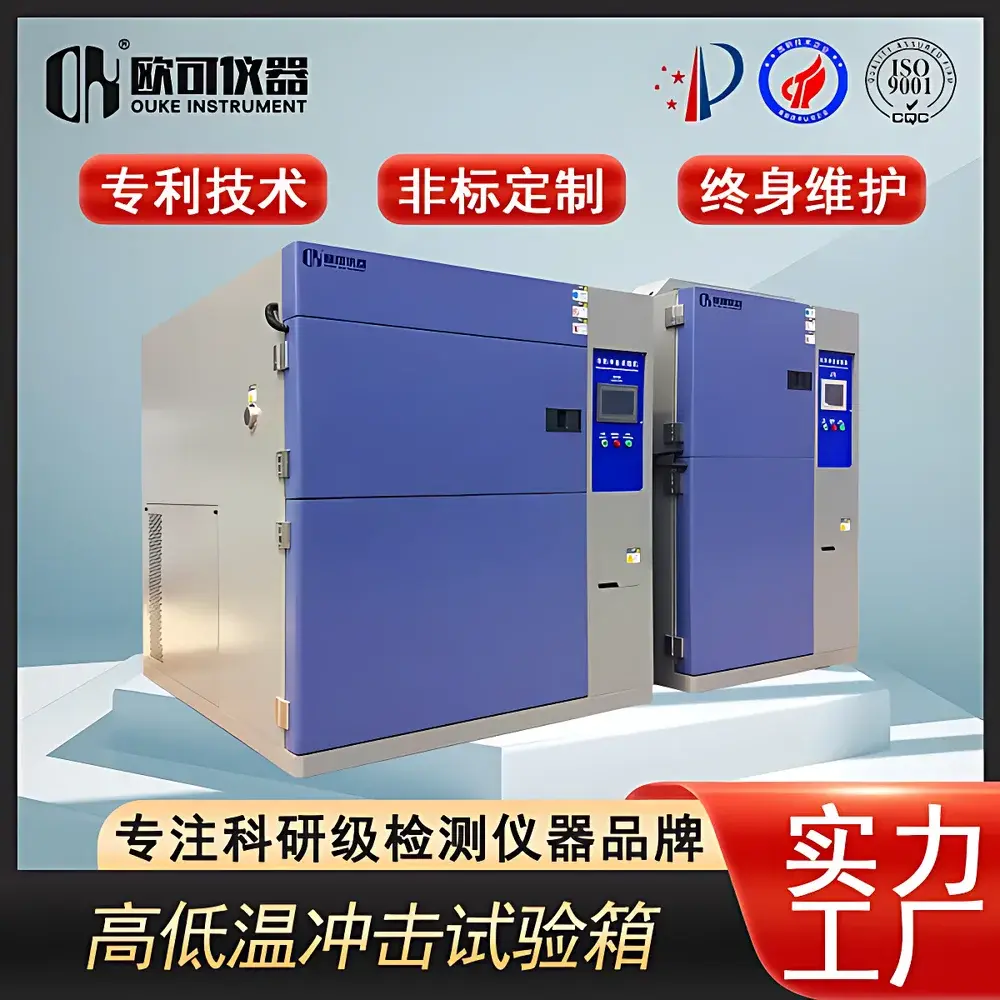
OK-TS-49.3 Three-Chamber Thermal Shock Test Chamber
| Brand | OK Instruments |
|---|---|
| Origin | Guangdong, China |
| Manufacturer Type | Direct Manufacturer |
| Product Origin | Domestic (China) |
| Model | OK-TS-49.3 |
| High-Temperature Range | +150 °C |
| Low-Temperature Range | −50 °C |
| Thermal Shock Range | −50 °C to +150 °C |
| Temperature Stability | ±2 °C |
| Heating Rate | 10 °C/min |
| Cooling Rate | 10 °C/min |
Overview
The OK-TS-49.3 Three-Chamber Thermal Shock Test Chamber is an engineered environmental test system designed for rapid, repeatable, and highly controlled thermal cycling between extreme temperature extremes. Unlike two-chamber (hot/cold basket-transfer) configurations, this three-chamber architecture isolates the test specimen in a dedicated, stationary test chamber while independently maintaining high-temperature and low-temperature reservoirs—enabling true zero-dwell thermal shock with minimal thermal mass interference. The system operates on the principle of forced convection air circulation combined with dual-stage cascade refrigeration, ensuring precise control over transition dynamics, dwell stability, and thermal gradient uniformity across the test volume. It is purpose-built for qualification testing of electronic assemblies, automotive components, aerospace materials, and polymer-based devices subjected to abrupt ambient shifts in operational or storage environments.
Key Features
- Three-compartment design: independent hot chamber (+150 °C), cold chamber (−50 °C), and static test chamber—eliminates mechanical transfer mechanisms and reduces contamination risk
- Cascade refrigeration system using dual German semi-hermetic compressors, optimized for rapid thermal transitions (10 °C/min heating/cooling rates) and stable dwell performance (±2 °C)
- Water-cooled condensing unit requiring external 10 m³/h cooling tower (user-supplied); enables consistent operation under sustained thermal load
- High-efficiency evaporative condenser interstage heat exchanger for optimal energy transfer between high- and low-stage refrigerant loops
- Intelligent energy modulation control: dynamically adjusts compressor capacity and airflow to maintain setpoint accuracy while minimizing power consumption and component wear
- Stainless steel interior construction with non-corrosive insulation; reinforced door gasketing and double-glazed observation window for thermal integrity and safety
Sample Compatibility & Compliance
The OK-TS-49.3 accommodates standard test specimens up to 400 × 400 × 400 mm (W × D × H) with configurable mounting fixtures and optional internal sensor ports. Its thermal profile fidelity supports rigorous compliance validation against internationally recognized standards including: IEC 60068-2-14 (Test N: Change of Temperature), MIL-STD-810H Method 503.6, GJB 150.5A–2009 (Temperature Shock), GB/T 2423.22–2012 (Environmental Testing – Temperature Change), and QC/T 17–1992 (Automotive Component Environmental Resistance). The chamber’s documented thermal uniformity, repeatability, and traceable calibration pathways support GLP-compliant reporting and integration into ISO/IEC 17025-accredited laboratory workflows.
Software & Data Management
Equipped with a Windows-based embedded controller featuring a 10.1″ capacitive touchscreen interface, the system provides real-time graphing of chamber and specimen temperatures (via optional thermocouple inputs), programmable multi-step profiles, and automatic event logging. All test data—including timestamps, setpoints, actual values, alarm states, and compressor duty cycles—are stored internally and exportable via USB or Ethernet in CSV format. Audit trail functionality complies with FDA 21 CFR Part 11 requirements when paired with user-defined electronic signatures and role-based access control (optional license). Remote monitoring and alarm notification (email/SMS) are supported via Modbus TCP or OPC UA protocols.
Applications
This thermal shock chamber serves critical roles in product development and quality assurance across multiple sectors: validation of solder joint reliability in PCBAs under thermal fatigue; evaluation of seal integrity and delamination resistance in MEMS packaging; assessment of coefficient-of-thermal-expansion (CTE) mismatch effects in multi-material assemblies; qualification of battery modules for EV applications per UN ECE R100 and GB/T 31467.3; and accelerated aging studies of optical adhesives, conformal coatings, and elastomeric gaskets. Its reproducible shock profiles make it suitable for failure mode identification in HALT/HASS protocols and supplier qualification audits.
FAQ
What distinguishes a three-chamber thermal shock system from a two-chamber design?
In a three-chamber configuration, the test sample remains stationary in an isolated chamber, while hot and cold reservoirs operate continuously—enabling faster transitions, higher repeatability, and reduced mechanical wear compared to basket-transfer systems.
Is external cooling infrastructure mandatory?
Yes. The water-cooled cascade condenser requires a dedicated 10 m³/h closed-loop cooling tower installed outdoors. Air-cooled alternatives are not supported due to thermal load constraints.
Can the chamber be integrated into an existing MES or LIMS environment?
Yes. Native Modbus TCP and OPC UA support enable bidirectional communication with manufacturing execution systems and laboratory information management systems for automated job dispatch and result ingestion.
Does the system support custom calibration certificates?
Yes. Optional NIST-traceable calibration services are available with full uncertainty budgets and as-found/as-left reports compliant with ISO/IEC 17025.
What maintenance intervals are recommended for long-term reliability?
Compressor oil analysis every 2,000 operating hours; refrigerant leak inspection quarterly; filter replacement every 6 months; full system performance verification annually per ASTM E74 or equivalent.
Related Products



