
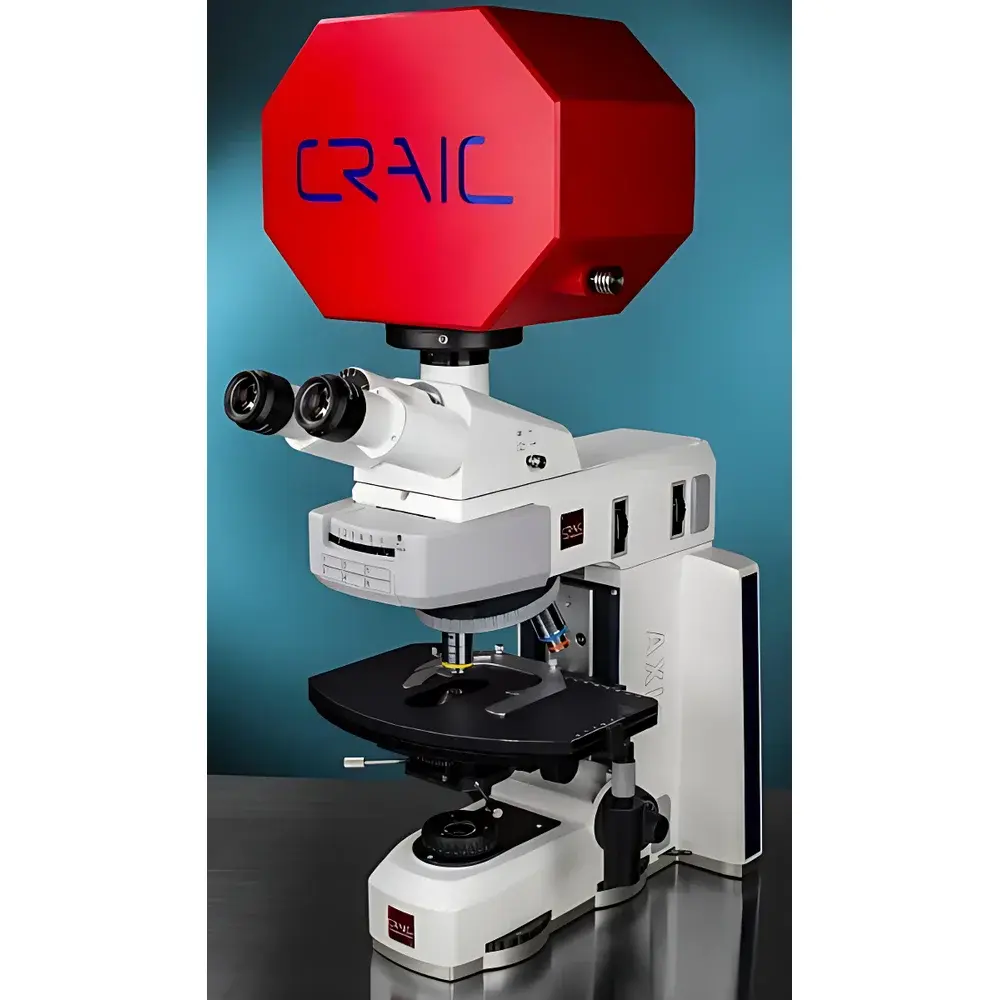
CRAIC FLEXT Microspectrophotometer
| Brand | CRAIC |
|---|---|
| Origin | USA |
| Model | FLEXT Microspectrophotometer |
| Spectral Range | 240–900 nm (UV-VIS-NIR) |
| Reflectance Range | 400–900 nm |
| Fluorescence Excitation | 365–546 nm |
| Fluorescence Emission | 254–546 nm |
| Fluorescence Range | 400–900 nm |
| Sampling Area | 1–10,000 µm² |
| Spectral Resolution | Adjustable from 1–15 nm |
| Detector | TE-cooled CCD array |
| Cooling | Thermoelectric (Peltier) |
| Minimum Scan Time (Full Spectrum) | 4 ms |
| Imaging Resolution | Up to 5 MP color digital imaging |
| Operating System | Windows 7/8 |
Overview
The CRAIC FLEXT Microspectrophotometer is a purpose-engineered UV-VIS-NIR microspectrophotometric platform designed for non-destructive quantitative optical characterization of microscopic samples. Based on the fundamental principles of microspectrophotometry—where spectroscopic measurement is spatially confined by a high-magnification microscope optical path—the FLEXT integrates a research-grade inverted microscope, a high-throughput Czerny-Turner spectrometer, and a thermoelectrically cooled CCD detector into a single, compact architecture. It enables precise acquisition of transmission, absorbance, reflectance, fluorescence emission, and photoluminescence spectra from features as small as 1 µm in lateral dimension, without physical contact or sample preparation. Its spectral coverage spans 240–900 nm, with dedicated configurations supporting deep-UV analysis down to 240 nm—critical for semiconductor metrology, forensic trace evidence examination, and thin-film optical characterization. The instrument’s optical design minimizes stray light and maintains wavelength fidelity across the full range, ensuring high photometric accuracy and long-term spectral reproducibility.
Key Features
- Integrated UV-VIS-NIR microscope-spectrometer system with motorized XYZ stage and precision focusing mechanism
- TE-cooled CCD detector array providing low-noise performance (<0.001 e⁻/pixel/sec dark current) and stable quantum efficiency over extended acquisition periods
- Adjustable spectral resolution (1–15 nm) via interchangeable slits and grating selection, optimized for either high sensitivity or high resolution applications
- Synchronized high-resolution color imaging (up to 5 megapixels) co-registered with spectral acquisition for precise region-of-interest (ROI) targeting
- Dual-path illumination: epifluorescence (with selectable excitation filters: 365 nm, 405 nm, 450 nm, 488 nm, 546 nm) and transmittance/reflectance modes with variable neutral density control
- Optimized optical train for minimal chromatic aberration across UV-VIS-NIR—enabling accurate refractive index mapping and thin-film thickness modeling using interference fringe analysis
- Robust mechanical housing with vibration-damped base and enclosed optical bench, suitable for shared laboratory environments and production floor deployment
Sample Compatibility & Compliance
The FLEXT accommodates a broad range of solid, thin-film, and particulate samples—including silicon wafers, polymer coatings, biological tissue sections, inked documents, glass fragments, and forensic trace materials—without requiring metallization or conductive coating. Its non-contact, non-invasive methodology complies with ASTM E2821–22 (Standard Guide for Microspectrophotometry of Forensic Evidence), ISO 13694 (Optics and photonics — Determination of spectral transmittance and reflectance), and USP (Spectrophotometric Absorbance). Data acquisition workflows support audit-trail generation and electronic signature capability per FDA 21 CFR Part 11 when operated under validated software configuration. Instrument calibration is traceable to NIST-standard reference materials (e.g., SRM 2036 for reflectance, SRM 2035 for transmittance), and routine performance verification follows GLP/GMP-aligned protocols.
Software & Data Management
The FLEXT operates with CRAIC’s proprietary MicroSuite™ software suite, a Windows-native application developed for scientific data integrity and regulatory readiness. It provides real-time spectral preview, multi-point mapping (line scans and area rastering), spectral library matching (with customizable reference databases), and quantitative thin-film modeling (Cauchy dispersion, Swanepoel method). All raw spectra are stored in vendor-neutral, metadata-rich formats (HDF5 and CSV), preserving acquisition parameters, instrument configuration, and calibration history. Software supports batch processing, statistical outlier detection, and export to third-party analysis platforms (MATLAB, Python via API, OriginLab). Audit logs record user actions, parameter changes, and calibration events with timestamps and operator IDs—fully compliant with ISO/IEC 17025 documentation requirements.
Applications
- Forensic Science: Identification and discrimination of ink, paint chips, textile fibers, and gunshot residue based on spectral fingerprinting in UV-VIS-NIR
- Semiconductor Metrology: Non-contact measurement of dielectric film thickness (SiO₂, SiNₓ, photoresist) and optical constants (n, k) on patterned wafers
- Materials Science: Characterization of 2D materials (graphene, TMDCs), quantum dots, and plasmonic nanostructures via localized absorption and photoluminescence
- Document Examination: Detection of alterations, erasures, and sequence of writing using differential UV absorption and fluorescence lifetime contrast
- Life Sciences: Quantitative analysis of stained histological sections, autofluorescence mapping in fixed tissues, and subcellular pigment distribution
- Quality Control: In-line verification of coating uniformity, color consistency, and optical filter performance in manufacturing environments
FAQ
What is the smallest feature size the FLEXT can resolve spectrally?
Spectral acquisition is limited by diffraction and objective NA; with a 100×, 0.9 NA objective, the practical spatial resolution is ~300 nm laterally, enabling analysis of features ≥1 µm in diameter with high signal-to-noise ratio.
Can the FLEXT perform quantitative thin-film thickness measurements?
Yes—using interference fringe analysis in reflectance mode, the software calculates film thickness with ±1 nm repeatability for layers between 10 nm and 2 µm, assuming known or modeled dispersion relations.
Is the system compatible with vacuum or inert atmosphere enclosures?
The FLEXT is designed for ambient operation; however, its modular optical interface allows integration with custom environmental chambers (e.g., glovebox ports or vacuum viewports) via optional coupling optics and fiber adapters.
Does the software support automated mapping of large sample areas?
Yes—MicroSuite™ includes programmable stage control, auto-focus routines, and grid-based spectral acquisition with configurable step sizes and dwell times, enabling unattended hyperspectral mosaic generation.
What maintenance is required for long-term calibration stability?
Annual verification using NIST-traceable standards is recommended; no consumables or lamp replacements are required—the xenon arc source has >2,000-hour lifetime and built-in intensity stabilization.





