
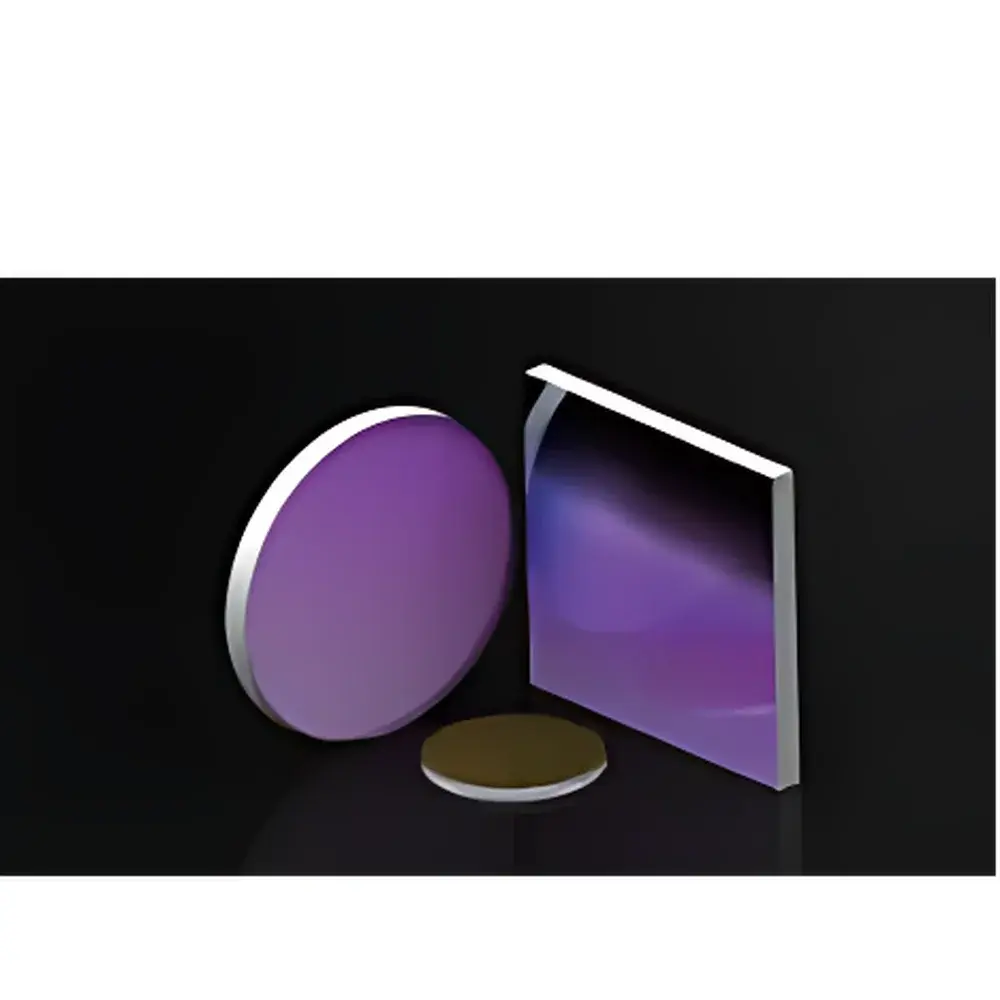
MiXran Meg1124 High-Power Nd:YAG Laser Mirror
| Brand | MiXran |
|---|---|
| Model | Meg1124 |
| Substrate Diameter | 25.4 mm |
| Substrate Thickness | 6.35 mm |
| Coating Type | High-Reflectivity (HR) Dielectric |
| Wavelength Options | 354.7 nm, 532 nm, 1064 nm, or Dual-Band (1064 & 532 nm) |
| Reflectivity | Rs > 99.5%, Rp > 99% (standard) |
| Angle of Incidence | 0° or 45° |
| Laser Damage Threshold | 3.2–40 J/cm² (depending on wavelength, pulse duration, and AOI) |
| Pulse Duration | 10–20 ns |
| Repetition Rate | 20 Hz |
| Component Category | Optical Element |
| Origin | Beijing, China |
Overview
The MiXran Meg1124 is a precision-engineered high-power dielectric laser mirror designed for demanding Nd:YAG laser systems operating at fundamental (1064 nm), second-harmonic (532 nm), and third-harmonic (354.7 nm) wavelengths. Based on a fused silica substrate with optimized thermal and mechanical stability, the Meg1124 employs multilayer dielectric coatings deposited via ion-beam sputtering (IBS) to achieve exceptional reflectivity (>99.5% for s- and p-polarized light at specified angles) and superior laser-induced damage threshold (LIDT). Its optical architecture is specifically tailored for continuous-wave (CW) and pulsed Nd:YAG sources—particularly Q-switched systems delivering nanosecond pulses at 20 Hz repetition rate—where long-term beam stability, minimal wavefront distortion, and consistent power handling are critical. The mirror’s performance is defined not only by its spectral fidelity but also by its robustness under high fluence conditions, making it suitable for industrial marking, scientific pumping cavities, LIDAR transmitter optics, and ultrafast amplifier staging.
Key Features
- Precision fused silica substrate (25.4 mm diameter × 6.35 mm thickness) with λ/10 surface flatness and <5 Å RMS surface roughness
- Ion-beam-sputtered (IBS) dielectric HR coatings offering polarization-insensitive reflectivity across designated wavelengths
- Configurable incidence angles: 0° (normal incidence) and 45° (for folded beam paths), each with wavelength-specific LIDT optimization
- High-damage-threshold variants available (e.g., YH04B-H) with enhanced coating density and reduced absorption for extended operational lifetime
- Low group delay dispersion (GDD) design minimizes temporal broadening in ultrafast applications where pulse integrity is essential
- Strict environmental qualification: humidity-resistant coating stack compliant with MIL-C-48497A and ISO 9211-4 standards
Sample Compatibility & Compliance
The Meg1124 mirrors are compatible with standard kinematic mounts (e.g., Thorlabs KM100, Newport UMB1) and vacuum-compatible optical tables. Each batch undergoes full spectral verification using calibrated spectrophotometry (PerkinElmer Lambda 1050+) and LIDT validation per ISO 21254-2:2018 (Test Method for Laser-Induced Damage Threshold — Onset Detection). Coating adhesion meets ASTM F394-22 requirements, and surface cleanliness conforms to ISO 10110-7 Class 5. While not certified for medical device use under FDA 21 CFR Part 820, the manufacturing traceability—including substrate lot numbers, coating run logs, and spectral test reports—is maintained for GLP-aligned laboratories requiring audit-ready documentation.
Software & Data Management
No embedded firmware or proprietary software is associated with the Meg1124, as it is a passive optical component. However, spectral performance data (reflectance vs. wavelength, angle, and polarization) is delivered in machine-readable CSV and .spc formats upon request. These datasets are structured to integrate directly into optical simulation platforms such as Zemax OpticStudio, CODE V, and FRED for cavity modeling, beam propagation analysis, and thermal load forecasting. Calibration certificates include NIST-traceable reference measurements and uncertainty budgets aligned with EURAMET cg-19 guidelines.
Applications
- Resonator end mirrors and folding mirrors in diode-pumped solid-state (DPSS) Nd:YAG lasers
- Harmonic separation optics in multi-wavelength laser systems (e.g., simultaneous 1064 nm/532 nm output)
- Beam steering and cavity dumping in high-repetition-rate amplifiers
- Optical parametric oscillator (OPO) pump delivery optics requiring broadband reflectivity control
- Industrial laser processing heads where thermal lensing resistance and long-term reflectivity stability are mission-critical
- Research-grade spectroscopy setups requiring minimal polarization-dependent loss (PDL) and high signal-to-noise ratio preservation
FAQ
What is the maximum average power this mirror can handle?
Average power handling depends on beam size, cooling configuration, and duty cycle. For a 2 mm beam diameter at 1064 nm CW, thermal modeling indicates safe operation up to ~250 W with conductive mounting; pulsed operation is governed by fluence limits (J/cm²), not average power.
Can I use the Meg1124 with femtosecond Ti:sapphire lasers?
The standard Meg1124 is optimized for nanosecond Nd:YAG pulses. For sub-100 fs pulses, consult the GDD specification sheet—custom low-GDD variants are available upon request.
Is the coating resistant to humidity or solvent cleaning?
Yes—the IBS coating stack includes a hermetic top layer meeting ISO 9211-4 environmental durability Class 2; mild acetone/isopropanol cleaning is permitted using Class 100 cleanroom protocols.
Do you provide custom diameters or wedge angles?
Standard configurations are 25.4 mm round; custom substrates (up to 75 mm) and wedge options (≤3 arcmin) are available under OEM agreement with minimum order quantities.
How is LIDT verified for each shipment?
Every production lot undergoes statistical sampling per ISO 21254-2, with ≥5 samples tested at the specified wavelength, pulse duration, and repetition rate. Full test reports are included with commercial orders.





