
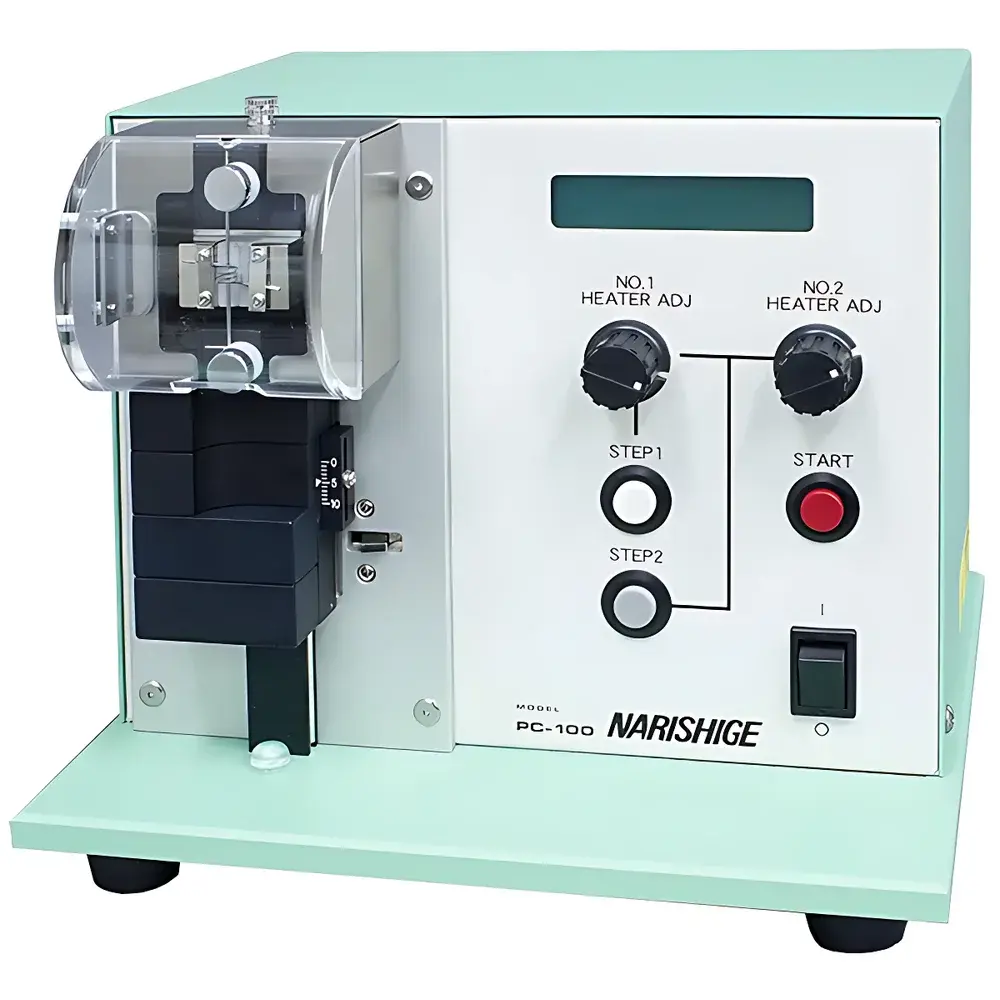
NARISHIGE PC-100 Vertical Pipette Puller
| Brand | NARISHIGE |
|---|---|
| Origin | Japan |
| Model | PC-100 |
| Power Supply | AC 100–240 V, 50/60 Hz |
| Power Consumption | ~70 W |
| Heating Element | Kanthal wire, max. 2.5 V |
| Pulling Force | ≈25 g × 2 (light) or ≈100 g × 2 (heavy) |
| Dimensions | 205 × 190 × 185 mm (W × D × H) |
| Weight | 3.45 kg |
| Tip Diameter Range | down to 1 µm |
| Capillary Compatibility | φ1 mm × 90 mm glass capillaries |
Overview
The NARISHIGE PC-100 Vertical Pipette Puller is a precision-engineered instrument designed for the reproducible fabrication of tapered glass micropipettes used in demanding electrophysiological, microinjection, and microfluidic applications. Operating on the principle of resistive heating combined with gravity-driven vertical pulling, the PC-100 employs a Kanthal wire heating element to soften borosilicate or soda-lime glass capillaries at precisely controlled temperatures, followed by mechanical elongation under calibrated gravitational force. This two-stage thermal-mechanical process enables deterministic control over tip geometry—including outer diameter, taper angle, shank length, and tip opening—critical for high-fidelity patch-clamp recordings, single-cell electrophysiology, and nanoliter-scale fluid delivery. As a direct evolution of the PC-10 platform, the PC-100 retains fundamental operational integrity while introducing enhanced digital feedback, dual-mode pulling (single-step and two-step), and improved thermal stability—making it suitable for GLP-compliant lab environments where protocol traceability and inter-operator repeatability are essential.
Key Features
- Gravity-based vertical pulling mechanism with dual-force selection (light: ≈25 g × 2; heavy: ≈100 g × 2), enabling consistent axial tension without servo-motor variability
- Dual-heater architecture supporting both single-step and two-step pull protocols—ideal for fabricating pipettes with complex geometries such as long shanks, short tapers, or double-tapered tips
- Real-time digital display of heater level (0–100 scale), elapsed time, and operational mode—facilitating rapid parameter validation and troubleshooting
- Adjustable heater position via calibrated linear sliders, ensuring precise localization of thermal softening relative to capillary centerline
- Integrated acrylic safety shield and guarded heating chamber, compliant with IEC 61010-1 for laboratory electrical safety
- Non-volatile memory for saving up to six user-defined protocols—including heater voltage, pull timing, and force configuration—for repeatable production runs
- Modular slide unit protected against dust ingress, maintaining mechanical accuracy across extended use cycles
Sample Compatibility & Compliance
The PC-100 accepts standard 1.0 mm OD × 90 mm glass capillaries (e.g., Sutter BF150-86-10, Narishige GD-1), compatible with common borosilicate (e.g., Pyrex-type) and filamented capillaries used in patch-clamp and intracellular recording. It supports fabrication of pipettes with tip outer diameters ranging from >10 µm (for microinjection or cell aspiration) down to ≤1 µm (for high-resistance seal formation in whole-cell or perforated-patch configurations). The instrument meets general requirements for ISO/IEC 17025-accredited laboratories when operated within documented SOPs, and its analog-digital hybrid control architecture allows full manual override—supporting audit-ready workflows under FDA 21 CFR Part 11 when paired with validated electronic logbook systems. All electrical components conform to CE marking directives and UL 61010-1 safety standards.
Software & Data Management
The PC-100 operates without proprietary software or computer interface—it is a stand-alone hardware system optimized for benchtop immediacy and minimal setup latency. Parameter inputs (heater level, step timing, force selection) are entered directly via front-panel rotary dials and confirmed through LED-based status indicators. Each pull cycle logs real-time heater activation duration, total elapsed time (displayed in seconds), and active mode (STEP 1 / STEP 2 / NO.1 HEATER / NO.2 HEATER), enabling manual correlation with post-pull microscopy validation. For labs requiring formal data traceability, integration with external time-stamped video capture (e.g., USB microscope + OBS Studio) or digital lab notebooks (e.g., LabArchives, Benchling) is recommended to link pull parameters with subsequent resistance testing (e.g., using Axopatch 200B) or SEM imaging results.
Applications
- Patch-clamp electrophysiology: Fabrication of low-capacitance, high-resistance micropipettes (R > 5 MΩ) for stable gigaseal formation in acute brain slices, cultured neurons, and stem-cell-derived cardiomyocytes
- Intracellular and sharp-electrode recording: Production of long-shank, fine-tipped electrodes for in vivo neural recordings with minimal tissue displacement
- Microinjection and nuclear transfer: Generation of robust, non-clogging injection needles (tip ID ≥ 0.5 µm) for pronuclear transfer, CRISPR ribonucleoprotein delivery, or organelle transplantation
- Microfluidic interfacing: Creation of monolithic glass termini for pressure-driven or electrokinetic coupling to PDMS or quartz chips
- Single-cell manipulation: Custom shaping of aspiration pipettes for gentle cell sorting, cytoplasmic extraction, or subcellular organelle isolation
- Electrochemical sensing: Preparation of carbon-fiber or metal-coated pipettes for amperometric detection at subcellular resolution
FAQ
What is the minimum achievable tip outer diameter with the PC-100?
Under optimal conditions—using high-purity borosilicate capillaries, stabilized ambient temperature (<25°C), and calibrated two-step pulling—the PC-100 routinely achieves tip outer diameters of 0.8–1.2 µm, verified by scanning electron microscopy (SEM) or laser diffraction sizing.
Can the PC-100 be used with coated or filamented capillaries?
Yes. The instrument accommodates filamented (e.g., GC150TF-10) and aluminum-coated capillaries, though heater voltage settings may require minor adjustment due to altered thermal conductivity.
Is the PC-100 compatible with automated patch-clamp platforms?
While the PC-100 itself is not programmable via API, its reproducible output enables pre-fabrication of standardized pipettes for integration into robotic patch-clamp systems (e.g., Sophion QPatch, Nanion SyncroPatch), provided tip geometry specifications are maintained across batches.
How does the two-step pull differ from single-step operation?
Two-step pulling separates thermal softening and mechanical elongation into sequential phases: Step 1 establishes initial taper and shank length; Step 2 refines tip geometry at a second, spatially offset heating zone—enabling independent control of cone angle and final tip diameter.
What maintenance is required for long-term calibration stability?
Annual verification of heater voltage output (using calibrated multimeter across Kanthal terminals) and mechanical alignment of slide rails is recommended. Replacement of Kanthal heater wires is advised after ~5,000 pulls or if observed discoloration or uneven heating occurs.
Related Products





