
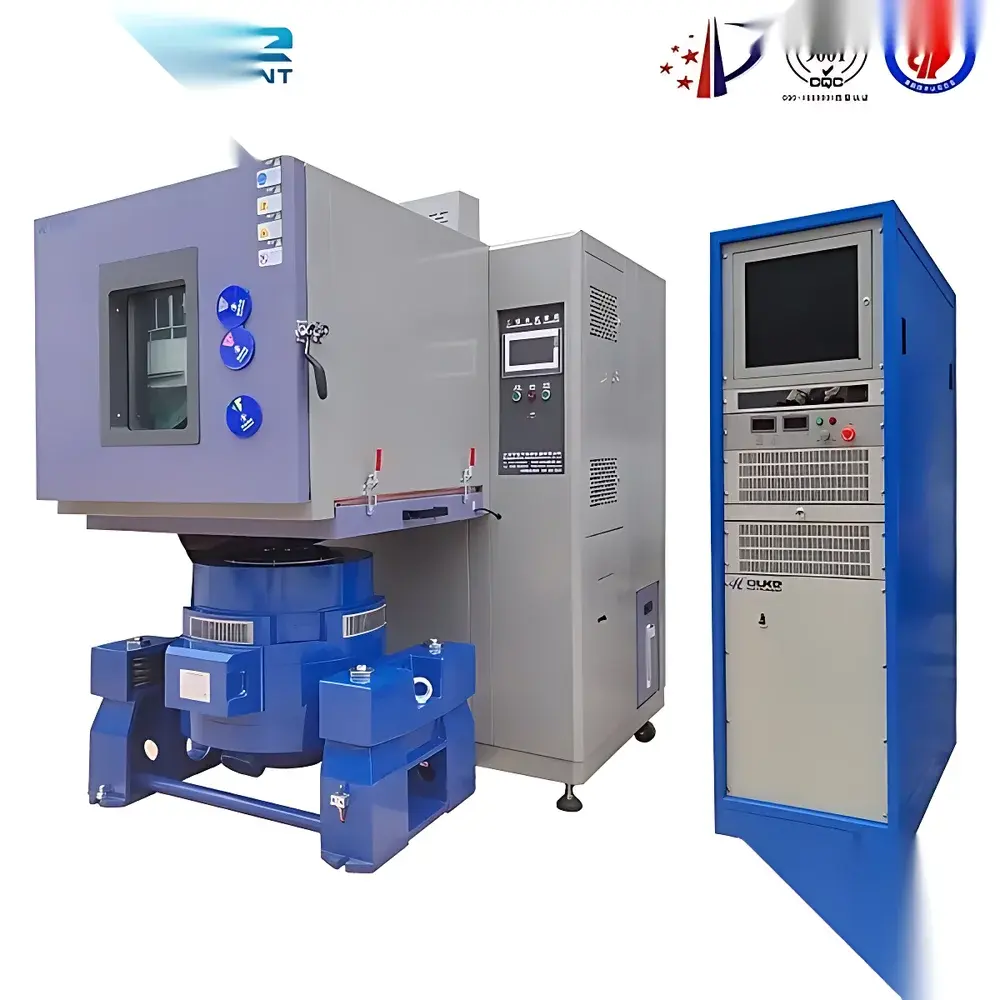
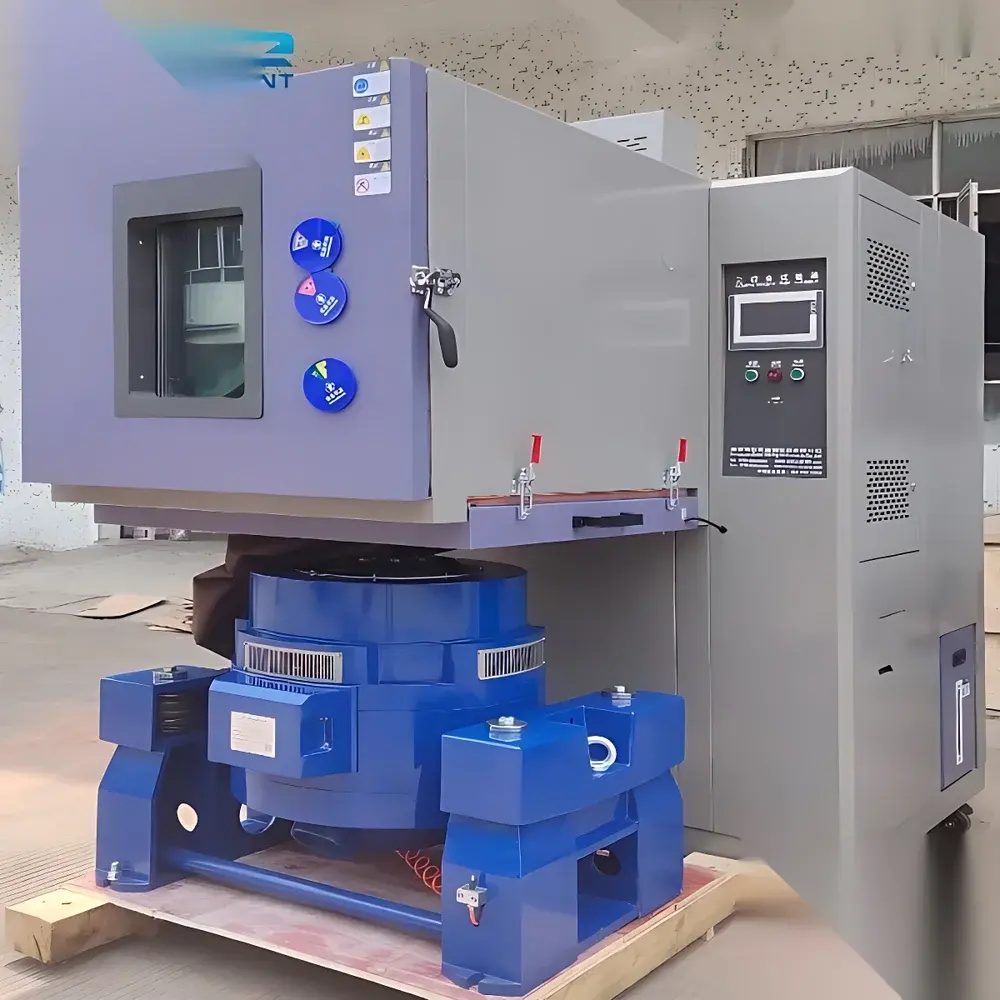
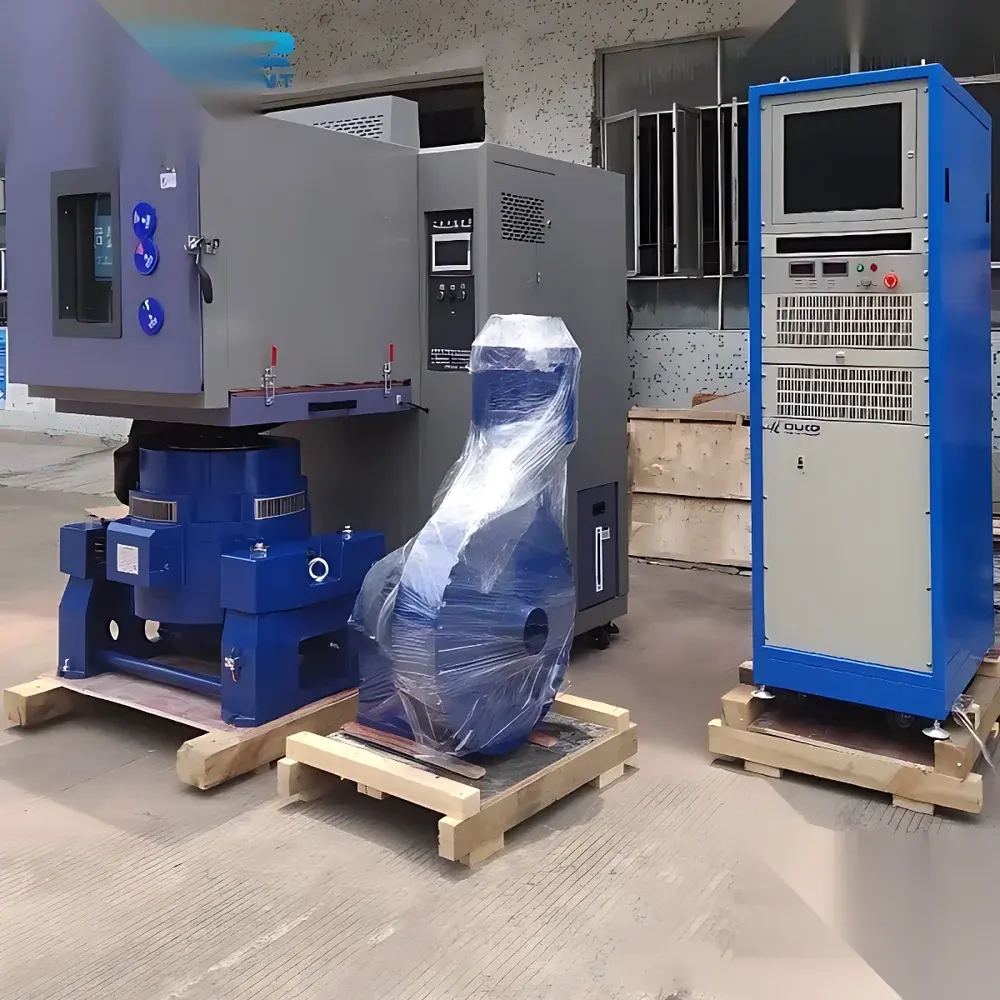
OK-ES Series Combined Temperature-Vibration Environmental Test Chamber
| Brand | Other Brands |
|---|---|
| Origin | Imported |
| Manufacturer Type | Authorized Distributor |
| Max Load Capacity | 100 kg |
| Frequency Range | 150–300 rpm |
| Amplitude Range | 25.4 mm (1 in) |
| Vibration Mode | Reciprocating (Rotary) |
| Simulated Vehicle Speed | 25–40 km/h |
| Tabletop Dimensions | 1000 × 1100 mm |
| Power Consumption | 1 HP |
| Unit Weight | 200 kg |
| Operating Ambient | 5–40 °C, ≤85% RH |
| Drive System | DC speed control or AC variable-frequency drive |
| Supply Voltage | 220 V, 50 Hz |
| Control Interface | Touchscreen with bilingual (Chinese/English) UI |
| Vibration Parameter Resolution | Frequency display to 0.01 Hz, accuracy ±0.1 Hz |
| Compliance Standards | EN 71, ANSI, UL, ASTM, ISTA |
Overview
The OK-ES Series Combined Temperature-Vibration Environmental Test Chamber is an integrated physical property testing system engineered for simultaneous thermal cycling and vertical mechanical vibration stress application. It operates on the principle of controlled reciprocating (rotary) excitation—generating reproducible sinusoidal or swept-sine vibration profiles—while maintaining precise temperature conditioning across a defined environmental envelope. Designed for reliability validation of packaged goods, electronic assemblies, automotive components, and consumer products under real-world transport and storage conditions, this chamber supports standardized simulation of road transportation dynamics—including simulated vehicle speeds from 25 to 40 km/h—coupled with thermal extremes. Its architecture integrates a rigid steel base frame with anti-vibration elastomeric mounts, eliminating the need for anchoring while ensuring mechanical stability during high-energy excitation.
Key Features
- Four-point synchronized electromagnetic excitation system ensures uniform acceleration distribution across the full 1000 × 1100 mm test table surface.
- Digital frequency controller with PID regulation delivers stable, low-drift operation over the 150–300 rpm range; frequency resolution extends to 0.01 Hz with ±0.1 Hz repeatability.
- Adjustable amplitude (25.4 mm peak-to-peak) and programmable acceleration profiles support both fixed-frequency endurance tests and logarithmic sweep protocols per ISTA 3A, ASTM D999, and ISO 13355.
- Embedded amplitude prediction algorithm enables rapid setup and iterative tuning without external instrumentation or manual calibration.
- Touchscreen HMI provides real-time visualization of waveform traces, RMS acceleration, displacement, elapsed time, and sweep count—fully synchronized with thermal setpoints.
- Integrated thermal subsystem maintains temperature stability within ±2 °C across the operational ambient range (5–40 °C, ≤85% RH), compatible with non-condensing humidity environments.
- EMI-hardened control circuitry mitigates interference from high-current drive stages, ensuring signal integrity during long-duration qualification runs.
- Bilingual (English/Chinese) interface with built-in thermal printer enables immediate generation of traceable test reports—including timestamped vibration spectra, parameter logs, and pass/fail annotations.
Sample Compatibility & Compliance
The OK-ES chamber accommodates test specimens up to 100 kg, making it suitable for full-package evaluation of shipping containers, palletized loads, and mid-size industrial enclosures. Its mechanical and thermal specifications align with internationally recognized transport simulation standards including ISTA 3A (General Simulation), ASTM D999 (Vibration Testing of Shipping Containers), EN 71-1 (Toy Safety – Mechanical and Physical Properties), UL 60950-1 (IT Equipment Safety), and ANSI MH1 (Unit Load Design). While not a humidity-controlled tri-combined chamber (i.e., no active humidification), its design satisfies dry-thermal + vibration requirements referenced in ISO 16750-4 (Road Vehicles – Environmental Conditions) and MIL-STD-810H Method 514.7 (Vibration) when operated within specified ambient limits.
Software & Data Management
The embedded controller firmware supports automated test sequencing, parameter logging at user-defined intervals (minimum 100 ms), and export of CSV-formatted datasets for post-processing in MATLAB, Python, or commercial analysis tools. All operational parameters—including thermal setpoint, actual chamber temperature, vibration frequency, amplitude, acceleration RMS, and elapsed cycle count—are recorded with millisecond-level timestamping. Audit trails are retained locally for ≥30 days and comply with GLP-aligned data integrity expectations. Optional Ethernet connectivity enables remote monitoring via Modbus TCP or custom SCADA integration, though native FDA 21 CFR Part 11 compliance requires supplementary validation documentation and user-defined electronic signature workflows.
Applications
- Transportation durability validation of e-commerce packaging per ISTA 3-series protocols.
- Pre-shipment qualification of printed circuit board assemblies subjected to thermal shock and mechanical resonance.
- Structural fatigue assessment of plastic housings, battery modules, and sensor enclosures under combined thermal-vibrational stress.
- Reliability screening of medical device packaging per ASTM D4169 and ISO 11607-1.
- Material-level investigation of damping characteristics and resonant frequency shifts under thermal gradient conditions.
- Process validation support for automotive Tier-1 suppliers requiring EN 13982-1 or VDA 278 compliance evidence.
FAQ
Does this chamber support humidity control?
No. The OK-ES Series is a dual-stress (temperature + vertical vibration) system only. Humidity conditioning is not integrated; for tri-combined (temperature/humidity/vibration) testing, a separate climatic chamber with external shaker table integration is required.
What is the maximum allowable payload for dynamic stability?
The rated load capacity is 100 kg, verified under center-of-gravity constraints and uniform mass distribution. Off-center loads exceeding 15% CG offset require prior dynamic balancing verification.
Can vibration waveforms be exported for third-party spectral analysis?
Yes. Raw acceleration time-history data (sampled at 1 kHz) can be exported via USB or network interface in IEEE-compliant CSV format, preserving phase coherence and scaling metadata.
Is calibration certification included with delivery?
A factory-as-built performance verification report is provided. NIST-traceable calibration of vibration sensors and thermal probes is available as an optional service, subject to regional metrology partner availability.
What safety interlocks are implemented?
Hardware-based emergency stop, over-temperature cutoff, vibration amplitude limiter, door-open interrupt, and motor thermal overload protection are all hardwired into the control loop—compliant with IEC 60204-1 and EN 61000-6-2.



