
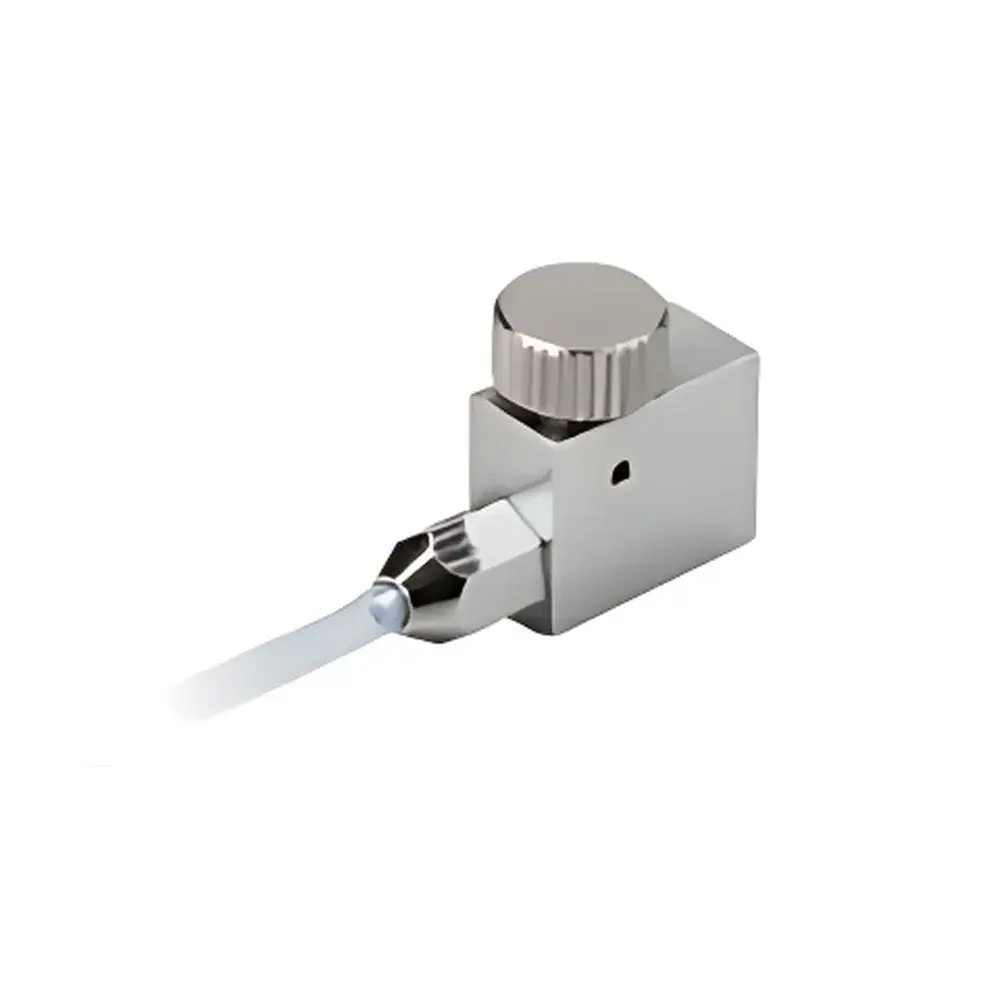
NARISHIGE CI-3 Multi-Function Tubing Connector with Integrated Valve
| Brand | NARISHIGE |
|---|---|
| Origin | Japan |
| Model | CI-3 |
| Body Material | 316L Stainless Steel or PEEK |
| Max Operating Pressure | 25 MPa |
| Temperature Range | −30 °C to +180 °C |
| Valve Type | Normally Closed / Normally Open (Selectable) |
| Flow Rate | 0.1–30 L/min |
| Actuation Torque | ≤0.2 N·m |
| Sealing | Dual O-ring + Metal Seal |
| Cycle Life | ≥100,000 cycles |
| Interface Standards | 1/8″–1/4″ NPT / BSPP / BSPT |
| Dimensions | W21 × D8 × H17 mm |
| Weight | 10 g |
Overview
The NARISHIGE CI-3 Multi-Function Tubing Connector is an engineered fluidic interface component designed for high-integrity liquid and gas handling in precision life science instrumentation. It integrates a compact, manually or actuator-compatible valve directly into a tubing coupling assembly—eliminating the need for discrete valve and adapter components in microfluidic and analytical instrument architectures. Its operational principle relies on a rotary-seal mechanism that translates low-torque rotational input (≤0.2 N·m) into precise axial displacement of a sealing plunger, enabling repeatable on/off control and fine-grained flow modulation. The device is optimized for use in cell analysis platforms—including automated cell counters, viability analyzers, and microfluidic cytometry systems—where reliable, bubble-free fluid path priming and reagent delivery are critical to measurement accuracy and assay reproducibility. Its construction adheres to material compatibility requirements for biological buffers, ethanol-based cleaning agents, and low-viscosity organic solvents commonly employed in cell culture and sample preparation workflows.
Key Features
- Integrated multi-function valve architecture supports three operational modes: flow regulation, pressure venting, and dual-path switching—reducing system footprint and interconnection points.
- Robust body fabricated from either electropolished 316L stainless steel or medical-grade PEEK polymer, ensuring resistance to chloride-induced stress corrosion cracking and long-term chemical stability against aqueous and mildly aggressive media.
- Dual-stage sealing system combining elastomeric O-rings (FKM or EPDM, depending on configuration) with a secondary metal-to-metal seat interface, validated for zero leakage after ≥100,000 mechanical cycles under full-rated pressure (25 MPa).
- Wide thermal operating envelope (−30 °C to +180 °C) enables compatibility with sterilization processes including autoclaving (for PEEK variant) and dry-heat depyrogenation protocols.
- Modular port geometry supports rapid field adaptation via interchangeable thread inserts for 1/8″, 3/16″, and 1/4″ NPT, BSPP, or BSPT standards—facilitating integration with syringe pumps (e.g., IM-9C pneumatic microinjectors), PTFE tubing, and OEM instrument manifolds.
Sample Compatibility & Compliance
The CI-3 connector is compatible with standard laboratory fluids used in cell analysis applications, including phosphate-buffered saline (PBS), Hank’s Balanced Salt Solution (HBSS), Trypan Blue dye solutions, and low-concentration ethanol/water mixtures. Its surface finish and material selection meet ISO 10993-5 (cytotoxicity) and USP Class VI biocompatibility criteria for short-term contact devices. While not a standalone diagnostic device, it complies with general design principles referenced in IEC 61010-1 for laboratory equipment safety and supports traceability requirements under GLP and GMP environments when deployed within validated instrument platforms (e.g., CE-marked cell counters or FDA-cleared hematology analyzers). No internal wetted parts contain phthalates, latex, or heavy metals above RoHS Directive thresholds.
Software & Data Management
As a passive mechanical component, the CI-3 does not incorporate embedded electronics or firmware. However, its deterministic mechanical response and documented torque–flow correlation curves enable seamless integration into closed-loop fluid control systems governed by third-party motion controllers or PLCs. When paired with compatible actuators (e.g., stepper-driven rotary stages), valve position can be synchronized with instrument software via analog voltage (0–10 V) or digital pulse inputs. Audit trails for maintenance intervals and replacement history may be logged within enterprise asset management (EAM) systems per ISO/IEC 17025 clause 6.4.10, supporting calibration traceability and preventive maintenance scheduling in regulated laboratories.
Applications
- Cell counter fluidics: Air purge and priming of IM-9C microinjector lines prior to automated cell suspension aspiration; flow gating during differential staining protocols.
- Microfluidic cytometry platforms: On-chip reagent switching between wash, lysis, and fixation channels without external solenoid banks.
- Automated blood analyzers: Isolation of optical detection zones from upstream pressure fluctuations during capillary fill cycles.
- Lab-on-a-chip development: Interfacing PDMS-based chips with external syringe pump modules while maintaining leak-tight integrity at sub-microliter volumes.
- Bioprocess monitoring systems: Sample extraction ports in single-use bioreactors where sterile disconnect capability and pressure containment are mandatory.
FAQ
Is the CI-3 suitable for sterile filtration applications?
No—the CI-3 is not a filter device and provides no particulate retention. It serves solely as a controllable fluidic junction and must be installed downstream of validated sterile filters in aseptic workflows.
Can the valve orientation be reversed in-field?
Yes—valve function (normally open vs. normally closed) is determined by internal spring preload and can be reconfigured during servicing using NARISHIGE-certified replacement kits.
Does the CI-3 require periodic recalibration?
No—its performance is defined by mechanical tolerances and material properties rather than electronic sensors; however, visual inspection for seal wear and torque verification are recommended every 50,000 cycles or per facility SOP.
What tubing outer diameters are supported with standard fittings?
Standard configurations accommodate PTFE tubing with ODs of 1.59 mm (1/16″), 2.38 mm (3/32″), and 3.18 mm (1/8″), secured via compression ferrules compliant with ISO 8434-1.
Is documentation available for IQ/OQ protocol development?
Yes—NARISHIGE provides dimensional drawings, material certifications (EN 10204 3.1), and functional test reports upon request, supporting user-defined installation and operational qualification activities.
Related Products




