
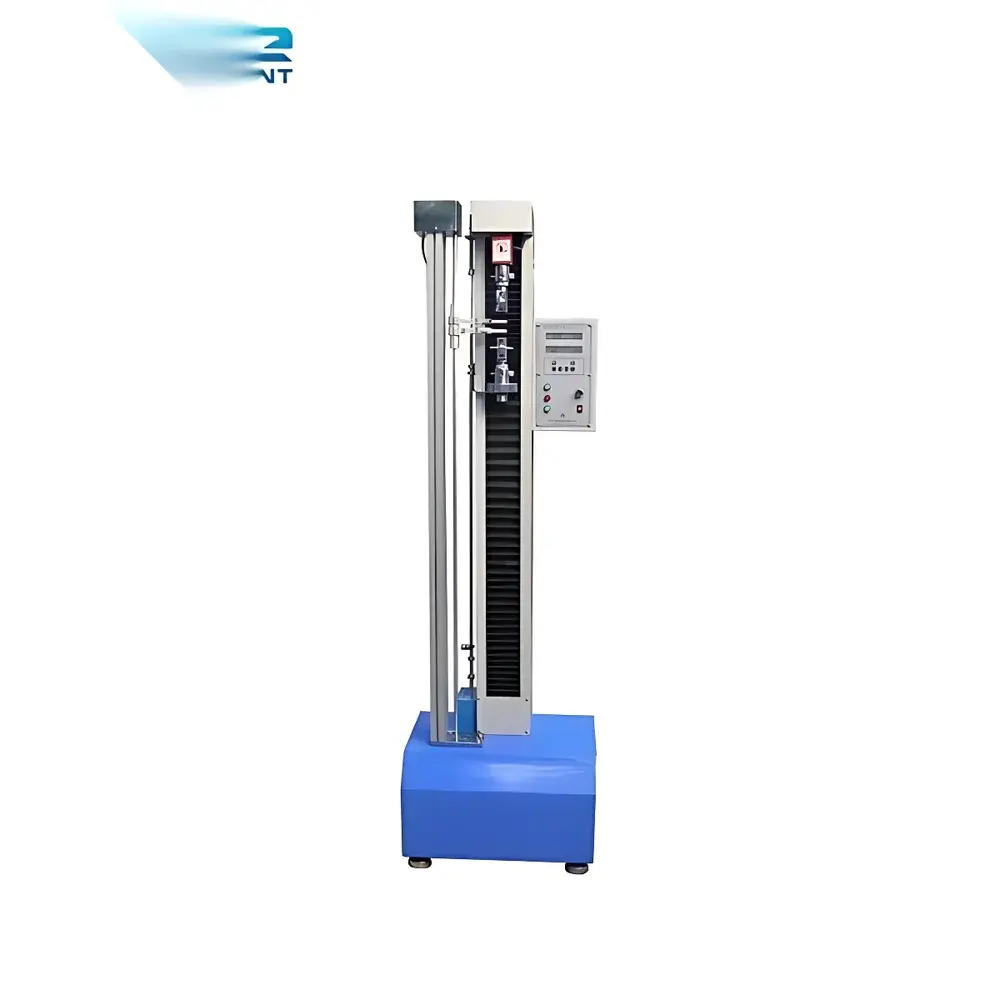
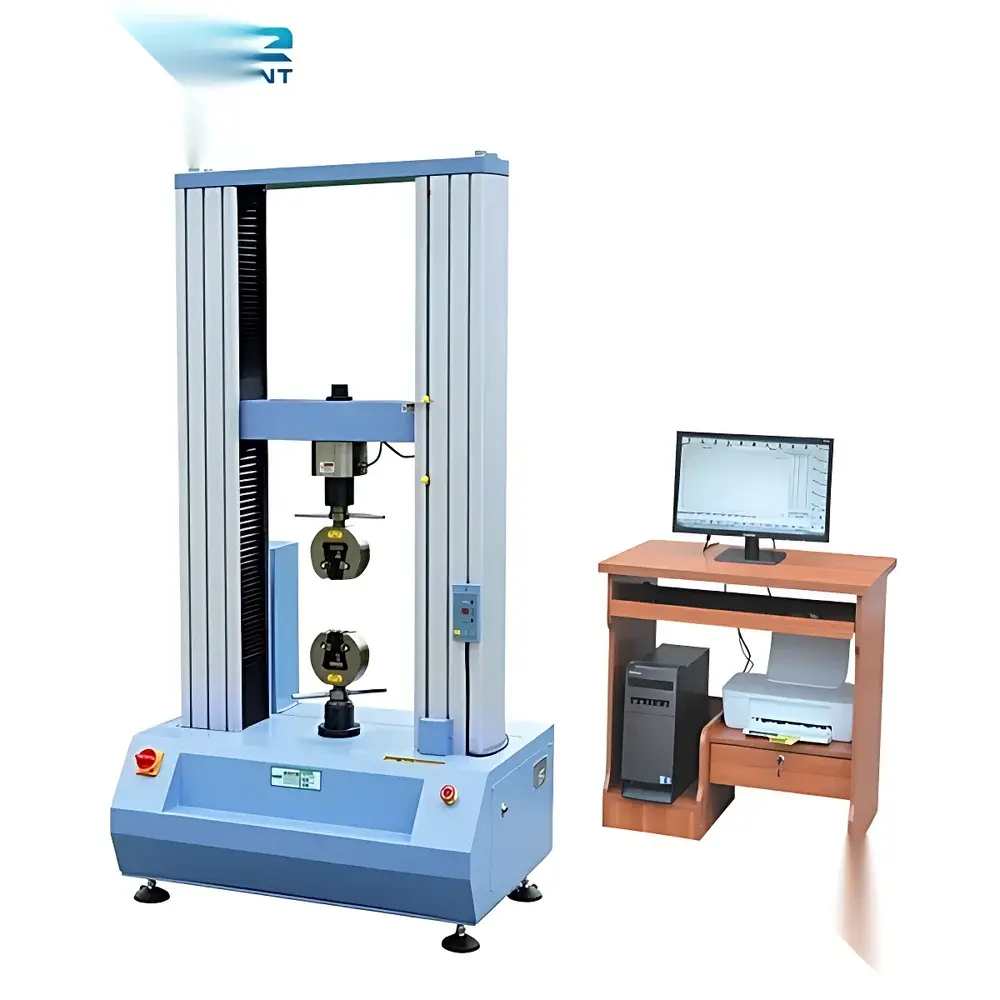
OK-NL-50 Universal Tensile Testing Machine
| Brand | OEM |
|---|---|
| Origin | Imported |
| Manufacturer Type | Authorized Distributor |
| Model | OK-NL-50 |
| Capacity | 50 kgf (490 N) |
| Load Cell Accuracy | ≤0.25% FS (for ≤1 kN range) |
| Load Resolution | 1/250,000 full scale |
| Stroke | 1000 mm (excluding grips) |
| Test Speed Range | 5–300 mm/min (software-controlled, stepless adjustment) |
| Drive System | Panasonic AC servo motor + servo driver |
| Transmission | Precision ball screw + timing belt + LM guide rail |
| Force Sensor | Explosion-proof high-precision load cell with auto-thermal compensation, zero drift <0.01% FS/°C, repeatability ±0.03% FS, overload capacity 150% FS |
| Position Resolution | 0.001 mm |
| Data Acquisition | Real-time PC-based control, curve plotting, peak hold, break-stop, overload protection, unit switching (g/kg/N/kN/lbf), report generation & export (CSV/PDF) |
| Compliance Standards | ASTM D412, D3574, D5035, D2061, ISO 37, 1421, 1798, GB/T 16491, GB/T 1040, GB/T 2792, GB/T 3923.1, EN ISO 9163, DIN 53507-A |
Overview
The OK-NL-50 Universal Tensile Testing Machine is an electromechanical static testing system engineered for precision mechanical characterization of polymeric, metallic, fibrous, and composite materials under uniaxial loading conditions. It operates on the principle of controlled displacement-driven force measurement, utilizing a closed-loop servo-controlled actuation system to apply calibrated tensile, compressive, flexural, peel, shear, and tear loads in accordance with standardized test protocols. Designed for laboratory and quality control environments, the OK-NL-50 delivers high reproducibility in material property quantification—including ultimate tensile strength, yield point, modulus of elasticity, elongation at break, and stress–strain hysteresis—across diverse specimen geometries and compliance requirements.
Key Features
- Panasonic AC servo motor coupled with high-resolution encoder (2500 PPR) ensures smooth, low-noise motion control and exceptional speed stability across the full 5–300 mm/min range.
- Precision-ground ball screw transmission paired with LM linear guide rails guarantees axial alignment accuracy better than ±0.02 mm over 1000 mm stroke, minimizing parasitic bending moments during testing.
- Explosion-rated load cell with integrated thermal drift compensation provides long-term stability; repeatability maintained at ±0.03% full scale, with transient overload tolerance up to 150% FS without calibration shift.
- Real-time data acquisition at 100 Hz sampling rate enables accurate capture of dynamic failure events, including brittle fracture onset and viscoelastic relaxation behavior.
- PC-based control software supports ASTM/ISO/GB-compliant test method templates, automatic parameter calculation (e.g., Young’s modulus via secant or tangent methods), and GLP-compliant audit trail logging per FDA 21 CFR Part 11 requirements.
- Dual-stage mechanical and electronic safety interlocks—including upper/lower limit switches, emergency stop circuitry, and real-time load threshold monitoring—prevent sensor damage and ensure operator safety during high-speed or high-force tests.
Sample Compatibility & Compliance
The OK-NL-50 accommodates specimens ranging from ultra-thin polymer films (≥10 µm thickness) to rigid metal rods (≤12 mm diameter) and textile yarns (≥5 dtex). Standardized grips include pneumatic flat-face clamps (for films and sheets), wedge-action serrated jaws (for metals and composites), and peel fixtures compliant with ASTM D1876 (T-peel) and ISO 8510-2 (90°/180° peel). The system meets structural and metrological requirements outlined in ISO 7500-1 Class 0.5, ASTM E4, and GB/T 16491 Class 0.5. All firmware and software modules are validated for traceable calibration against NIST-traceable reference standards, supporting ISO/IEC 17025 accredited laboratories.
Software & Data Management
The embedded Windows-compatible control suite features intuitive workflow navigation, customizable test sequences, and automated pass/fail evaluation based on user-defined acceptance criteria. Raw force–displacement data is stored in binary format with metadata tagging (operator ID, timestamp, environmental conditions, calibration certificate ID). Export options include CSV (for third-party statistical analysis), PDF test reports with embedded stress–strain curves and tabulated results, and XML for LIMS integration. Audit trails record all user actions—including method edits, calibration events, and result overrides—with immutable timestamps and digital signatures to satisfy GMP/GLP documentation requirements.
Applications
- Mechanical validation of thermoplastic elastomers (TPE), silicone rubbers, and hydrogels per ISO 37 and ASTM D412.
- Peel strength assessment of pressure-sensitive adhesives (PSAs) on flexible substrates per PSTC-7 and ISO 8510.
- Tensile performance screening of biomedical sutures, wound dressings, and surgical meshes per ISO 13934-1 and ASTM D2061.
- Quality assurance of automotive interior trim materials (leather, nonwovens, foams) per ISO 1798 and DIN 53507-A.
- Compliance verification of packaging films (BOPP, PET, PE) for seal integrity, puncture resistance, and dart impact correlation per ASTM D882 and GB/T 1040.
- Research-grade characterization of nanocomposite thin films and fiber-reinforced polymers under controlled humidity and temperature (when integrated with environmental chamber).
FAQ
What is the maximum recommended test load for routine use on the OK-NL-50?
For optimal accuracy and longevity, the nominal test load should remain within 20–80% of the 50 kgf (490 N) capacity—i.e., 100–400 N—per ISO 7500-1 guidance.
Does the system support multi-step cyclic testing?
Yes; the software allows programmable load/displacement waveforms, including tension–compression cycles, creep–recovery sequences, and staircase ramping, with dwell time control down to 0.1 s resolution.
Is calibration certification included with delivery?
Each unit ships with a factory-issued calibration certificate traceable to national metrology institutes (NMI), covering force, displacement, and speed axes, valid for 12 months under normal operating conditions.
Can the OK-NL-50 be integrated into an automated production line?
It supports RS-232, Ethernet TCP/IP, and optional PLC I/O interfaces for external trigger synchronization, batch ID input, and pass/fail signal output compatible with MES/SCADA systems.
What maintenance intervals are recommended?
Ball screw lubrication every 500 hours of operation; load cell verification every 6 months; annual full recalibration recommended—documented in the included maintenance logbook and supported by certified service partners worldwide.



