
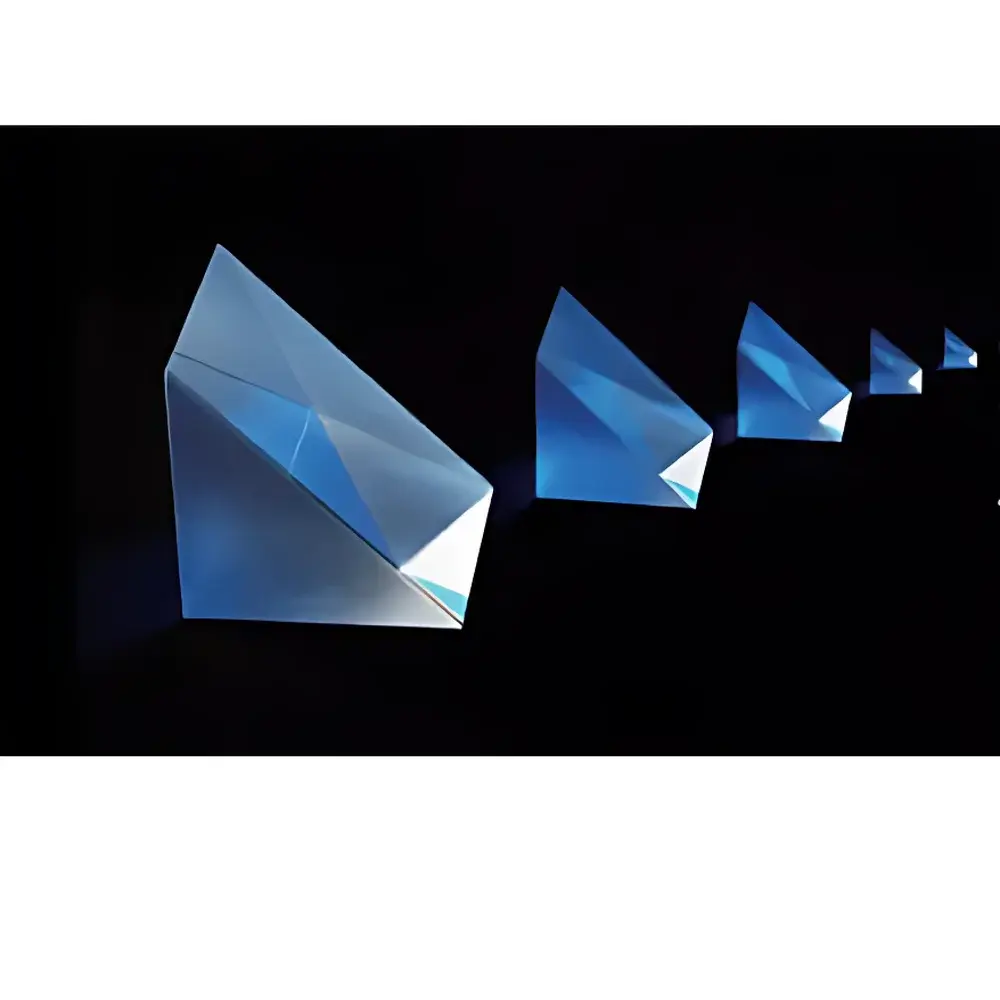
MiXran Meg1040 Standard-Accuracy Right-Angle Prism
| Brand | MiXran |
|---|---|
| Model | Meg1040 |
| Component Type | Optical Prism |
| Material | Optical Grade BK7 Glass |
| Angle Tolerance | ±3 arcseconds |
| Surface Quality | 40-20 scratch-dig |
| Flatness | λ/4 @ 633 nm |
| Coating Options | Uncoated |
| Dimensions (A=B=C) | 5–50 mm (cubical geometry) |
| Clear Aperture | ≥90% of face dimension |
Overview
The MiXran Meg1040 Standard-Accuracy Right-Angle Prism is a precision optical component engineered for reliable beam deviation, retroreflection, and image erection in laboratory, industrial, and OEM optical systems. Fabricated from high-homogeneity BK7 borosilicate crown glass, the Meg1040 adheres to ISO 10110-3 surface quality standards and maintains a right-angle tolerance of ±3 arcseconds — sufficient for non-critical alignment tasks, educational optics setups, and cost-sensitive instrumentation where diffraction-limited performance is not required. Its 90° internal angle enables total internal reflection (TIR) across visible wavelengths when used uncoated, while optional dielectric or metallic coatings extend functionality into NIR spectral bands and enhance throughput in folded-path configurations. Unlike high-precision prisms requiring λ/10 flatness or sub-arcsecond angular accuracy, the Meg1040 balances metrological integrity with manufacturability, making it suitable for prototyping, teaching labs, and auxiliary optical trains in spectrometers, interferometers, and laser alignment tools.
Key Features
- Precision-ground and polished BK7 substrate with certified surface flatness of λ/4 at 633 nm (HeNe wavelength), verified via interferometric testing per ISO 10110-5.
- Cubical geometry (A = B = C) ensures mechanical symmetry and simplifies mounting in kinematic or threaded prism holders.
- Multiple coating configurations optimized for spectral performance: aluminum (Al) reflective coating on the hypotenuse face paired with either VIS broadband anti-reflection (AR) coating (400–700 nm, R < 0.5% per surface) or NIR AR coating (700–1100 nm, R < 0.8% per surface) on the two perpendicular faces.
- Alternative coating schemes include VIS/NIR AR on the hypotenuse with aluminum on the input/output faces — enabling customized beam routing in multi-prism assemblies.
- Surface quality rated 40–20 scratch-dig per MIL-PRF-13830B, ensuring minimal scatter for low-power visible and near-infrared applications.
- Dimensional options span 5 mm to 50 mm edge length, supporting scalability from compact micro-optics modules to large-aperture collimation benches.
Sample Compatibility & Compliance
The Meg1040 is compatible with standard optomechanical mounts including SM1-threaded prism cages, kinematic bases, and custom aluminum housings. Its BK7 material exhibits low thermal expansion (7.1 × 10⁻⁶ /K) and excellent transmission from 350 nm to 2.0 µm, allowing integration into UV-VIS-NIR systems without material-induced absorption artifacts. All coated variants comply with RoHS Directive 2011/65/EU for hazardous substance restrictions. While not certified to ISO 9001 at the component level, each batch undergoes incoming inspection per ISO 10110-7 for coating adhesion (tape test per ASTM D3359), environmental durability (48-hour 85°C/85% RH humidity test), and spectral reflectance/transmittance verification using a calibrated PerkinElmer Lambda 950 UV/VIS/NIR spectrophotometer.
Software & Data Management
As a passive optical element, the Meg1040 does not incorporate embedded electronics or firmware. However, its dimensional and coating specifications are fully parameterized in Zemax OpticStudio (ZOS) and CODE V optical design libraries. A complete set of manufacturer-provided ZOS .zmx files — including models for all size/coating combinations — supports accurate ray tracing, ghost image analysis, and polarization-dependent performance simulation. Spectral data (R/T curves) and mechanical drawings (GD&T annotated STEP files) are delivered digitally upon order fulfillment, enabling traceable integration into PLM systems compliant with ISO 13485 or AS9100 workflows.
Applications
- Educational optics kits for demonstrating TIR, dispersion, and image inversion principles in undergraduate physics laboratories.
- Retroreflector arrays in alignment lasers and position-sensing interferometers where moderate angular stability suffices.
- Beam folding in compact spectrometer designs, particularly in portable NIR analyzers operating between 780–1050 nm.
- Input/output coupling optics in fiber-optic sensor interfaces, leveraging aluminum + NIR AR configuration to minimize insertion loss.
- Reference elements in calibration jigs for autocollimators and electronic theodolites requiring geometrically stable 90° benchmarks.
- OEM integration into machine vision illumination modules where cost-effective beam steering replaces articulated mirror mounts.
FAQ
What is the maximum power density the Meg1040 can withstand in continuous-wave laser operation?
For uncoated BK7, the damage threshold is approximately 0.5 GW/cm² for 10 ns pulses at 1064 nm (ISO 21254-1). For CW operation below 532 nm, derate to ≤5 W/cm² average power density; above 700 nm, up to 20 W/cm² is permissible with adequate heat sinking.
Are custom coating specifications available beyond the listed VIS/NIR AR options?
Yes — custom MgF₂ single-layer, V-coat, or multi-band AR stacks (e.g., 350–450 nm + 750–850 nm) can be quoted separately; lead time increases by 4–6 weeks.
Do you provide measurement certificates for individual prisms?
Standard delivery includes batch-level interferometric flatness and spectral verification reports. Individual prism certification (including interferogram and angle measurement traceable to NIST standards) is available as a value-added service.
Is the aluminum coating protected with a SiO₂ overcoat?
All aluminum coatings on Meg1040 prisms include a 20 nm protective SiO₂ layer deposited in the same vacuum run, meeting MIL-C-48497A requirements for humidity resistance.
Can the Meg1040 be used in vacuum environments?
Yes — BK7 glass and SiO₂-capped aluminum coatings are vacuum-compatible to 10⁻⁶ Torr; outgassing rates conform to ECSS-Q-ST-70-02C for space-qualified optical components.




