
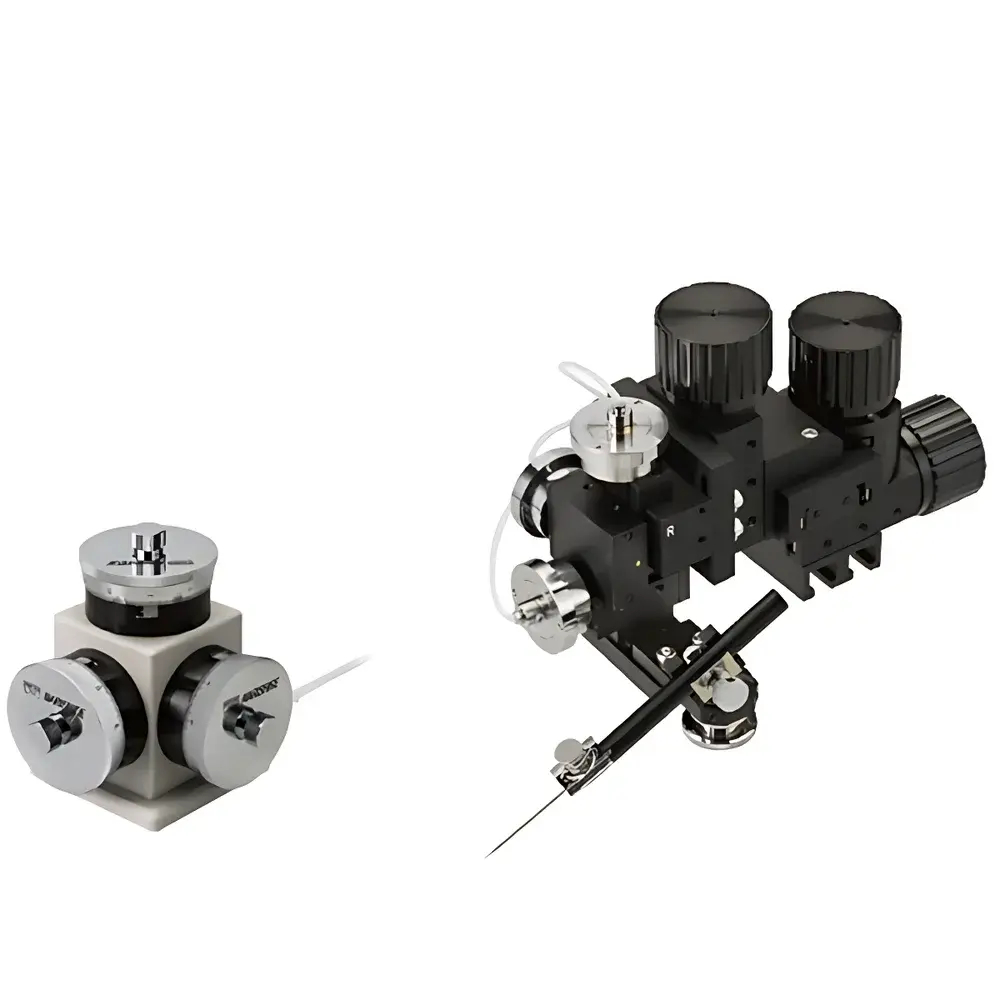
MHW-3 Three-Axis Hydraulic Micromanipulator by Narishige
| Brand | Narishige |
|---|---|
| Origin | Japan |
| Model | MHW-3 |
| Drive Mechanism | Water-Hydraulic |
| Motion Resolution (Fine) | 0.2 µm (min. scale) |
| Coarse Travel Range (X/Y/Z) | 30 mm each |
| Fine Travel per Full Knob Rotation | 50 µm |
| Coarse Travel per Full Knob Rotation | ~4 mm |
| Control Unit Dimensions | 115 × 115 × 132 mm, 1.6 kg |
| Drive Unit Dimensions | 155 × 155 × 100 mm, 900 g |
| Hydraulic Tubing Length | 900 mm |
| Joint Type | Spherical Ball Joint (B-9 Standard) |
| Electrode Holder | H-12 Type |
| Included Accessories | Hex Key Wrench, Dual Adapter, Isolation Mounting Platform |
Overview
The Narishige MHW-3 Three-Axis Hydraulic Micromanipulator is a precision mechanical positioning system engineered for high-stability, long-duration microscale manipulation in electrophysiological and electrochemical applications. Unlike oil-based hydraulic systems, the MHW-3 employs a water-hydraulic actuation mechanism—selected for its significantly lower thermal expansion coefficient (≈0.00021/°C for water vs. ≈0.0007/°C for typical silicone oils), thereby minimizing thermally induced positional drift during extended experiments. Its dual-range architecture integrates coarse and fine motion control within a single compact drive unit: coarse movement enables rapid repositioning over ±30 mm per axis (X/Y/Z), while fine adjustment delivers sub-micron repeatability with a calibrated resolution of 0.2 µm—the smallest engraved scale on the micrometer dials. The system’s mechanical foundation relies on a rigid, monolithic drive body coupled with a B-9 standard spherical ball joint, ensuring kinematic stability and eliminating backlash under load. This design prioritizes positional fidelity over time, making it suitable for patch-clamp recordings, intracellular electrode placement, and multi-electrode array alignment where nanoscale drift compromises data integrity.
Key Features
- Water-hydraulic actuation system with inherently low thermal expansion for minimized thermal drift during prolonged operation
- Dual-stage motion control: coarse travel (±30 mm/axis) and fine travel (50 µm per full knob rotation, 0.2 µm minimum readable increment)
- Robust spherical ball joint (B-9 standard) enabling unrestricted angular freedom without mechanical coupling to the manipulator base
- Modular mounting via dual adapter or vibration-isolation platform—decoupling the drive unit from direct rod attachment to suppress transmission of stage vibrations
- Ergonomic roller-type control unit with large-diameter knobs providing high-torque leverage and linear response across full rotation range
- Integrated H-12 electrode holder compatible with standard glass micropipettes (OD ≤ 1.5 mm) and metal microelectrodes
Sample Compatibility & Compliance
The MHW-3 is designed for use with standard electrophysiology and electrochemical probes—including borosilicate glass pipettes, tungsten or platinum-iridium microelectrodes, and carbon-fiber sensors. Its mechanical interface complies with widely adopted international standards for micromanipulator interoperability: B-9 spherical joint geometry conforms to ISO 80000-4:2019 (quantities and units — mechanics), and mounting dimensions align with common vibration isolation platforms used in GLP-compliant electrophysiology labs. While the device itself is not certified to IEC 61000-6-2 (immunity) or IEC 61000-6-4 (emissions), its passive hydraulic architecture ensures electromagnetic silence—critical in low-noise recording environments where electronic actuators introduce interference. No electrical power supply is required; operation is purely mechanical and fluidic.
Software & Data Management
The MHW-3 operates as a standalone analog positioning instrument with no embedded electronics, firmware, or digital interface. Consequently, it does not generate telemetry data or require software drivers. All position settings are manually recorded using the engraved micrometer scales—supporting traceable, operator-documented protocols compliant with FDA 21 CFR Part 11 Annex 11 principles when integrated into validated laboratory workflows. Users may log coordinates manually or via external imaging systems (e.g., motorized microscope stages synchronized via TTL triggers). For laboratories maintaining electronic lab notebooks (ELNs), position metadata is entered as structured text fields referencing dial readings, eliminating reliance on proprietary software ecosystems.
Applications
- Patch-clamp electrophysiology: precise, drift-free positioning of recording electrodes onto single cells or tissue slices
- Intracellular injection and impalement: stable axial advancement during penetration and sustained holding
- Microelectrode array (MEA) calibration and probe alignment in electrochemical sensing setups
- Scanning electrochemical microscopy (SECM) probe positioning with sub-micron reproducibility
- Combined optical-electrochemical experiments requiring mechanical decoupling from motorized stages
- Long-term neuronal culture monitoring where thermal stability prevents focal plane shift over hours
FAQ
Is the MHW-3 compatible with inverted microscopes?
Yes—the B-9 spherical joint and optional dual adapter enable secure, vibration-damped mounting above or beside standard inverted microscope stages without obstructing optical paths.
What maintenance does the water-hydraulic system require?
The system uses deionized water with corrosion inhibitors; annual replacement of hydraulic fluid and inspection of O-rings is recommended per Narishige’s service bulletin MHW-3-REV2023.
Can the MHW-3 be integrated into automated workflows?
No—it is a manual, non-motorized system. However, its mechanical stability makes it ideal as a reference platform for validating automated micromanipulators.
Does the H-12 electrode holder accept quartz or fused-silica pipettes?
Yes, provided outer diameter falls within 1.0–1.5 mm and taper angle is ≤15°; clamping force is adjustable via hex-key tension screw.
Is technical documentation available in English with metrological traceability statements?
Yes—Narishige provides English-language calibration certificates (traceable to JCSS-accredited standards) upon request, covering dial linearity verification across full travel range.






