
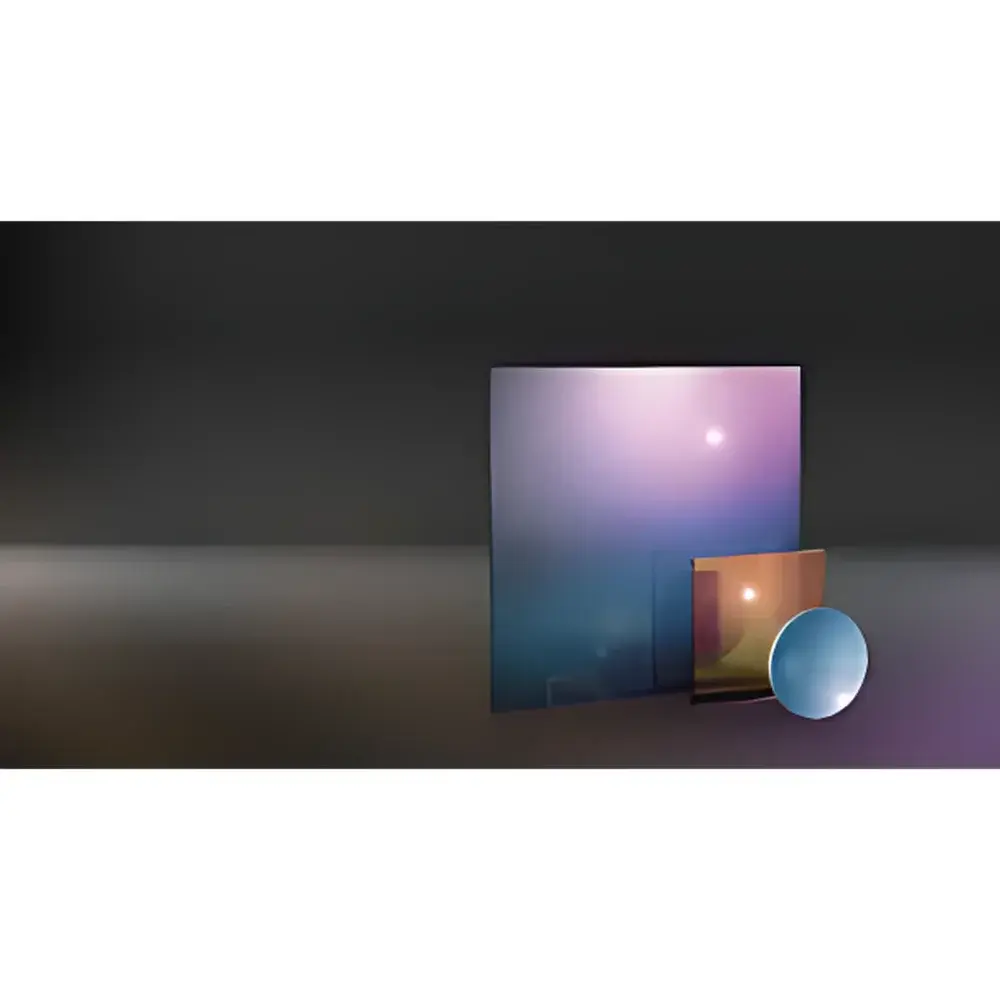
MiXran Meg1118 High-Performance Cold Mirror
| Brand | MiXran |
|---|---|
| Model | Meg1118 |
| Type | Dielectric Cold Mirror |
| Substrate Material | Fused Silica or BK7 (Standard) |
| Thickness | 2 mm ±0.1 mm |
| Surface Flatness | λ/10 @ 633 nm |
| Surface Quality | 20–10 Scratch-Dig |
| Clear Aperture | ≥90% of Diameter/Length |
| Damage Threshold | >5 J/cm² @ 1064 nm, 10 ns, 10 Hz (typ.) |
| Operating Temperature Range | –40 °C to +80 °C |
| Humidity Resistance | MIL-C-48497A compliant |
| Mounting Compatibility | Standard kinematic or lens-mount adapters (e.g., SM1, SM2, or custom flange) |
Overview
The MiXran Meg1118 is a high-precision dielectric cold mirror engineered for spectral beam separation in demanding optical systems where thermal management, wavelength selectivity, and long-term stability are critical. Unlike metallic-coated mirrors, the Meg1118 employs a multilayer all-dielectric thin-film coating deposited via ion-assisted electron-beam evaporation, enabling near-zero absorption across the visible spectrum (typically 95%) in the near-infrared (NIR) range (750–1200 nm). This spectral behavior follows the fundamental principle of interference-based reflectance: constructive interference of reflected waves in the visible band and destructive interference in the NIR, resulting in efficient reflection of visible light and transmission of infrared radiation. The mirror is optimized for use as an output coupler in high-power short-wave NIR sources (e.g., 808 nm, 850 nm, or 940 nm laser diode arrays), fluorescence imaging illumination paths, thermal imaging beam combiners, and multi-spectral illumination modules where heat-induced wavefront distortion must be minimized.
Key Features
- Ultra-low absorption dielectric coating: Absorption <0.2% in 400–700 nm band ensures minimal thermal loading under high irradiance (up to 5 kW/cm² continuous wave, with appropriate cooling)
- High NIR transmission: >95% average transmission from 750 nm to 1200 nm, enabling efficient coupling of pump or signal beams in solid-state and fiber laser systems
- High laser-induced damage threshold (LIDT): >5 J/cm² at 1064 nm (10 ns pulse, 10 Hz repetition rate), validated per ISO 21254-1
- Substrate options: Fused silica (for UV-NIR broadband stability and low thermal expansion) or BK7 (cost-optimized for visible-NIR applications); both substrates polished to λ/10 surface flatness @ 633 nm
- Robust environmental performance: Coating adheres to MIL-C-48497A for humidity resistance and passes 24-hour salt fog testing (ASTM B117)
- Standard mechanical formats: Available in round (Φ12.5 mm to Φ80 mm) and rectangular (35×35 mm to 110×120 mm) configurations with 2 mm nominal thickness and chamfered edges per ISO 10110-7
Sample Compatibility & Compliance
The Meg1118 cold mirror is compatible with standard optomechanical mounting platforms including SM1-threaded lens tubes, kinematic mirror mounts (e.g., KM100, KCB1), and custom flanged housings. It meets key international standards for optical component qualification: ISO 10110-7 (edge treatment), ISO 14997 (laser damage testing methodology), and ISO 9211-4 (coating environmental durability). For regulated environments—such as medical device illumination subassemblies or aerospace-grade optical benches—the mirror’s batch traceability, coating process documentation, and post-deposition spectral verification reports support compliance with ISO 13485 and AS9100 requirements. While not intrinsically certified for FDA or CE marking, it is routinely integrated into Class I and Class IIa medical optical systems where end-device validation includes full optical safety assessment per IEC 62471.
Software & Data Management
As a passive optical component, the Meg1118 does not incorporate embedded electronics or firmware. However, its spectral performance data—including measured R(λ) and T(λ) curves (350–1400 nm, 1 nm resolution), surface map interferograms (Zygo Verifire™), and LIDT test logs—are delivered digitally with each shipment in standardized CSV and PDF formats. These files are compatible with common optical design software (Zemax OpticStudio, CODE V, FRED) for system-level modeling. Traceable calibration certificates include NIST-traceable spectrophotometer validation (PerkinElmer Lambda 1050+ with 150 mm integrating sphere) and are archived for 10 years per MiXran’s GLP-aligned quality management system (QMS Rev. 3.2).
Applications
- Laser pumping architectures: Separation of visible pump light (e.g., 532 nm green DPSS lasers) from NIR emission in Nd:YAG or Yb:fiber amplifier chains
- Multi-spectral machine vision: Simultaneous visible inspection and SWIR defect detection using shared illumination optics
- Biomedical endomicroscopy: Cold filtering of excitation light in confocal or two-photon probe designs to reduce photothermal tissue damage
- Thermal imaging illumination: Coupling of NIR LED arrays into uncooled microbolometer optical trains without heating the cold shield
- Aerospace EO/IR sensor heads: Beam combining of visible CCD and MWIR/LWIR detector paths in stabilized gimbal systems
FAQ
What is the primary spectral function of the Meg1118 cold mirror?
It reflects >99.5% of visible light (400–700 nm) while transmitting >95% of near-infrared radiation (750–1200 nm), minimizing thermal load on downstream optics.
Can the Meg1118 be used with pulsed lasers?
Yes—validated for nanosecond pulses at 1064 nm; for ultrafast (fs/ps) or UV applications, consult MiXran’s application engineering team for substrate and coating customization.
Is anti-reflection (AR) coating available on the substrate backside?
Optional single-layer MgF₂ or broadband AR coatings (350–1100 nm) can be applied upon request; increases transmission by ~1.5% per surface.
What mounting solutions are recommended for high-stability alignment?
Kinematic mounts with three-point contact (e.g., Thorlabs KM100 series) or flexure-based adjustable mounts are preferred to avoid stress-induced birefringence.
Does MiXran provide spectral measurement reports for each unit?
Yes—every Meg1118 mirror ships with a unique serial-numbered spectral report generated on a calibrated PerkinElmer Lambda 1050+ spectrophotometer.






