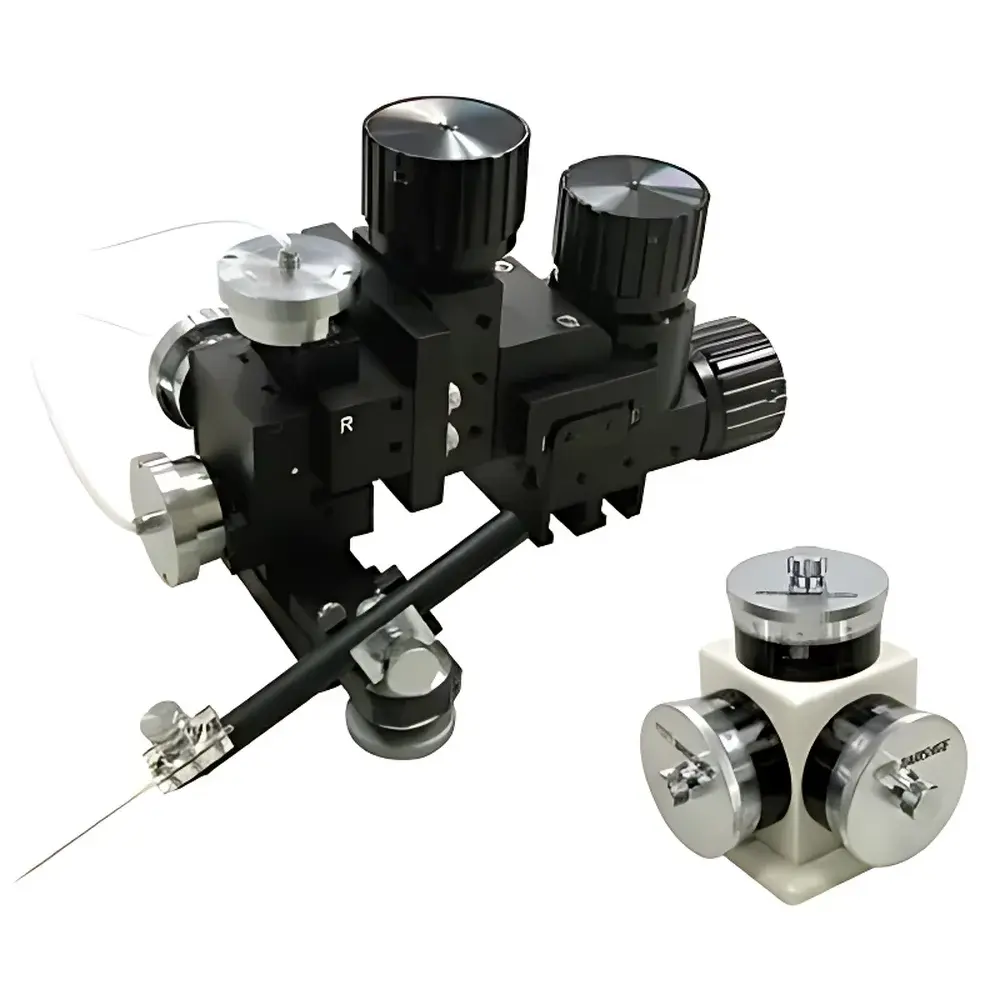
NARISHIGE MHW-3 Three-Axis Hydraulic Micromanipulator
| Brand | NARISHIGE |
|---|---|
| Origin | Japan |
| Model | MHW-3 |
| Coarse Movement Range (X/Y/Z) | 30 mm |
| Fine Movement Range (X/Y/Z) | 2 mm per full knob rotation |
| Minimum Graduation | 0.2 µm |
| Coarse Knob Travel per Full Rotation | ~4 mm |
| Fine Knob Travel per Full Rotation | 50 µm |
| Control Unit Dimensions | 115 × 115 × 132 mm, 1.6 kg |
| Drive Unit Dimensions | 155 × 155 × 100 mm, 0.9 kg |
| Hydraulic Tubing Length | 0.9 m |
| Included Accessories | B-9 Ball Joint, H-12 Electrode Holder, Allen Wrench |
Overview
The NARISHIGE MHW-3 is a precision-engineered three-axis hydraulic micromanipulator specifically developed for patch-clamp electrophysiology applications. It employs a water-based hydraulic transmission system—distinct from conventional oil-based alternatives—to deliver superior thermal stability, minimal thermal expansion drift, and reduced susceptibility to temperature-induced fluid leakage. This design choice directly addresses a critical operational constraint in long-duration patch-clamp experiments, where even sub-micron thermal drift can compromise seal formation or recording stability. The MHW-3 operates on a dual-range actuation principle: coarse positioning enables rapid approach over 30 mm per axis (X/Y/Z), while fine adjustment provides 2 mm of travel per full knob rotation with a calibrated minimum increment of 0.2 µm—achievable via a high-ratio (5:1) needle valve mechanism that suppresses mechanical hysteresis and fluid compressibility artifacts. Its rigid drive architecture, coupled with a spherical joint interface (B-9), ensures orthogonal axis decoupling and maintains positional fidelity under load, essential for consistent electrode tip alignment during gigaseal formation.
Key Features
- Water-hydraulic actuation system optimized for thermal stability and low-drift performance in ambient-lab environments
- Dual-scale control: coarse adjustment (30 mm range, ~4 mm/knob revolution) and ultra-fine adjustment (2 mm range, 50 µm/knob revolution, 0.2 µm minimum resolution)
- Ergonomic drum-shaped control unit with oversized handle for high linearity, tactile feedback, and fatigue-resistant operation during extended recordings
- Robust drive unit housing engineered for mechanical rigidity and minimal flexure under axial loading—critical for maintaining electrode orientation during pipette penetration
- Integrated B-9 ball joint mount with direct clamping (no support rods), enhancing structural integrity and reducing vibration coupling from stage or microscope frame
- H-12 electrode holder compatibility ensures secure, low-noise fixation of glass micropipettes with standardized taper geometry
Sample Compatibility & Compliance
The MHW-3 is designed exclusively for use with glass micropipettes employed in whole-cell, cell-attached, and outside-out patch-clamp configurations. Its mechanical interface conforms to standard NARISHIGE mounting protocols and integrates seamlessly with upright and inverted research-grade microscopes equipped with XYZ translation stages. While the device itself is not certified to ISO 13485 or FDA 21 CFR Part 11, its operational repeatability and traceable mechanical graduation support GLP-compliant experimental documentation when paired with validated laboratory procedures. The absence of hydrocarbon-based hydraulic fluid eliminates contamination risk to biological samples and optical paths—a key consideration in clean-room electrophysiology suites adhering to ISO 14644-1 Class 5/6 standards.
Software & Data Management
The MHW-3 is a fully manual, analog micromanipulator with no embedded electronics, firmware, or digital interface. All position adjustments are performed mechanically via calibrated knobs; therefore, it generates no native digital data stream. However, its deterministic mechanical response—verified through metrological calibration using laser interferometry or capacitive displacement sensors—enables precise correlation with external acquisition systems (e.g., Axon Digidata, HEKA EPC10). Users may log positional metadata manually or integrate the manipulator into automated workflows via third-party motorized stage controllers using custom kinematic mapping tables. For audit-trail requirements, laboratories commonly document knob positions, rotation counts, and associated electrophysiological events in ELN systems compliant with ALCOA+ principles.
Applications
- Gigaseal formation in acute brain slice preparations and cultured neurons
- Targeted patching of subcellular compartments (dendritic spines, axon initial segments) under IR-DIC or two-photon guidance
- Long-term stable recordings (>1 hour) requiring minimal thermal drift compensation
- Multi-electrode simultaneous patching setups where mechanical crosstalk between axes must be minimized
- Combined optogenetic-physiological experiments demanding vibration-isolated, non-magnetic positioning
FAQ
Is the MHW-3 compatible with motorized or computer-controlled systems?
No—the MHW-3 is a purely manual hydraulic manipulator without electronic components, encoders, or communication interfaces.
Why does NARISHIGE use water instead of oil in this hydraulic system?
Water’s lower coefficient of thermal expansion and negligible vapor pressure reduce temperature-dependent volume changes and eliminate oil mist contamination risks near sensitive optical paths and biological specimens.
What is the functional significance of the 5:1 needle valve ratio?
It amplifies operator input torque while attenuating fluid compressibility effects, enabling smoother, more predictable sub-micron motion without overshoot or stick-slip behavior.
Can the MHW-3 be mounted on vibration isolation tables?
Yes—its compact, low-center-of-gravity drive unit and rigid mounting interface make it suitable for integration onto active or passive optical tables meeting ISO 22477-1 vibration criteria.
Does the included B-9 ball joint support angular repositioning without recalibration?
Yes—the B-9 joint allows ±15° tilt adjustment while preserving zero-reference alignment across all three axes due to its kinematically constrained spherical pivot geometry.