
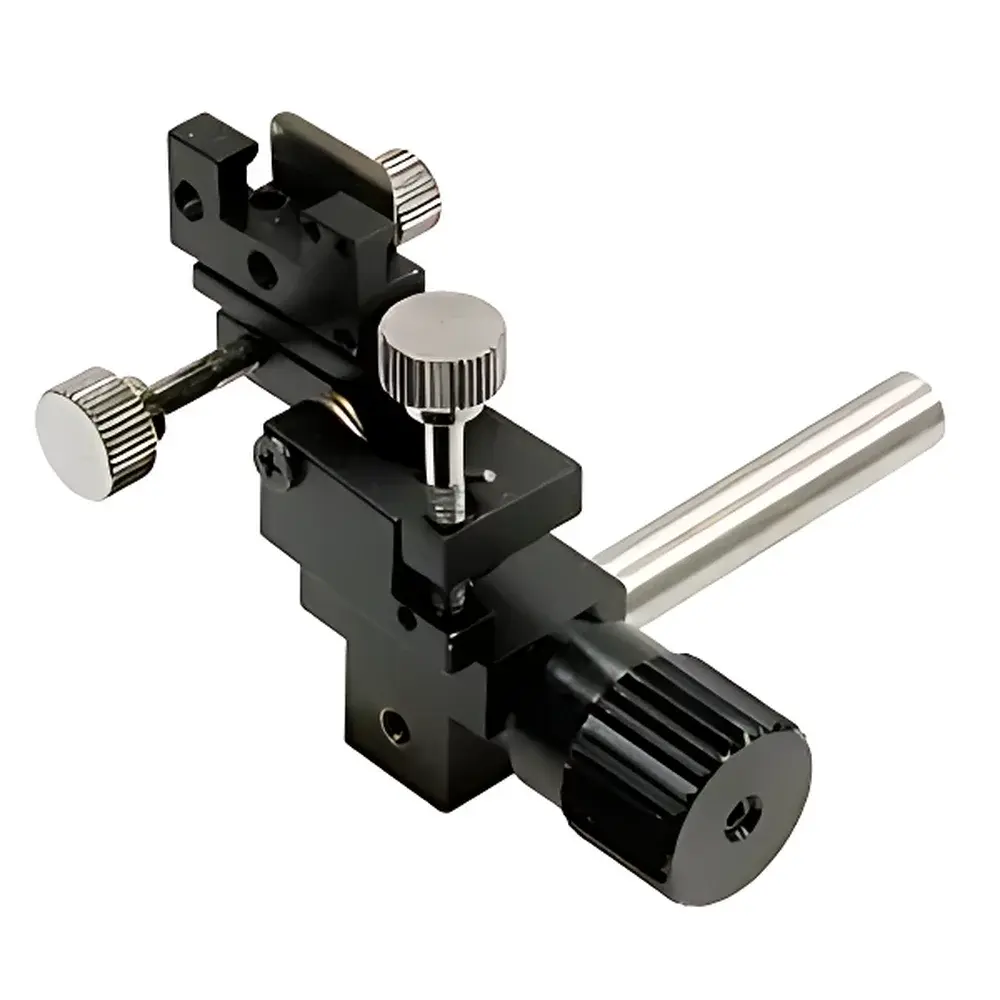
U-12C Micromanipulator by NARISHIGE
| Brand | NARISHIGE |
|---|---|
| Origin | Japan |
| Model | U-12C |
| Mounting Compatibility | 6 mm diameter support rod (e.g., URC-1 stand) |
| Adjustment Mechanism | Coarse X-axis translation (14 mm), pivot-and-tilt fine positioning |
| Dimensions (W×D×H) | 40 × 30 × 42 mm |
| Weight | 47 g |
| Material | Precision-machined stainless steel and brass components |
| Drive Type | Manual mechanical adjustment via knurled knobs and friction-based locking |
| Compliance | Designed for laboratory-grade micro-positioning in electrochemical and electrophysiological setups |
Overview
The U-12C Micromanipulator is a compact, manually operated one-dimensional coarse-positioning device engineered by NARISHIGE—a Japanese manufacturer with decades of expertise in precision micromanipulation systems for life science and electrochemical research. Unlike motorized or multi-axis digital manipulators, the U-12C employs a robust mechanical architecture based on friction-locking knurled knobs, enabling stable, backlash-free linear displacement along the X-axis (±7 mm from center, total travel 14 mm). Its integrated pivot-and-tilt mechanism allows fine angular reorientation of mounted tools—such as microelectrodes, glass pipettes, or reference electrodes—without requiring secondary fixtures. This hybrid coarse/fine design supports rapid initial placement followed by sub-degree angular refinement, making it particularly suitable for electrode alignment in three-electrode electrochemical cells, microelectrode insertion into gel matrices, or probe positioning in localized corrosion studies.
Key Features
- Compact footprint (40 × 30 × 42 mm) and ultra-lightweight construction (47 g), minimizing mechanical load on vibration-sensitive optical tables or inverted microscope stages.
- Standard 6 mm rod-mounting interface compatible with NARISHIGE’s URC-1 universal support stand and widely adopted third-party vertical posts.
- Coarse X-axis translation achieved via a calibrated lead-screw mechanism with tactile feedback; travel range precisely limited to 14 mm to prevent over-extension.
- Dual-axis fine adjustment: pivot (rotation about vertical axis) and tilt (inclination about horizontal axis), both secured independently via dedicated locking screws to maintain positional integrity during measurement.
- Corrosion-resistant materials—including passivated stainless steel shafts and brass gear housings—ensure long-term reliability in humid or mildly aggressive chemical environments typical of electrochemical workstations.
- No power supply or software required; fully operational in Faraday cages, gloveboxes, or shielded EMI-sensitive setups where electronic actuators are prohibited.
Sample Compatibility & Compliance
The U-12C is routinely deployed in configurations involving standard 1.0–1.5 mm OD glass microelectrodes, Pt-Ir wire tips, Ag/AgCl reference electrodes, and capillary-based pH or ion-selective sensors. Its mechanical simplicity avoids electromagnetic interference that could compromise low-current (<1 nA) amperometric or potentiostatic measurements. While not certified to ISO/IEC 17025 or ASTM E2918, the device conforms to general laboratory equipment safety standards (IEC 61010-1) when used within its specified environmental operating range (15–35 °C, <80% RH non-condensing). Its passive design inherently satisfies requirements for use in GLP-compliant electrochemical validation protocols where audit trails for actuator commands are unnecessary.
Software & Data Management
The U-12C operates entirely without firmware, drivers, or host software. Positional repeatability relies solely on mechanical consistency and user technique—not algorithmic control or digital encoding. Consequently, no data logging, calibration certificate generation, or audit trail functionality is embedded. This absence of digital dependency aligns with laboratories maintaining strict separation between analog signal acquisition hardware (e.g., potentiostats) and mechanical positioning subsystems—particularly relevant under FDA 21 CFR Part 11 considerations where electronic records must be validated separately. Users document positioning via manual logbooks or integrate physical scale readings into LIMS entries alongside electrochemical datasets.
Applications
- Precise alignment of counter/reference electrodes relative to working electrodes in custom-built electrochemical flow cells.
- Manual positioning of scanning electrochemical microscopy (SECM) probes prior to automated raster scanning.
- Adjustment of micro-reference electrodes in localized pH mapping experiments across corroding metal surfaces.
- Stabilization and orientation of dual-barrel ion-selective electrodes in real-time ion flux monitoring.
- Mounting platform for miniaturized gas-diffusion electrodes in CO₂ reduction studies requiring angular optimization of catalyst exposure.
- Support fixture for in situ Raman spectroelectrochemistry cells where optical access constraints demand minimal-profile tooling.
FAQ
Is the U-12C compatible with inverted microscopes?
Yes—its low profile and side-mounting capability allow unobstructed objective clearance; however, Z-axis height must be manually pre-set using the supporting stand.
Can it be used in inert atmosphere gloveboxes?
Yes—the all-mechanical operation eliminates electrical hazards and outgassing concerns associated with stepper motors or encoders.
Does it include mounting hardware?
It ships with M3 mounting screws and is designed for direct attachment to 6 mm rods (e.g., URC-1); no additional brackets are included unless specified separately.
What is the angular range of the pivot-and-tilt mechanism?
Pivot rotation is unrestricted (360° continuous), while tilt is mechanically limited to ±15° to preserve structural rigidity and avoid binding.
How is positional stability maintained during long-duration experiments?
Friction-locking knobs provide static retention; for extended stability (>24 h), users should verify knob tightness before initiating measurements and avoid thermal cycling exceeding ±2 °C.




