
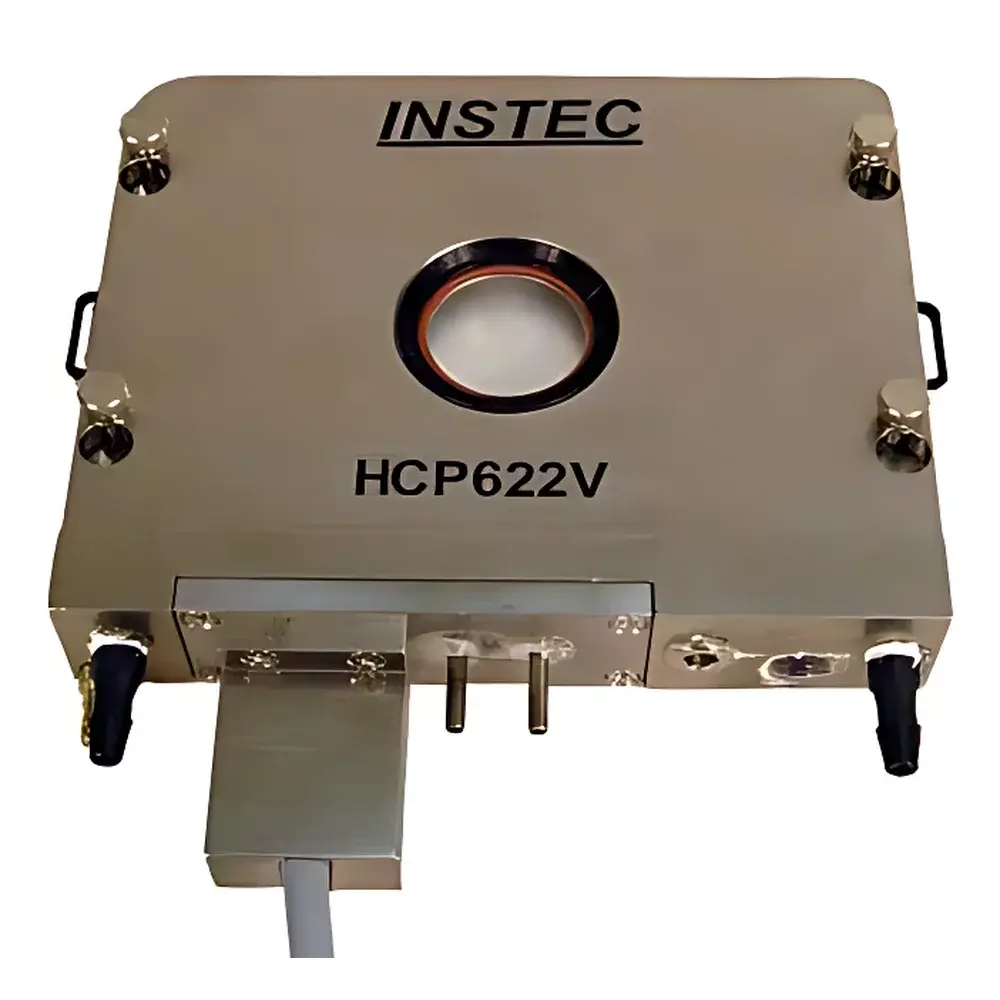
INSTEC HCS622G High-Performance Programmable Cryo-Hot Stage
| Brand | Instec |
|---|---|
| Origin | USA |
| Model | HCS622G |
| Temperature Range | −190 °C to +600 °C (optional up to +700 °C) |
| Temperature Resolution | 0.1 °C |
| Temperature Stability | ±0.01 °C at 100 °C |
| Max. Heating Rate | 230 °C/min at 200 °C |
| Max. Cooling Rate | −130 °C/min at 200 °C |
| Min. Ramp Rate | ±0.1 °C/hour |
| Control Method | Switching PID (LVDC PID optional) |
| Sensor | 100 Ω Platinum RTD |
| Working Distance | 5.8 mm |
| Condenser Distance | 12.7 mm |
| Sample Area | 38 mm × 38 mm |
| Chamber Height | 0.76 mm (with inner cover) |
| Viewing Aperture | 26.5 mm (reflected light), 2.0 mm (transmitted light) |
| Vacuum Port | 1/8″ NPT female |
| Gauge Port | 1/8″ NPT female |
Overview
The INSTEC HCS622G is a high-precision, vacuum-compatible programmable cryo-hot stage engineered for in situ thermal analysis under optical and electron microscopy. It operates on the principle of resistive heating and Peltier-assisted active cooling, enabling precise, bidirectional temperature control across an extended range from −190 °C to +600 °C—with an optional upgrade path to +700 °C for specialized high-temperature applications. Unlike conventional thermostats or benchtop ovens, the HCS622G integrates directly into inverted or upright microscope optical paths, maintaining full compatibility with transmitted-light, reflected-light, polarized-light, and Raman spectroscopy configurations. Its core architecture features a thermally isolated sample chamber with calibrated platinum resistance thermometer (100 Ω RTD) feedback, delivering ±0.01 °C stability at 100 °C and 0.1 °C resolution over the entire operational span—including sub-zero conditions—without interpolation or extrapolation artifacts. Designed for reproducible thermal cycling in research-grade environments, it supports both static isothermal holds and dynamic ramp-and-hold protocols with user-defined rate limits down to ±0.1 °C/hour.
Key Features
- Wide operational temperature range: −190 °C to +600 °C (standard), extendable to +700 °C with high-temp configuration
- High-fidelity thermal control: ±0.01 °C stability at 100 °C; 0.1 °C resolution across full range
- Dual-mode temperature regulation: Switching PID standard; Linear Variable DC (LVDC) PID available for ultra-low-noise applications requiring minimal thermal overshoot
- Optimized optical geometry: 5.8 mm working distance and 12.7 mm condenser distance ensure compatibility with high-NA objectives and long-working-distance condensers
- Large sample area: 38 mm × 38 mm active platform accommodates multi-sample arrays, custom substrates, and electrode-integrated devices
- Vacuum and inert-gas ready: Integrated 1/8″ NPT female vacuum port and separate gauge port support pressure-controlled experiments down to 10−6 mbar
- Modular chamber design: 0.76 mm chamber height with removable inner cover enables precise gap control for thin-film, melt, or confined-phase studies
Sample Compatibility & Compliance
The HCS622G supports diverse sample formats—including bulk metallurgical specimens, ceramic wafers, polymer films, geological thin sections, single-crystal substrates, and electrochemical cells—without compromising optical access or thermal fidelity. Its mechanical and thermal design complies with ISO 17025-relevant environmental conditioning requirements for accredited testing laboratories. When configured with optional LVDC PID and traceable RTD calibration certificates, the system meets ASTM E1142 (Standard Guide for Thermal Analysis Terminology) and supports GLP/GMP-aligned workflows where audit-ready temperature logging and protocol validation are required. The stage is compatible with vacuum-compatible adhesives, gold-sputtered substrates, and quartz windows for UV–Vis–NIR transmission studies.
Software & Data Management
Control is executed via INSTEC’s proprietary StageLink™ software (Windows-based), which provides intuitive graphical programming of multi-segment temperature profiles, real-time sensor monitoring, and synchronized data export in CSV and HDF5 formats. All temperature setpoints, actual readings, ramp rates, and timestamped events are logged with millisecond resolution. Optional integration with third-party acquisition platforms (e.g., MATLAB, LabVIEW, Python via COM/ActiveX) enables closed-loop coupling with spectrometers, cameras, or potentiostats. Audit trails include user authentication, parameter change history, and electronic signatures—fully compliant with FDA 21 CFR Part 11 when deployed with validated IT infrastructure.
Applications
- In situ phase transition analysis of alloys, shape-memory materials, and ferroelectrics during heating/cooling cycles
- Melt crystallization kinetics and polymorph screening in pharmaceutical solid-state development
- Thermal expansion coefficient (CTE) mapping of composite laminates using digital image correlation (DIC)
- Low-temperature Raman spectroscopy of superconductors and quantum materials
- Hydration/dehydration behavior of clays and silicates in geoscience thin sections
- Thermo-mechanical aging studies of high-performance polymers under controlled atmosphere
FAQ
What is the minimum achievable temperature, and does it require liquid nitrogen?
The HCS622G achieves −190 °C using integrated cryogenic cooling; no external LN₂ supply is required—operation is fully self-contained.
Can the stage be used under high vacuum or reactive gas environments?
Yes—vacuum-rated construction and dual NPT ports support operation from atmospheric pressure down to ultra-high vacuum (<10−6 mbar) and controlled inert or reducing atmospheres.
Is the temperature calibration traceable to NIST standards?
Calibration certificates with NIST-traceable RTD verification are available upon request and recommended for ISO/IEC 17025-compliant labs.
How is thermal uniformity characterized across the 38 mm × 38 mm sample area?
Uniformity is specified as ±0.3 °C over the central 25 mm × 25 mm region at steady state (100 °C), verified per ASTM E220 methodology.
Does the system support synchronization with external triggers (e.g., camera exposure or laser pulse)?
Yes—TTL-compatible trigger I/O allows hardware-level synchronization with imaging systems, spectrometers, or data acquisition units.



