
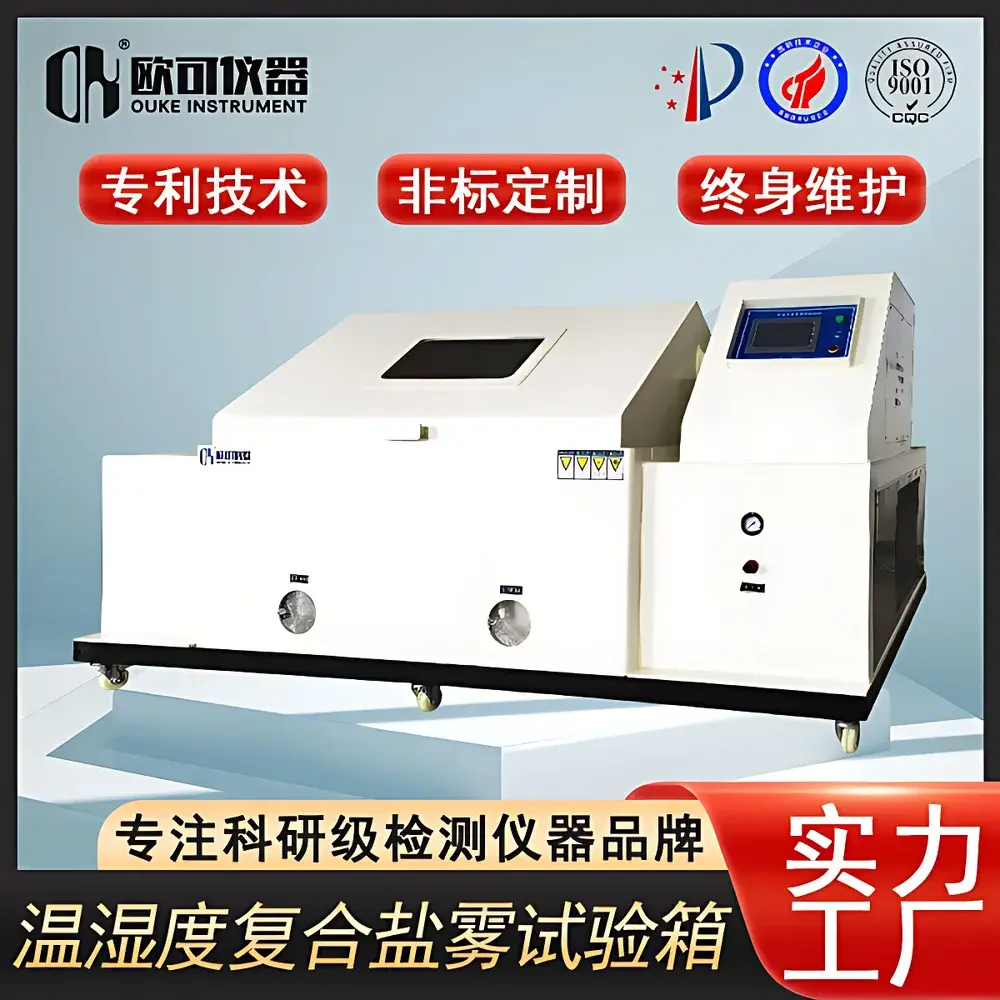
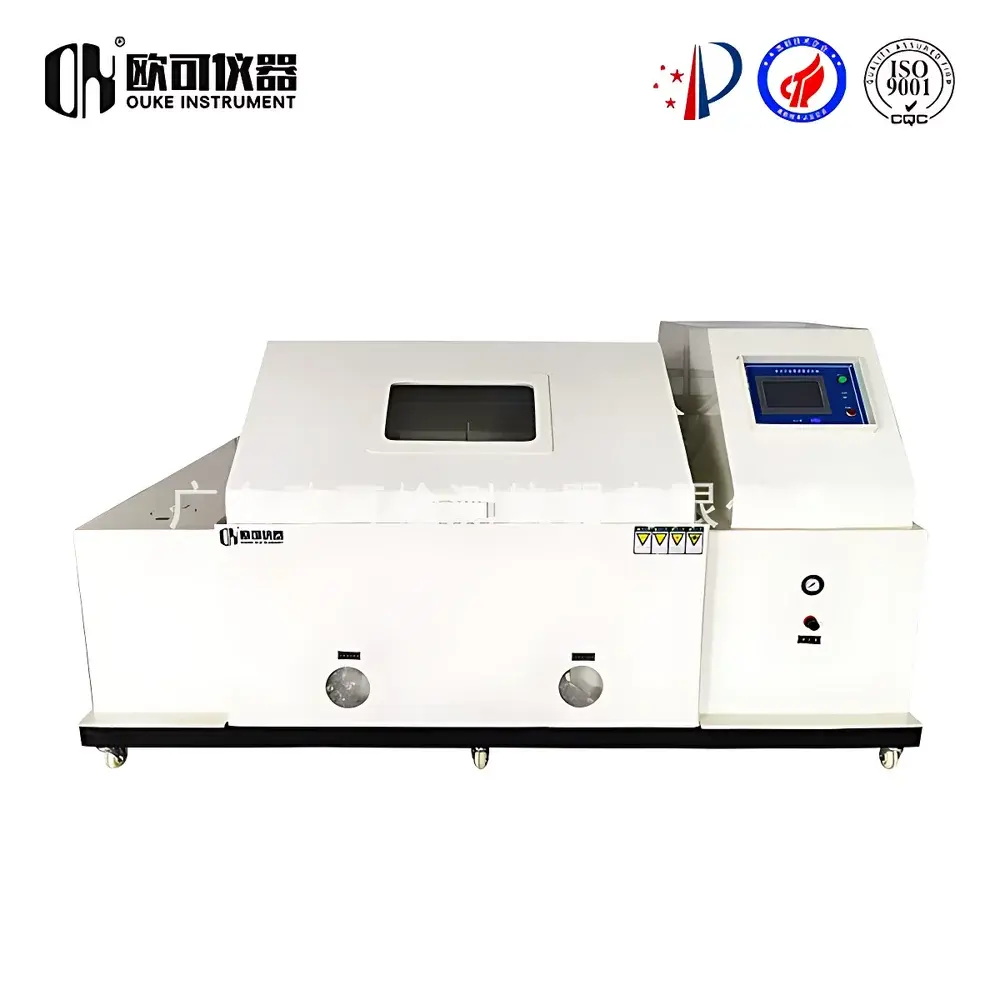
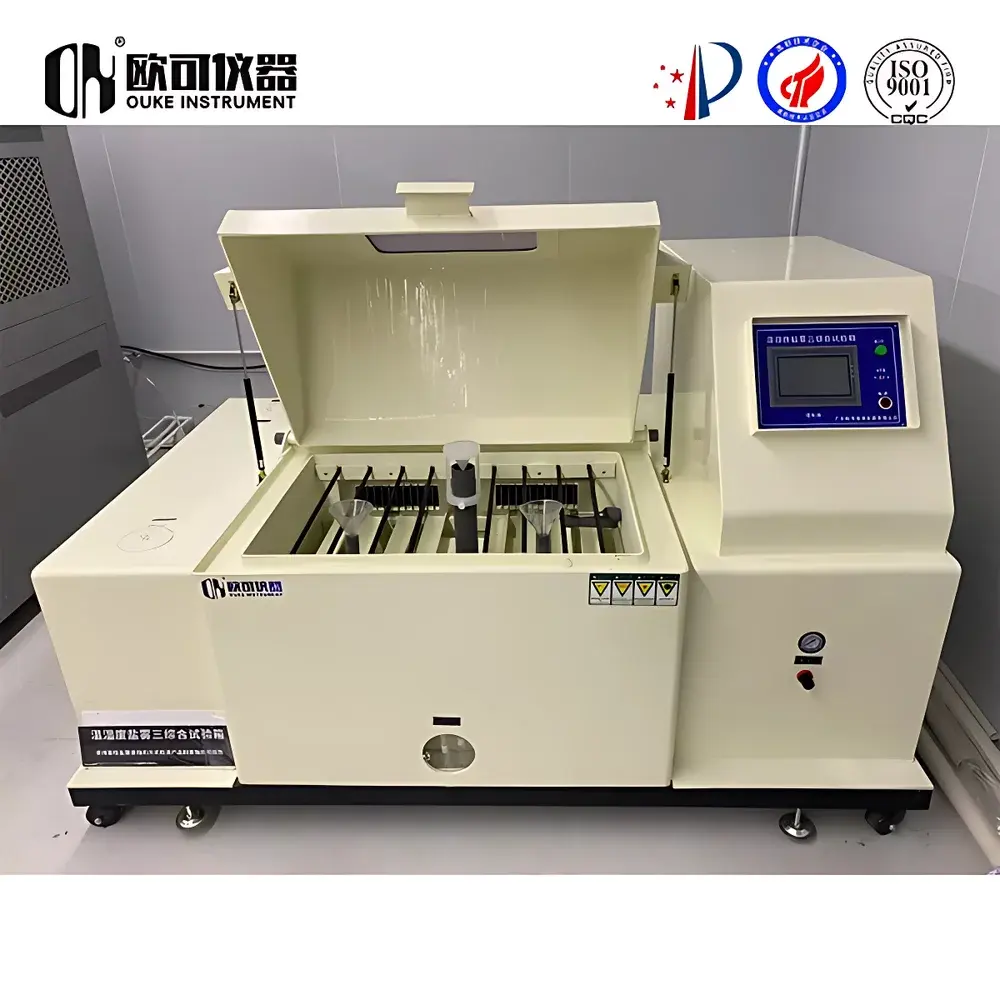
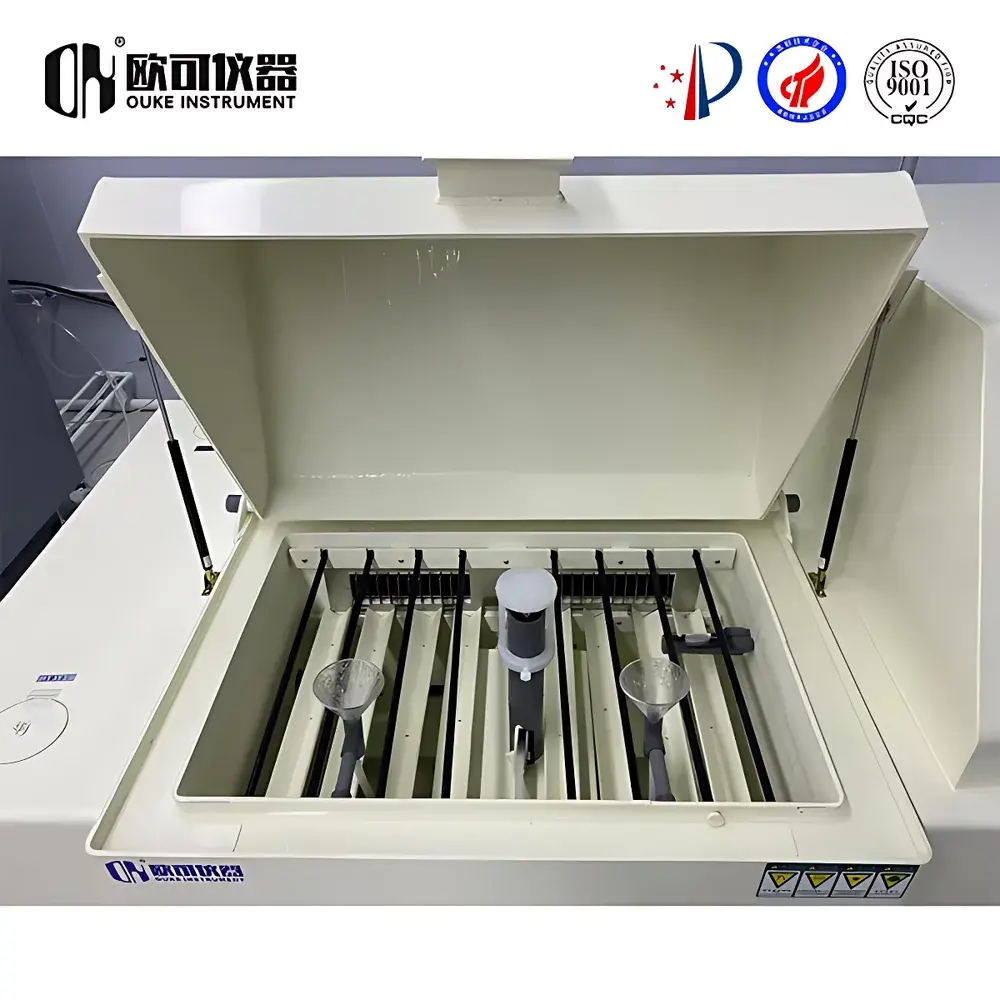
OK-FH-90.00 Triple-Integrated Environmental Test Chamber (Temperature/Humidity/Salt Spray)
| Brand | OK Instruments |
|---|---|
| Origin | Guangdong, China |
| Manufacturer Type | OEM/ODM Producer |
| Model | OK-FH-90.00 |
| Spray Mode | Continuous Atomization |
| Salt Solution Delivery Rate | 1–2 mL / 80 cm²·hr |
| Nozzle Pressure | 0.7–1.0 kg/cm² |
| Fog Removal Method | Pneumatic Air-Scavenging Exhaust |
| Salt Fog Deposition Rate | ~1.0–2.0 mL/80 cm²·hr (ASTM B117-compliant range) |
| Temperature Range Options | A: 0–80°C |
| B | −20–80°C |
| C | −40–80°C |
Overview
The OK-FH-90.00 Triple-Integrated Environmental Test Chamber is an engineered platform for accelerated corrosion testing under dynamically coupled thermal, hygric, and saline stress conditions. Unlike conventional single-stress salt spray chambers (e.g., ASTM B117-compliant units), this system implements programmable multi-phase cyclic corrosion testing (CCT) — integrating neutral salt fog (NSS), drying, high-humidity storage, and sub-zero conditioning within a single sealed test volume. Its operational principle relies on sequential environmental modulation: precise thermodynamic control (via cascade refrigeration and PID-heated air distribution), gravimetrically calibrated salt solution atomization through corrosion-resistant nozzles, and active decontamination cycles to eliminate residual chloride carryover between phases. Designed for laboratory-grade reproducibility and long-term stability in aggressive chloride-laden atmospheres, the chamber enables predictive lifetime assessment of metallic substrates, coated systems, electronic enclosures, and automotive assemblies exposed to coastal, marine, or de-icing salt environments.
Key Features
- Triple-stress integration: Simultaneous or sequential control of temperature (−40°C to +80°C), relative humidity (10–98% RH), and neutral salt fog (pH 6.5–7.2, 5% NaCl w/v)
- Corrosion-resilient construction: Inner chamber fabricated from PP-H (polypropylene homopolymer) and titanium-clad stainless steel (AISI 316L with Ti-coated internal ductwork); all gaskets rated for continuous salt fog exposure per ISO 16750-4
- Contamination-avoidance architecture: Dedicated purge-and-dry phase between salt fog and humidity cycles; integrated compressed-air scavenging exhaust with inline HEPA + activated carbon filtration
- High-fidelity deposition control: Adjustable nozzle pressure (0.7–1.0 kg/cm²) and calibrated collection funnel array ensuring ±15% uniformity in salt fog deposition across 80 cm² test area (per ISO 9227 Annex A)
- Modular climate subsystems: Dual-stage refrigeration system (R404A/R23 cascade) for −40°C capability; steam-based humidification with condensate recovery; PID-controlled heating elements with thermal inertia compensation
- Industrial-grade controller: 10.1″ capacitive touchscreen HMI with embedded real-time OS; supports up to 999-step user-defined CCT profiles including GMW 14872, SAE J2334, and ISO 16750-4 compliant sequences
Sample Compatibility & Compliance
The OK-FH-90.00 accommodates test specimens up to 90 L volume (W600 × D500 × H300 mm), with standardized mounting fixtures for automotive fasteners, PCB assemblies, battery housings, and painted metal panels. It meets structural and functional requirements of key international standards: ASTM G85 Annex A1 (CCT-I), ISO 16750-4 (road vehicle environmental conditions), IEC 60068-2-52 (salt mist, cyclic), and VW PV1210. While not certified to FDA 21 CFR Part 11, its audit trail functionality (timestamped parameter logs, operator ID tagging, and profile version control) supports GLP-aligned validation protocols. All sensors — Pt100 Class A temperature probes, capacitive RH transducers (Vaisala HUMICAP®), and digital pressure transmitters — are NIST-traceable and field-calibration-capable.
Software & Data Management
The embedded OK-TestSuite™ software provides ISO/IEC 17025-aligned data integrity: automatic generation of CSV and PDF test reports with embedded metadata (chamber ID, operator, calibration due date, ambient lab conditions). Each cycle execution is logged with millisecond-resolution timestamps for temperature, humidity, and spray status. Remote monitoring via Ethernet (TCP/IP) enables integration into enterprise LIMS or MES platforms. Audit trails retain full history of parameter modifications, emergency stops, and maintenance alerts — supporting traceability for ISO 9001:2015 internal audits. Optional USB export allows offline analysis in MATLAB or Python-based corrosion modeling frameworks (e.g., electrochemical impedance spectroscopy correlation studies).
Applications
This chamber is deployed in R&D labs and quality assurance departments across sectors requiring high-fidelity corrosion prediction: automotive OEMs validating chassis components against GMW 14872 10-cycle protocols; aerospace suppliers qualifying aluminum alloy fasteners per MIL-STD-810H Method 509.6; photovoltaic manufacturers testing junction box ingress protection (IP67) under IEC 61215 thermal cycling + salt mist sequences; and electronics manufacturers evaluating conformal coating durability per IPC-J-STD-001. Its ability to replicate diurnal moisture condensation followed by chloride-induced galvanic degradation makes it especially valuable for assessing interconnect reliability in EV battery modules and 5G outdoor base stations.
FAQ
What distinguishes the OK-FH-90.00 from a standard salt spray cabinet?
It performs fully automated, multi-phase cyclic corrosion tests — not just static NSS exposure — with controlled transitions between salt fog, drying, and humid soak phases, eliminating cross-contamination via active purge cycles.
Can it run GMW 14872 Cycle A without modification?
Yes — preloaded profiles include GMW 14872 Cycle A (24-hr salt fog → 24-hr dry → 24-hr humid soak), with adjustable ramp rates and dwell tolerances per specification.
How is salt residue removed before humidity cycles?
A dedicated 15-min air-sweep phase at 60°C with >12 air changes per hour evacuates residual aerosol, followed by desiccant-assisted dew point reduction to <5°C prior to RH ramp-up.
Are temperature and humidity sensors recalibratable onsite?
Yes — all Pt100 and capacitive RH sensors feature two-point field calibration routines accessible via service menu with documented uncertainty budgets.
Does the system support remote validation and IQ/OQ documentation?
OK Instruments provides vendor-qualified IQ/OQ templates aligned with ASTM E2500 and ISO/IEC 17025, including sensor mapping reports, uniformity verification protocols, and alarm response validation checklists.



