
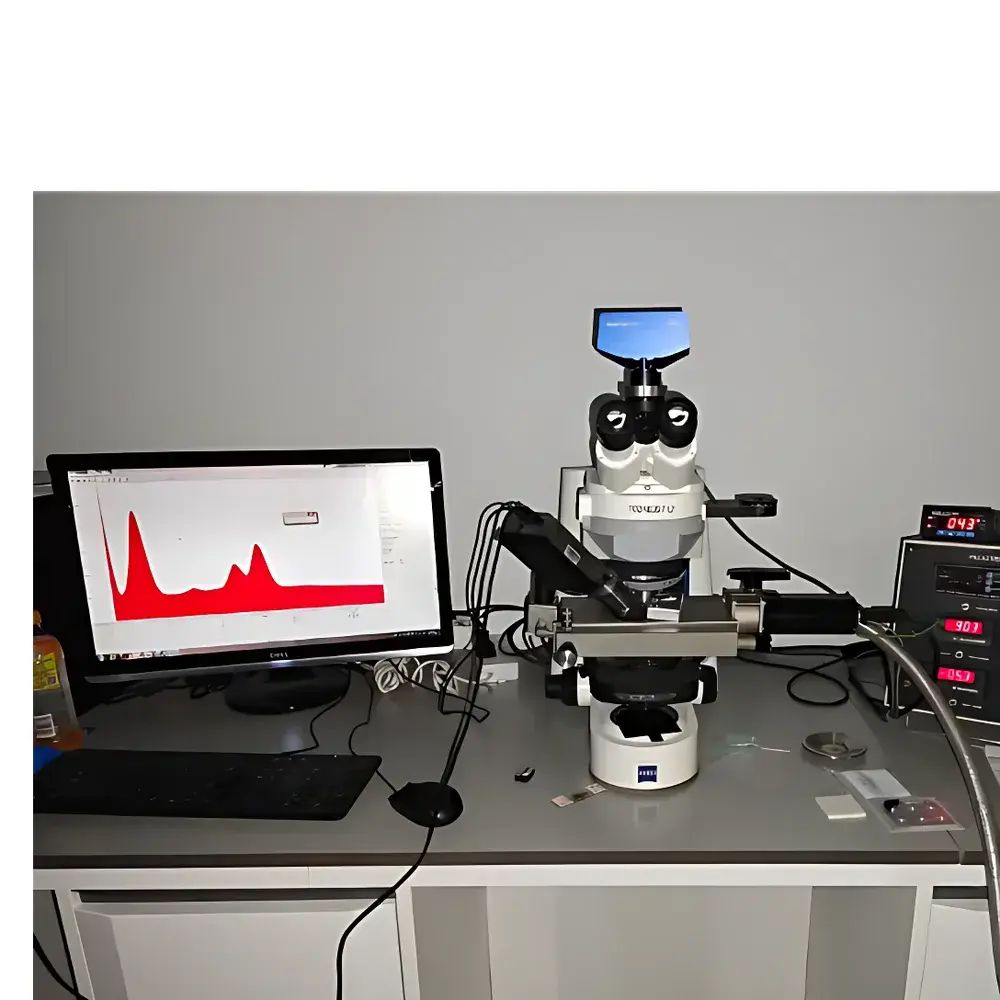
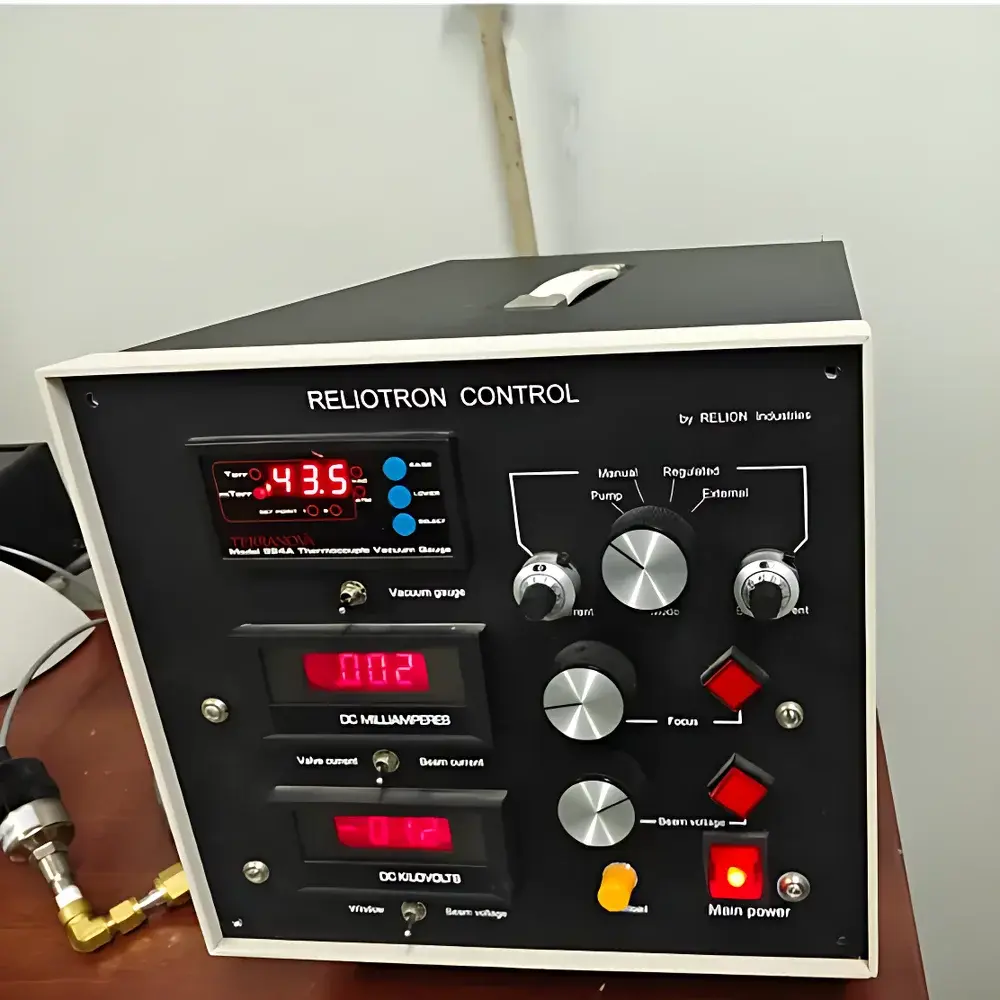
RELION V CL Cathodoluminescence Instrument
| Brand | RELION |
|---|---|
| Origin | USA |
| Manufacturer Type | Authorized Distributor |
| Product Category | Imported |
| Model | RELION V CL |
| Component Type | Cathodoluminescence Detection System |
| Beam Voltage Range | 0–30 kV (continuously adjustable, typically operated ≤25 kV) |
| Beam Current Range | 0–1.5 mA (continuously adjustable with overload protection) |
| Vacuum Level | ≥0.25 mbar |
| Focusing Spot Size | Down to 0.1 mm (point focus) |
| Vacuum Chamber Material | Non-magnetic, inert-gas welded stainless steel |
| Observation Window | 40 mm diameter circular lead-glass viewport (3 mm thick), plus optional 20 mm concave window |
| Sample Stage Capacity | Accommodates up to three standard optical slides (50.8 mm × 76.2 mm) or two elongated thin-sections |
| Power Requirement | ≥800 W |
| Compatibility | Designed for integration with optical microscopes, SEM-compatible mounting interfaces, and modular spectroscopic detection units |
Overview
The RELION V CL Cathodoluminescence Instrument is a high-performance, electron-beam-excited luminescence detection system engineered for quantitative spatially resolved optical emission analysis in materials science, geology, semiconductor research, and nanophotonics. Operating on the principle of cathodoluminescence—where incident electrons generate photon emission from luminescent materials—the RELION V CL delivers controlled, stable excitation across a broad energy range (0–30 kV beam voltage, 0–1.5 mA beam current). Its design emphasizes reproducible beam delivery, vacuum integrity, and seamless integration with optical microscopy platforms. The system employs a non-magnetic, inert-gas-welded stainless-steel vacuum chamber, ensuring magnetic field immunity critical for concurrent electron-optical correlation experiments. With a base vacuum level of ≥0.25 mbar maintained by a dual-stage rotary vane pump equipped with a mist eliminator, the instrument supports both ambient inert gas purging and high-stability low-vacuum operation—enabling compatibility with air-sensitive or insulating samples without mandatory conductive coating.
Key Features
- Precisely tunable electron optics: Integrated focusing coil enables continuous adjustment from sub-0.1 mm point focus to wide-field defocused illumination—essential for correlating microstructural features with spectral response.
- Programmable beam steering: Electromagnetic deflection system allows arbitrary rastering or static positioning of the electron probe, supporting line scans, area mapping, and region-of-interest targeting.
- Dual-mode observation interface: Standard 40 mm Ø lead-glass viewport (3 mm thickness, X-ray shielding compliant) plus optional 20 mm concave window for enhanced angular collection efficiency in directional CL studies.
- Modular sample handling: Precision-machined stage accommodates up to three standard microscope slides (50.8 mm × 76.2 mm) or two extended thin sections—facilitating comparative analysis and multi-condition screening under identical beam parameters.
- Integrated digital control architecture: Centralized main control unit provides real-time digital readouts and fine-grained analog adjustment of beam voltage, current, vacuum pressure, and electromagnetic lens currents—designed for GLP-compliant experimental logging.
- High-power, thermally stable platform: Rated ≥800 W power supply ensures consistent beam performance during extended acquisition cycles, with thermal management optimized to minimize drift in beam position and intensity.
Sample Compatibility & Compliance
The RELION V CL is compatible with a broad spectrum of solid-state specimens—including geological thin sections, semiconductor wafers, phosphor coatings, quantum dot arrays, and ceramic scintillators. Its non-magnetic vacuum chamber and flexible grounding architecture permit direct coupling with upright or inverted optical microscopes, as well as integration into custom SEM-CL or STEM-CL configurations. The system meets mechanical and electrical safety requirements per IEC 61010-1 and incorporates interlocked vacuum monitoring per ISO 27462 for operational hazard mitigation. While not an FDA-regulated device, its digital control interface supports audit-trail-capable parameter logging aligned with 21 CFR Part 11 principles when paired with validated third-party data acquisition software. Vacuum components comply with ASTM E595 outgassing specifications for ultra-high-purity environments.
Software & Data Management
The RELION V CL operates via hardware-synchronized analog control signals, enabling synchronization with external spectrometers (e.g., Horiba iHR, Andor Shamrock), ICCD/EMCCD detectors, and stage controllers. While the base system does not include proprietary acquisition software, it provides standardized TTL and analog I/O ports (0–10 V, ±10 V) for integration into LabVIEW, Python (PyVISA), or MATLAB-based automation frameworks. All operational parameters—including beam voltage, current, vacuum pressure, and lens currents—are accessible as real-time analog outputs, permitting time-stamped logging in accordance with ISO/IEC 17025 documentation standards. Optional firmware upgrades support trigger-locked spectral acquisition and coordinate-mapped hyperspectral CL imaging workflows.
Applications
- Quantitative defect mapping in III–V and II–VI semiconductors (e.g., GaN dislocation identification, InP quantum well uniformity assessment)
- Spatially resolved rare-earth activation analysis in phosphors and down-conversion materials
- Trace-element zonation and growth banding characterization in zircon, apatite, and carbonate minerals
- Nanoscale plasmonic mode visualization in metallic nanostructures and metamaterials
- Interface recombination kinetics evaluation at heterojunctions in perovskite solar cell absorbers
- Beam-induced luminescence stability testing for radiation-hardened optoelectronic components
FAQ
Is the RELION V CL compatible with scanning electron microscopes (SEM)?
Yes—the system is designed for standalone use or SEM integration via standard flange interfaces (CF-63 or KF-40). Beam alignment and vacuum interlocks can be configured to synchronize with SEM column operation.
What vacuum level is required for optimal CL signal-to-noise ratio?
While the system achieves stable operation at ≥0.25 mbar, optimal spectral resolution and reduced surface charging are achieved at ≤0.1 mbar; users may upgrade to a turbomolecular pump package for high-vacuum CL applications.
Can the instrument be used with cryogenic stages?
The non-magnetic chamber and feedthrough layout support integration with commercial cryo-stages (e.g., Gatan Alto, Quorum PP3010T); thermal contraction compensation must be applied during stage calibration.
Does the system include spectral detection hardware?
No—the RELION V CL is a beam-generation and sample-excitation platform only. Spectral collection requires external monochromators, spectrometers, or photomultiplier tube assemblies, connected via the viewport or fiber-coupled ports.
Is remote operation supported?
All analog control lines and status signals are accessible via DB-25 or terminal block connectors, enabling full remote operation through programmable logic controllers (PLCs) or PC-based DAQ systems.



