
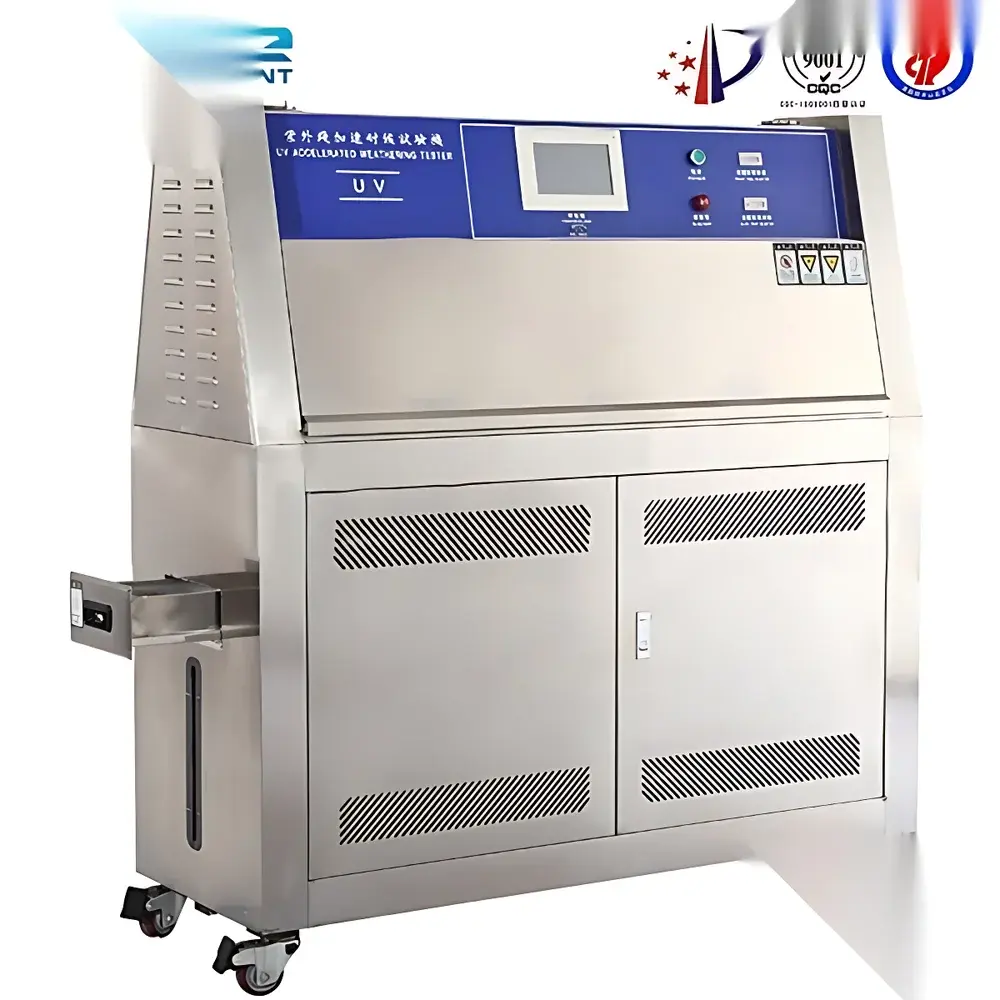
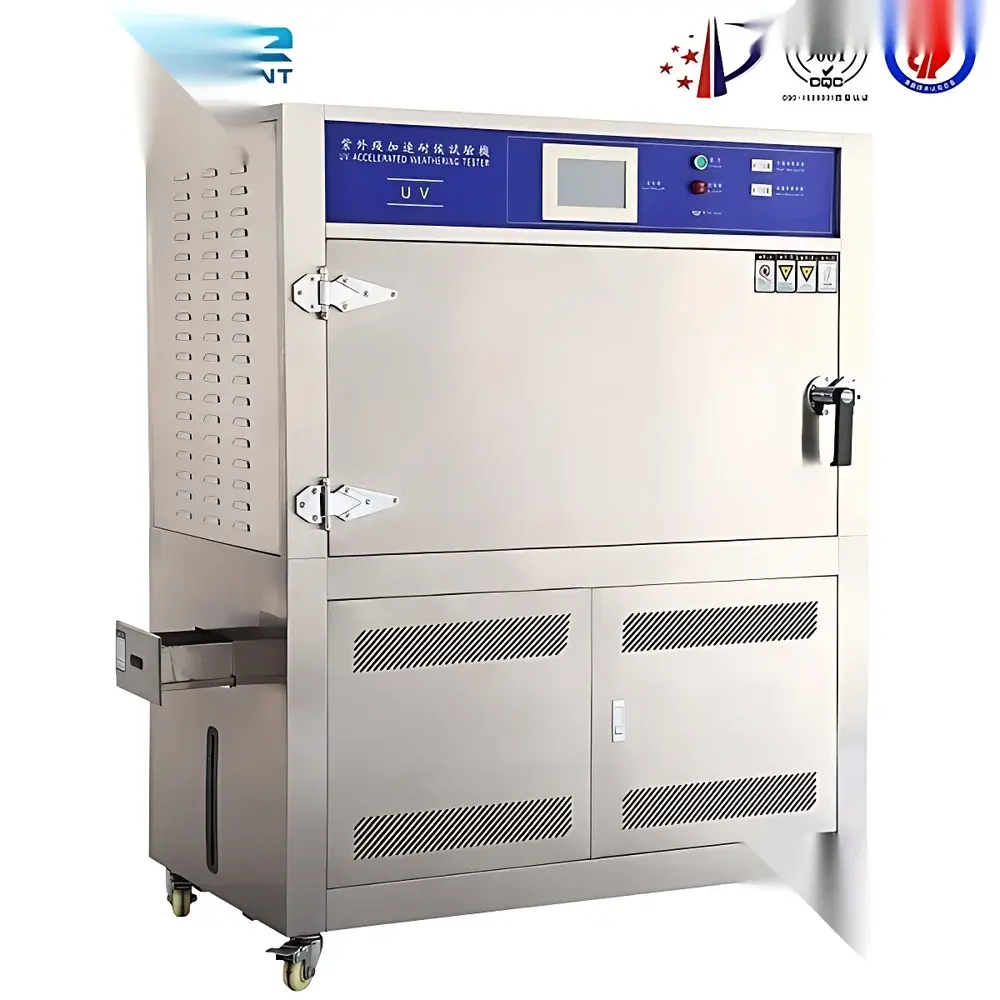
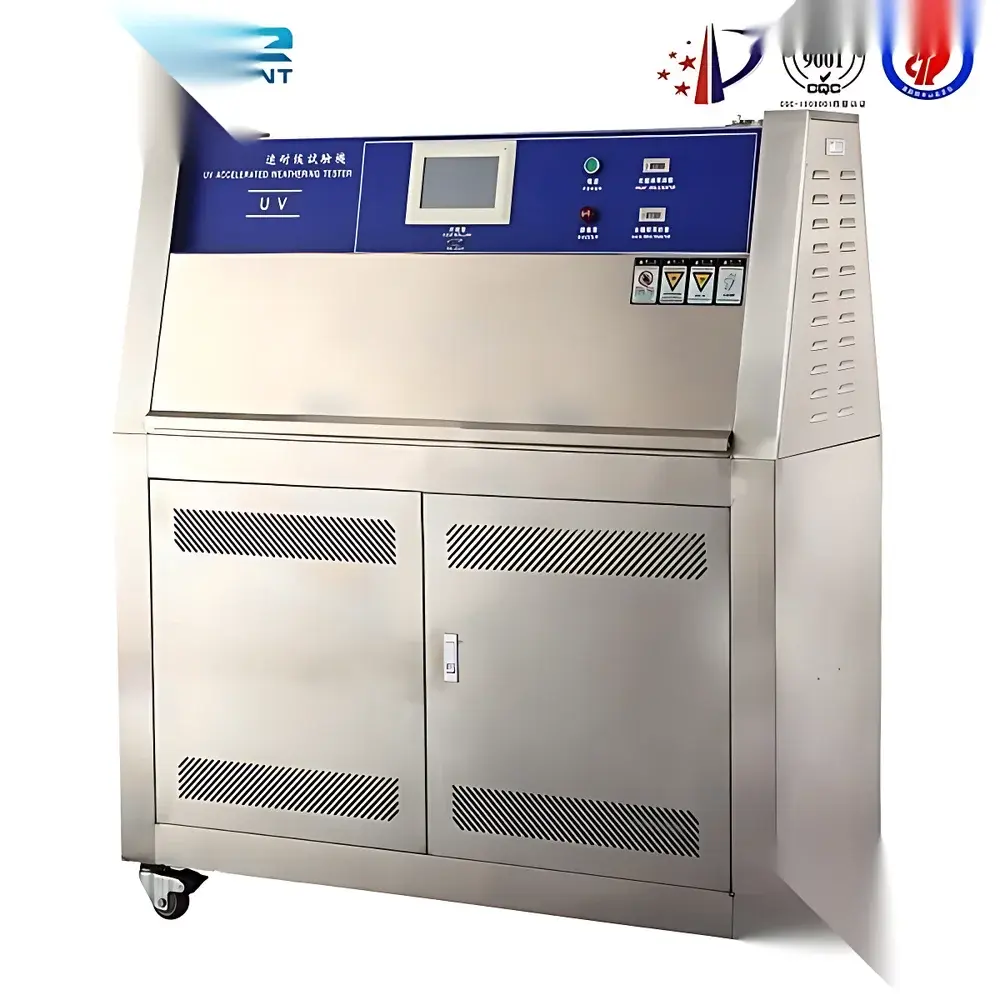
OK-UV-290 UV Aging Test Chamber
| Brand | Other Brands |
|---|---|
| Origin | Imported |
| Manufacturer Type | General Distributor |
| Price | USD 3,100 (approx.) |
| Model | OK-UV-290 |
| Interior Dimensions (W×H×D) | 114 × 40 × 40 cm |
| Exterior Dimensions (W×H×D) | 135 × 140 × 65 cm |
| Temperature Range | Ambient to 70 °C |
| Humidity Range | ≥95% RH |
| Temperature Control Accuracy | ≤±0.5 °C |
| Temperature Uniformity | ≤±2 °C or ≤±3% |
| UV Light Source | Fluorescent UV Lamps (UVA-340 or UVB-313 typical) |
| UV Wavelength Range | 280–400 nm |
| Lamp Lifetime | ~2,000 hours |
| Exposure Time Range | 0–999 hours (adjustable) |
| Chamber Material | SUS#304 Stainless Steel (inner & outer) |
| Heating System | U-shaped Titanium Alloy Heaters |
| Safety Features | Interlocked Door Cut-off, Over-Temperature Protection, Low-Water Level Protection |
| Power Supply | AC 220 V ±5%, 50 Hz |
Overview
The OK-UV-290 UV Aging Test Chamber is a precision-engineered environmental test system designed to accelerate photodegradation of polymeric, coated, and organic materials under controlled ultraviolet radiation, temperature, and humidity conditions. It operates on the principle of fluorescent UV irradiation—primarily using UVA-340 (simulating solar UV down to 295 nm) or UVB-313 (extending into shorter, more aggressive wavelengths)—combined with cyclic condensation (100% RH, 40–60 °C) and optional water spray to replicate key outdoor weathering stressors: solar photon energy, thermal cycling, moisture absorption, and hydrolytic degradation. Unlike xenon arc or carbon arc testers, this chamber emphasizes spectral fidelity in the critical 280–400 nm range where most polymer chain scission, photooxidation, and chromophore degradation occur. Its design supports repeatable, inter-laboratory comparable data generation aligned with internationally recognized accelerated weathering protocols.
Key Features
- Fluorescent UV lamp array with standardized spectral output (UVA-340 or UVB-313), calibrated per ASTM G154 Annex A1 for irradiance uniformity across specimen plane
- Integrated condensation cycle via heated water reservoir and controlled chamber wall temperature—enabling sustained 100% RH exposure without external humidification systems
- Precise PID-controlled temperature regulation (ambient to 70 °C) with ≤±0.5 °C accuracy and ≤±2 °C uniformity over working volume
- SUS#304 stainless steel construction (both interior and exterior) ensures corrosion resistance, long-term dimensional stability, and compliance with cleanroom-compatible maintenance practices
- Interlocked safety circuitry: automatic UV lamp shutdown upon door opening; independent over-temperature cutoff; low-water-level alarm and heater disable
- Programmable exposure timer (0–999 hours) with non-volatile memory retention for unattended operation and audit-ready session logging
Sample Compatibility & Compliance
The OK-UV-290 accommodates flat-panel specimens up to 110 cm wide × 35 cm high × 10 cm deep, mounted on adjustable stainless steel racks. It supports standard sample holders compliant with ASTM D6675 and ISO 4892-3 geometries. The chamber meets core regulatory and industry-standard requirements including ASTM G154 (Standard Practice for Operating Fluorescent Ultraviolet (UV) Lamp Apparatus for Exposure of Non-Metallic Materials), ASTM D4329 (Standard Practice for Fluorescent UV Exposure of Plastics), ASTM D4587 (Standard Practice for Fluorescent UV-Condensation Exposures of Paint and Related Coatings), ISO 4892-3 (Plastics — Methods of Exposure to Laboratory Light Sources — Part 3: Fluorescent UV Lamps), SAE J2020 (Surface Vehicle Standard for UV Exposure of Automotive Materials), and ASTM D4799 (Standard Test Method for Accelerated Weathering of Pressure-Sensitive Tapes). Its architecture supports GLP-compliant testing when integrated with external data loggers meeting FDA 21 CFR Part 11 requirements for electronic records.
Software & Data Management
While the OK-UV-290 features a standalone digital controller with real-time display of chamber temperature, elapsed exposure time, and lamp status, it is compatible with third-party data acquisition systems via RS-485 or analog 4–20 mA outputs (optional interface module required). Users may configure multi-step test profiles—including UV-only, UV/condensation, and UV/spray sequences—with timestamped event logging. For full traceability, integration with laboratory information management systems (LIMS) enables automatic import of exposure metadata (start/stop time, lamp batch ID, calibration date) into material qualification dossiers. All control firmware adheres to IEC 61508 functional safety principles for industrial controllers.
Applications
This chamber is routinely deployed in R&D and QC laboratories for predictive durability assessment across sectors: automotive OEMs validate exterior trim, headlamp lenses, and sealants per SAE J2020; coatings manufacturers qualify architectural and industrial paints against ASTM D4587; plastic compounders screen stabilizer packages (HALS, UVAs) for PP, ABS, and PC formulations; adhesive developers assess bondline integrity under UV/moisture synergy; and medical device suppliers evaluate polymer housing yellowing per ISO 10993-12. It is also used in academic polymer physics research to correlate Norrish Type I/II reaction kinetics with Arrhenius-based lifetime modeling.
FAQ
What UV lamp types are supported, and how often must they be replaced?
The chamber accepts standard 40 W fluorescent UV lamps (e.g., Q-Panel UVA-340 or UVB-313). Lamp output degrades over time; replacement is recommended every 2,000 hours of operation or after 6 months of continuous use—whichever occurs first—to maintain irradiance within ±10% of initial specification.
Can the OK-UV-290 perform water spray cycles?
Yes—the optional water spray kit enables intermittent aqueous exposure synchronized with dark cycles, simulating thermal shock and surface erosion effects per ASTM D5208.
Is calibration documentation provided with shipment?
Each unit ships with a factory calibration certificate covering temperature sensor accuracy (NIST-traceable RTD), timer linearity, and lamp socket voltage. On-site recalibration services are available through authorized service partners.
How is specimen temperature monitored during testing?
Black panel thermometers (BPT) or insulated black standard thermometers (BST) are placed adjacent to samples per ASTM G151 to measure radiant temperature rise—critical for correlating lab data to field performance.
Does the chamber support remote monitoring or network connectivity?
The base model includes local control only; Ethernet or Wi-Fi modules can be added as field-upgradable options for SNMP-based status polling and SMTP alerting.



