
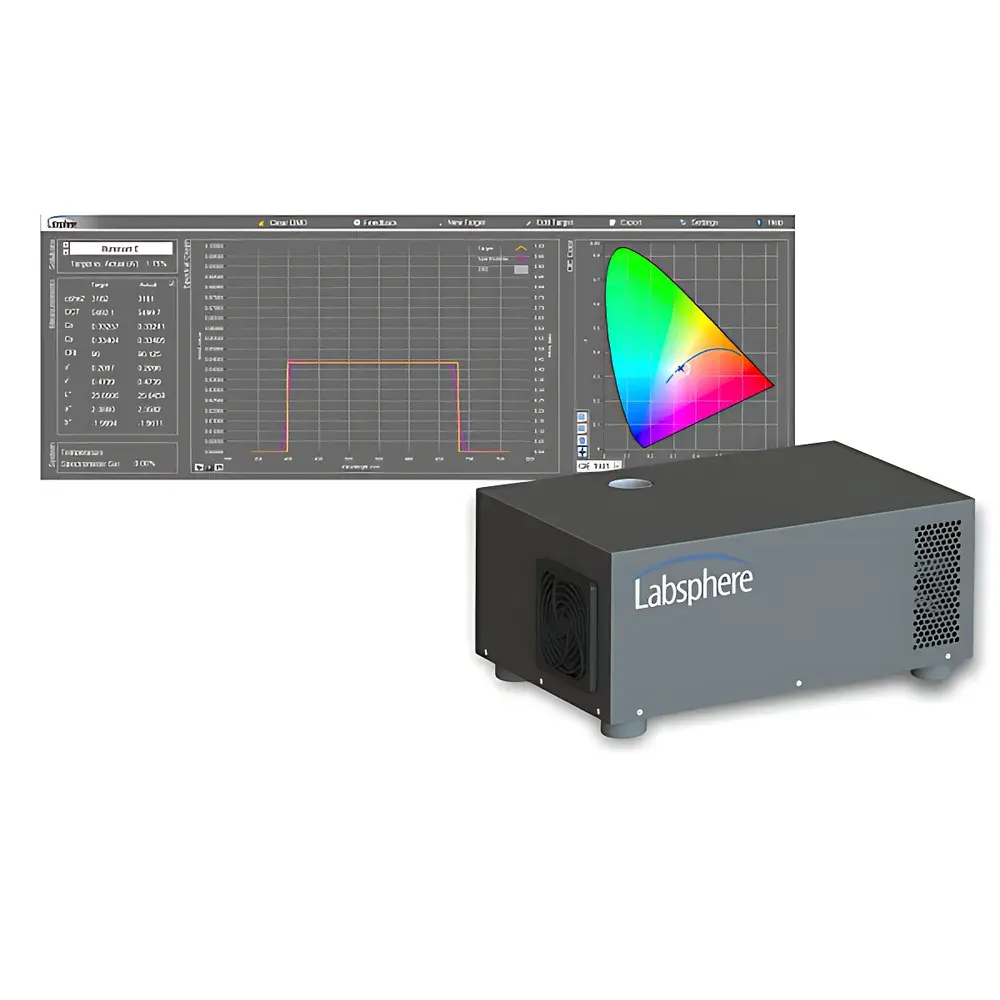
Labsphere Spectra-UT Ultra-Spectral Calibration Integrating Sphere Source
| Brand | Labsphere |
|---|---|
| Origin | USA |
| Model | Spectra-UT |
| Light Source Type | Tunable Solid-State Spectral Source |
| Illumination Mode | External Illumination |
| Spectral Range | 390–780 nm |
| FWHM | 12 nm ± 2 nm |
| Peak Wavelength Spacing | 0.4 nm |
| Spectral Accuracy | < 0.5 nm |
| Max Luminance | 1000 cd/m² |
| Luminance Adjustment Range | 25–1000 cd/m² |
| Luminance Uniformity | ≥99% |
| Max Spectral Scan Rate | < 1.0 spectrum/sec |
Overview
The Labsphere Spectra-UT Ultra-Spectral Calibration Integrating Sphere Source is an engineered reference illumination system designed for metrologically traceable spectral radiance calibration in optical measurement laboratories. Built upon Labsphere’s decades of expertise in integrating sphere technology and spectral radiometry, the Spectra-UT employs a stabilized quartz-tungsten-halogen (QTH) broadband source coupled with a high-resolution monochromator and real-time feedback-controlled solid-state spectral shaping architecture. Unlike conventional broadband or LED-based sources, the Spectra-UT generates programmable, high-fidelity spectral power distributions (SPDs) by sequentially scanning and recombining narrowband spectral components—enabling precise reproduction of complex, non-Lambertian, or time-varying SPDs across the visible spectrum (390–780 nm). Its core application lies in calibrating and validating colorimetric and spectroradiometric instruments—including imaging colorimeters, spectrophotometers, hyperspectral cameras, and photopic/photobiological sensors—where spectral fidelity, spatial uniformity, and traceability to NIST-traceable standards are mandatory.
Key Features
- Programmable spectral output with 0.4 nm peak wavelength resolution and < 0.5 nm absolute spectral accuracy, certified via integrated NIST-traceable QTH reference lamp and onboard calibration-grade spectrometer
- High spatial uniformity (>99% over 95% of exit port area), compliant with CIE Publication 15 and ISO/CIE 11664-1 for uniform field generation
- Dynamic luminance control from 25 to 1000 cd/m² with stability better than ±0.2% over 30 minutes (2σ)
- Full spectral scan rate up to 0.95 spectra per second, supporting rapid instrument characterization protocols
- Modular output interface compatible with fiber-optic light guides, collimators, and custom apertures for both flood and directional illumination configurations
- Integrated thermal management and active air stabilization ensure long-term spectral repeatability (<0.1% RMS drift over 8-hour operation)
Sample Compatibility & Compliance
The Spectra-UT is optimized for use with flat-field imaging systems, display metrology setups (OLED, MicroLED, LCD), and optical sensor arrays requiring spectrally resolved irradiance or radiance input. It supports standard 50 mm and 100 mm integrating sphere exit ports and interfaces seamlessly with commercial goniophotometers and automated test benches. All spectral calibrations adhere to ASTM E308-23 (computing tristimulus values), ISO 13406-2 (display uniformity testing), and CIE S 014-2/E:2022 (spectral irradiance measurement uncertainty). The system includes full documentation for GLP/GMP audit readiness, including calibration certificates with uncertainty budgets and traceability chains to NIST SRM 2020 and 2021.
Software & Data Management
Control and spectral programming are executed via Labsphere’s SpectraView™ v4.2 software suite, a Windows-based application supporting SCPI command protocol for integration into LabVIEW, Python (PyVISA), or MATLAB environments. The software enables creation and storage of user-defined SPD libraries—including CIE illuminants (D50, D65, A, F series), display primaries, and custom daylight/skylight models—and exports spectral data in IES, CIE 15:2018, and CSV formats. Audit trails, calibration logs, and operator authentication comply with FDA 21 CFR Part 11 requirements when configured with optional electronic signature modules.
Applications
- Calibration and verification of imaging colorimeters and spectroradiometers used in display manufacturing QA
- Quantification of tristimulus value mismatch errors across multi-instrument fleets in global R&D labs
- Characterization of spectral responsivity for unfiltered and bandpass-filtered silicon, InGaAs, and photodiode-based sensors
- Optimization of display color gamut mapping and white point stability under variable ambient SPD conditions
- Validation of multispectral/hyperspectral camera channel crosstalk and spectral reconstruction algorithms
- Development and testing of human-centric lighting metrics (e.g., melanopic EDI, CQS, TM-30 Rf/Rg)
FAQ
Is the Spectra-UT suitable for calibrating instruments outside the visible range?
No—the Spectra-UT is optimized exclusively for the CIE photopic visible spectrum (390–780 nm); UV or NIR extensions require separate source modules not included in the base configuration.
Can it simulate pulsed or time-varying spectra?
Yes—via external TTL triggering and programmable dwell-time per wavelength step, enabling emulation of flickering displays or modulated lighting profiles.
What level of spectral uncertainty does the factory calibration provide?
The base calibration achieves k=2 expanded uncertainty of ±0.35 nm in wavelength and ±1.8% in relative spectral irradiance (390–700 nm), documented per ISO/IEC 17025 procedures.
Does the system support automated recalibration routines?
Yes—SpectraView™ includes scheduled self-check sequences using the internal QTH reference lamp, generating recalibration reports with pass/fail flags against user-defined thresholds.
Is mechanical integration with third-party goniometers supported?
Yes—standardized mounting flanges (ISO-KF 50 and CF-100) and digital I/O ports enable synchronized motion control and data acquisition in automated photometric test stations.



