
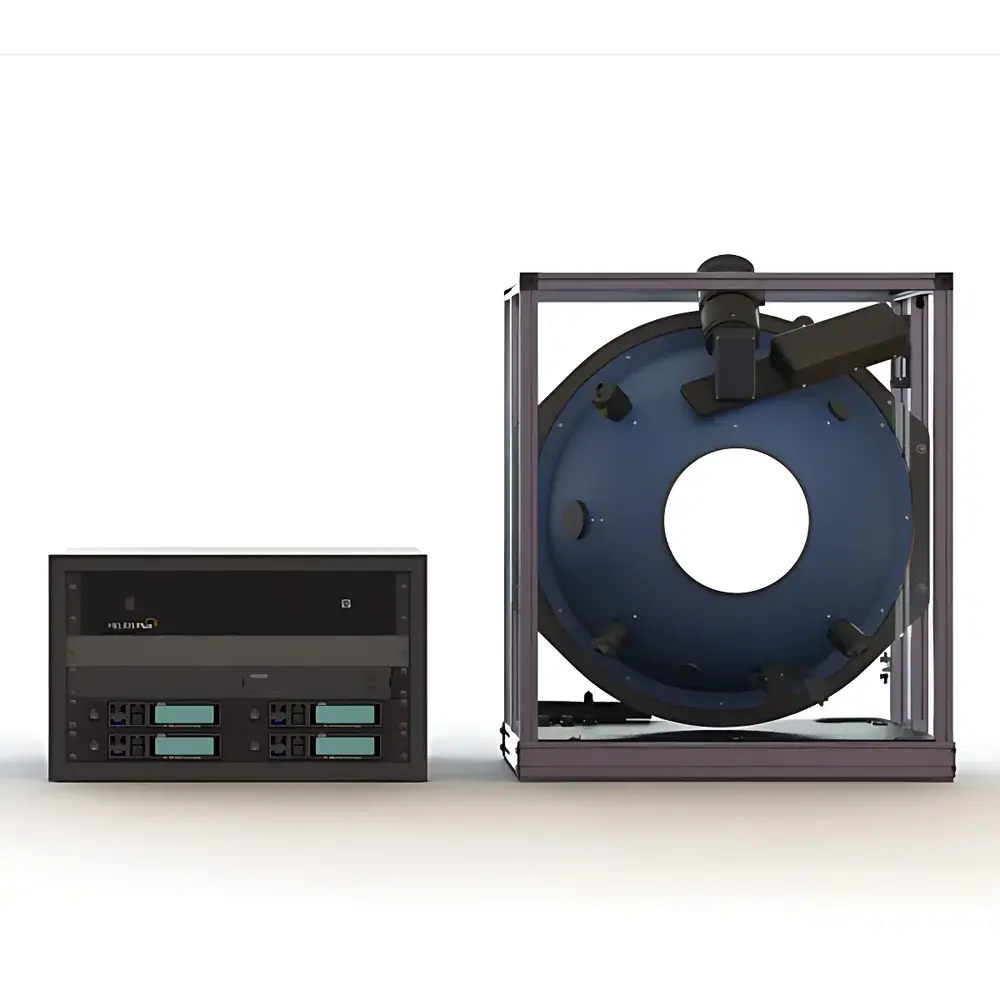
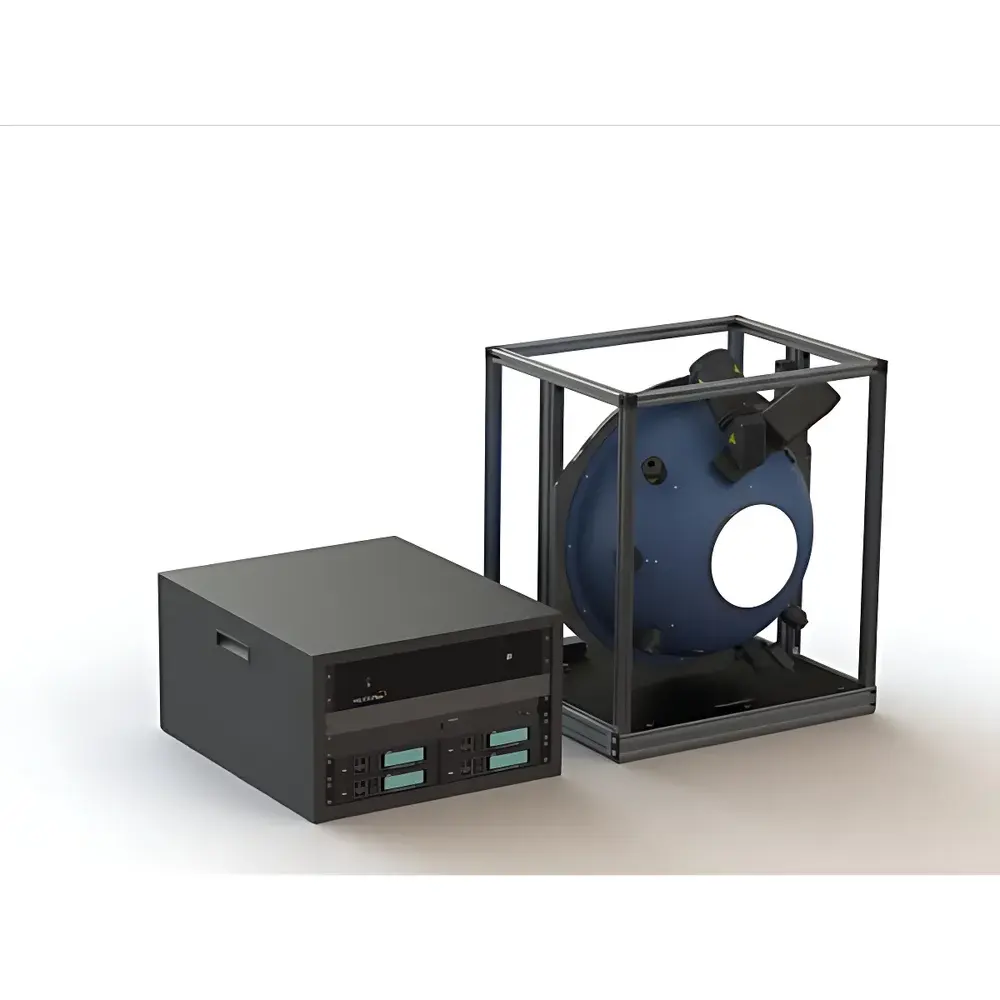
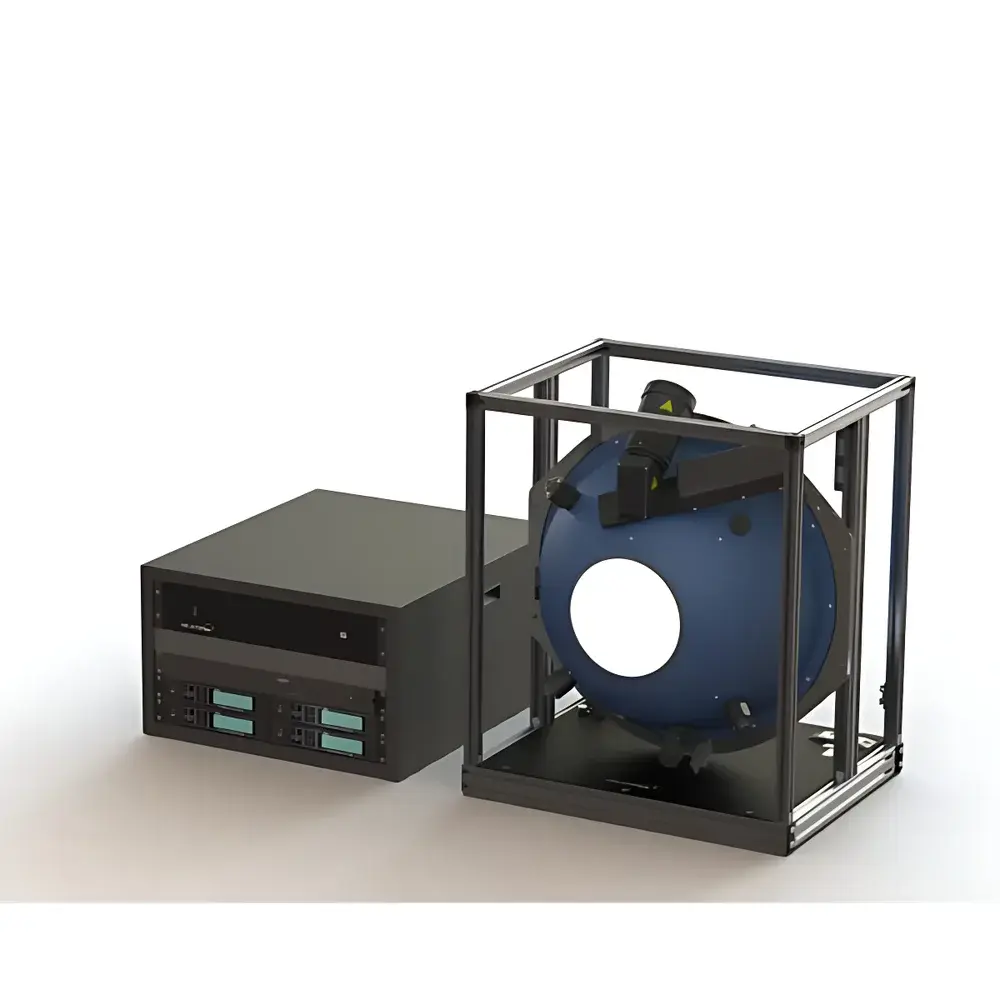
Labsphere Helios-D Series Large Dynamic Range Integrating Sphere Source
| Brand | Labsphere |
|---|---|
| Origin | USA |
| Model | Helios-D Series |
| Light Source Type | Tungsten-Halogen |
| CCT | 3000K ± 50K |
| Exit Port Diameter | 2", 4", or 8" |
| Max Luminance | Up to 80,000 cd/m² |
| Exit Port Illuminance | Up to 251,200 lux |
| Angular Uniformity (FOV) | ±2.0% within ±35° |
| Internal Coating | Spectraflect or Spectralon |
| Variable Attenuator Options | Advanced VAA-220A (2.00E+06 steps), Dynamic VAD-012/VAD-021 (2.40E+04–4.80E+04 steps), Manual VA-MM (2.00E+04–4.00E+04 steps) |
| Dynamic Range | Up to 160 dB (26-bit equivalent) |
| Software Interface | HELIOSense GUI with LSAPI support |
| Compliance | Designed for ASTM E308, ISO/CIE colorimetry standards, and GLP/GMP-aligned calibration traceability |
Overview
The Labsphere Helios-D Series Large Dynamic Range Integrating Sphere Source is a precision-engineered uniform light source system designed for radiometric, photometric, and colorimetric calibration of imaging sensors, cameras, displays, and optical test equipment. Built upon Labsphere’s legacy of integrating sphere metrology, the Helios-D platform utilizes stabilized tungsten-halogen lamps coupled with high-fidelity spectral filtering to deliver a stable, broadband blackbody-like spectrum centered at 3000K ± 50K — closely approximating daylight-to-low-light illumination conditions across an exceptionally wide luminance range. Unlike xenon or LED-based sources, the halogen architecture ensures continuous spectral output from 350 nm to 2500 nm with minimal temporal drift and high spatial uniformity. The core measurement principle relies on Lambertian emission from a highly reflective, spectrally neutral integrating sphere interior (Spectraflect or Spectralon), enabling repeatable, geometry-independent irradiance and radiance characterization. This makes the Helios-D Series particularly suited for applications demanding traceable, NIST-traceable calibrations under controlled thermal and electrical conditions.
Key Features
- Ultra-wide dynamic luminance range: up to 160 dB (26-bit equivalent), achieved via synchronized lamp power control and multi-stage variable optical attenuation
- Three attenuator configurations: Advanced VAA-220A (motorized, 2.00E+06 total resolution steps), Dynamic VAD-012/VAD-021 (closed-loop feedback-driven, 24k–48k steps), and Manual VA-MM (micrometer-driven, 20k–40k steps)
- Multiple exit port options: standardized 2″, 4″, and 8″ diameters, each optimized for specific field-of-view and throughput requirements
- High angular uniformity: ±2.0% spatial non-uniformity over ±35° full-angle field of view, validated per CIE 122 and ISO 13655
- Dual-coating compatibility: Spectraflect (high UV-VIS-NIR reflectance, matte finish) and Spectralon (ultra-high diffuse reflectance >99% in VIS-NIR, low BRDF dependency)
- Integrated thermal stabilization: active lamp current regulation and forced-air cooling ensure <±0.1% luminance drift over 4-hour operational periods
- Modular hardware architecture: all components communicate via Labsphere’s standardized LSAPI (Labsphere System Application Programming Interface), enabling seamless integration with third-party DAQ systems and custom test scripts
Sample Compatibility & Compliance
The Helios-D Series supports calibration of a broad class of optoelectronic devices, including CMOS/CCD image sensors, automotive ADAS cameras, medical endoscopes, smartphone front/rear cameras, and AR/VR microdisplays. Its spectral stability and geometric uniformity meet the foundational requirements of ASTM E308 (computing tristimulus values), ISO/CIE 11664 (colorimetry), and IEC 62676-5 (surveillance camera testing). While not intrinsically FDA-certified, the system’s architecture supports 21 CFR Part 11-compliant audit trails when deployed with validated HELIOSense software configurations and documented calibration procedures. All factory calibrations are traceable to NIST through Labsphere’s A2LA-accredited (ISO/IEC 17025) Metrology Lab. Custom characterization — including spectral radiance mapping, linearity verification, and stray-light profiling — is available upon request to satisfy application-specific uncertainty budgets per GUM (Guide to the Expression of Uncertainty in Measurement).
Software & Data Management
HELIOSense is the native graphical user interface for configuring, operating, and validating the Helios-D system. It provides real-time monitoring of lamp voltage/current, sphere temperature, attenuator position, and detector feedback signals. The software implements a responsive “Hunt & Seek” closed-loop algorithm that automatically adjusts lamp output and attenuator position to achieve and maintain a target radiance value within ±0.25% tolerance. Scripting capabilities (Python/Lua API bindings) allow integration into automated production test sequences or R&D validation workflows. All measurement data — including timestamped radiance values, spectral scans (when paired with optional USB spectroradiometers), and system configuration logs — are exported in CSV and HDF5 formats. Audit trail functionality records operator actions, parameter changes, and calibration events, supporting GLP and GMP documentation requirements. LSAPI compliance ensures plug-and-play recognition of auxiliary hardware such as reference detectors, shutter controllers, and environmental monitors.
Applications
- Radiometric calibration of scientific and industrial imaging systems across visible and near-infrared bands
- Dynamic range validation of HDR camera pipelines (e.g., automotive perception systems compliant with ISO 20653 and SAE J2945/1)
- Linearity and responsivity testing of photodetectors, pyroelectric sensors, and photodiode arrays
- Display uniformity and Mura defect analysis using calibrated luminance targets
- Development and verification of tone-mapping algorithms in computational photography
- Testing of low-light vision systems, night-vision goggle (NVG) compatibility, and scotopic luminance response
- Reference source for inter-laboratory comparison studies under ILAC-MRA frameworks
FAQ
What spectral range does the Helios-D Series cover?
The tungsten-halogen source emits continuously from approximately 350 nm to 2500 nm, with peak output near 1000 nm. Optional bandpass filters or dichroic mirrors can be integrated to isolate UV, VIS, or NIR sub-bands.
Is NIST traceability included with purchase?
Yes — each system ships with a factory calibration certificate traceable to NIST via Labsphere’s A2LA-accredited laboratory. On-site recalibration services and uncertainty budget reports are available separately.
Can the Helios-D be used for spectral radiance measurements?
When coupled with a calibrated spectroradiometer (e.g., Ocean Insight QE Pro or Instrument Systems CAS 140D), the Helios-D serves as a stable, uniform spectral radiance source for sensor spectral responsivity characterization.
How is thermal drift managed during extended operation?
The system incorporates dual-stage thermal regulation: closed-loop lamp current control maintains constant filament temperature, while integrated thermal sensors and variable-speed fans stabilize sphere wall temperature to ±0.5°C over 8-hour runs.
Does HELIOSense support remote automation in production environments?
Yes — HELIOSense exposes a full RESTful API and Python SDK. It has been deployed in automated test cells for Tier-1 automotive suppliers and smartphone OEMs, interfacing with NI TestStand, Keysight PathWave, and custom CI/CD pipelines.



