
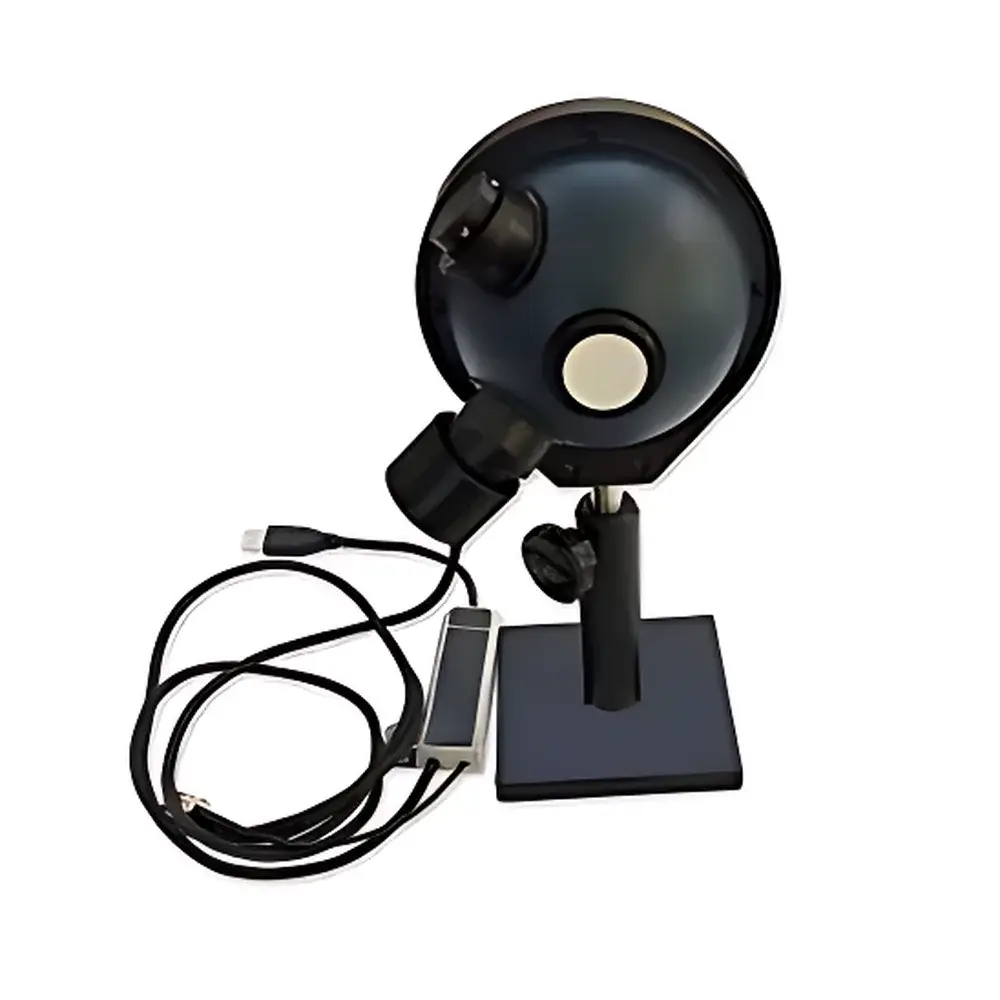
Labsphere LPMS Laser Power Measurement System with Integrating Sphere
| Brand | Labsphere |
|---|---|
| Origin | USA |
| Model | LPMS Laser Power Measurement System |
| Sphere Diameters | 2", 4", 6" |
| Detector Options | Silicon (Si), Indium Gallium Arsenide (InGaAs) |
| Spectral Range | 350–1700 nm |
| Power Range | ~1 nW to ~数百 W (dependent on configuration) |
| Calibration Traceability | NIST-traceable |
| Coating Materials | Spectraflect®, Infragold®, or Spectralon® |
| Input Port Angle | 45° relative to detector axis |
| Metrics Reported | Average Radiant Power (CW), Average Peak Radiant Power (Pulsed), COV (CW), Sampling Rate (Hz), Scan Interval (s), Power Density (W/cm²), Max/Min CW Power, Overrange Alert, Pulse Width, Repetition Rate, Standard Deviation (CW), System Responsivity Thresholds (min/max), Total Measurement Time, Pulse Count, Wavelength Selection (user-defined per calibration data) |
Overview
The Labsphere LPMS Laser Power Measurement System is an engineered solution for high-accuracy, repeatable radiant power quantification of lasers—including VCSELs, edge-emitting laser diodes, fiber-coupled emitters, and divergent monochromatic sources—across a broad spectral and power range. Built upon the fundamental principle of integrating sphere photometry, the system leverages near-Lambertian scattering from highly stable, spectrally neutral internal coatings (Spectraflect®, Infragold®, or Spectralon®) to spatially homogenize incident radiant flux. This geometry eliminates dependence on beam divergence, polarization state, pointing stability, or spatial profile—critical advantages when characterizing non-ideal or rapidly evolving laser sources such as pulsed VCSEL arrays or multimode diodes. The 45° detector port orientation further restricts field-of-view while preserving collection efficiency, enabling robust measurement of highly divergent beams without compromising radiometric accuracy. All LPMS configurations are calibrated against NIST-traceable standards, ensuring metrological integrity for ISO/IEC 17025-compliant laboratories and R&D environments requiring audit-ready documentation.
Key Features
- Three standard integrating sphere diameters (2″, 4″, and 6″) optimized for distinct power and spatial constraints—smaller spheres for low-power precision; larger spheres for high-power attenuation and thermal management.
- Dual-detector architecture: primary measurement port plus secondary port for concurrent spectral analysis (e.g., fiber-coupled spectrometer integration) or redundant power verification.
- Detector selection tailored to spectral coverage: silicon photodiodes for 350–1100 nm; extended-range InGaAs detectors for 900–1700 nm, each with documented responsivity curves and linearity validation per wavelength.
- Robust mechanical design featuring precision-machined aluminum housings, thermally stable mounting fixtures, and hardened fiber adapter interfaces compatible with SMA905, FC/PC, and custom collimator mounts.
- NIST-traceable calibration certificates provided for each configured sphere/detector/wavelength combination, including uncertainty budgets compliant with GUM (JCGM 100:2008) guidelines.
- Integrated optical baffling and port geometry to minimize stray light contributions and suppress first-surface reflections—essential for low-noise sub-nW measurements.
Sample Compatibility & Compliance
The LPMS system accommodates a wide array of laser sources under controlled laboratory conditions: continuous-wave (CW) and pulsed (nanosecond to microsecond pulse widths), single-emitter and multi-emitter VCSEL arrays, free-space and fiber-delivered beams, and divergent sources up to ±30° full-angle emission. It supports compliance workflows aligned with IEC 60825-1 (laser safety classification), ISO 11554 (laser beam parameter measurements), and ASTM E275 (standard practices for optical radiation measurements). For regulated environments—including FDA-regulated medical laser development and automotive LiDAR qualification—the system’s traceable calibration records, configurable audit logs, and deterministic measurement protocols support GLP and GMP documentation requirements. While not inherently 21 CFR Part 11 compliant, the LPMS hardware is fully compatible with validated third-party data acquisition software that implements electronic signatures, role-based access control, and immutable audit trails.
Software & Data Management
The LPMS operates via Labsphere’s proprietary LPMS Control Software (Windows-based), which provides real-time visualization of raw detector signals, auto-scaling waveform capture, and automated calculation of all standard radiometric metrics—including average CW power, peak pulsed power, coefficient of variation (COV), pulse count, repetition rate, and power density (requiring user-input beam area in cm²). Data export is supported in CSV, XML, and HDF5 formats, preserving metadata such as timestamp, wavelength setting, calibration ID, detector gain, and environmental temperature. The software enforces strict input validation (e.g., out-of-range wavelength alerts, saturation warnings, invalid pulse width entries) and logs all operator actions—including parameter changes and manual overrides—for retrospective traceability. Custom scripting interfaces (via .NET API) enable integration into automated test benches and LIMS platforms.
Applications
- VCSEL array characterization during wafer-level testing and package-level burn-in, where spatial uniformity and pulse-to-pulse stability are critical.
- Laser diode lifetime testing and accelerated aging studies, leveraging long-term drift monitoring with documented calibration stability (Spectralon®-coated spheres demonstrate <0.1% reflectance change/year).
- Medical laser source verification for dermatology, ophthalmology, and surgical systems—ensuring output consistency across regulatory submission batches.
- LiDAR emitter validation for autonomous vehicles, supporting both peak power and average power reporting at 905 nm and 1550 nm under realistic pulse repetition conditions.
- Calibration transfer between primary standards labs and end-user facilities, enabled by NIST-traceable intercomparisons and documented uncertainty propagation.
- Optical component R&D, including anti-reflection coating performance evaluation and fiber coupling efficiency mapping using dual-port configuration.
FAQ
What spectral ranges does the LPMS support, and how is wavelength selection handled?
The system covers 350–1700 nm via interchangeable detector modules. Users select the measurement wavelength prior to acquisition based on the calibrated responsivity curve for their specific detector/sphere combination—no real-time spectral scanning is performed.
Can the LPMS measure both CW and pulsed lasers simultaneously?
No—it operates in either CW or pulsed mode per acquisition session. However, dual acquisitions (one CW, one pulsed) can be sequenced automatically using script-driven workflows.
Is beam diameter or area input mandatory for all measurements?
Beam area input is required only when calculating power density (W/cm²); all other reported metrics (e.g., total radiant power in watts) are independent of beam geometry.
How often must the system be recalibrated?
Labsphere recommends annual recalibration for ISO/IEC 17025 compliance; however, stability testing shows typical drift <±0.3% per year for Spectralon®-coated spheres under controlled lab conditions.
Does the LPMS include provisions for environmental monitoring?
The base system does not integrate temperature or humidity sensors, but its software API supports external sensor input synchronization for environmental-correlated measurement logging.



