
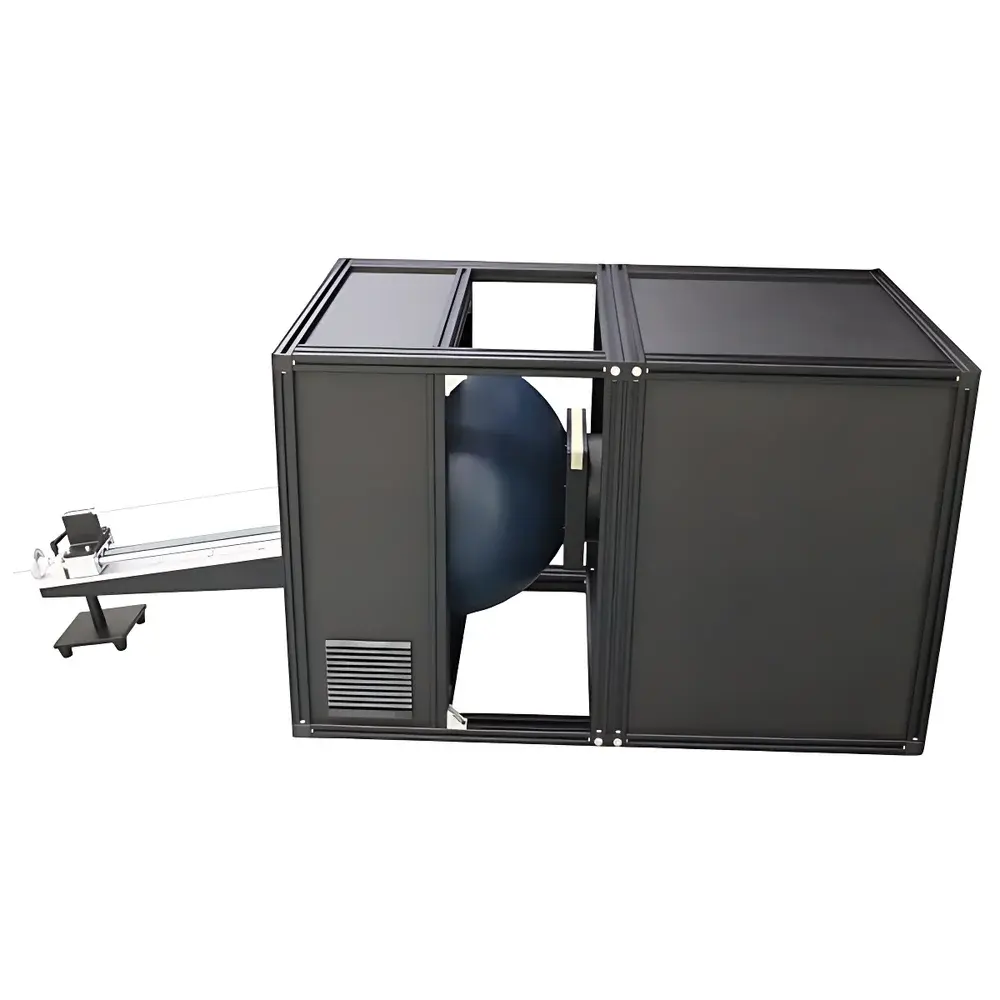
Labsphere CSTM-CM-PD Stray Light and Veiling Glare Test System
| Brand | Labsphere |
|---|---|
| Origin | USA |
| Manufacturer Type | Authorized Distributor |
| Product Category | Imported |
| Model | CSTM-CM-PD |
| Price Range | USD 1,400 – 140,000 |
Overview
The Labsphere CSTM-CM-PD Stray Light and Veiling Glare Test System is a precision-engineered optical measurement platform designed to quantify stray light performance of imaging lenses and optical systems in strict compliance with international and national standards—including ISO 9358:1994, GB/T 10988–2009 (issued by SAC and AQSIQ), and JB/T 8248.4–1999. The system implements the standardized veiling glare index (VGI) measurement methodology, which defines stray light as the ratio of illuminance at the image center when a black target (low-reflectance patch) is placed in a uniform extended field, versus the illuminance at the same location when replaced by a white target (high-reflectance patch), expressed as a percentage. This ratio—measured under controlled geometric and photometric conditions—serves as a critical metric for evaluating lens flare suppression, contrast degradation, and overall image fidelity in demanding applications such as aerospace imaging, medical endoscopy, surveillance optics, and machine vision.
Key Features
- Modular dual-integrating-sphere architecture: Primary uniform illumination sphere (coated with Spectraflect®—97% diffuse reflectance) and separate light-trap sphere for high-dynamic-range background suppression
- Configurable illumination sources: Optional tunable 3000–6000 K LED array (≥5000 lux at test plane) or broadband tungsten-halogen source (3000 K, ≥5000 lux), both integrated with high-stability DC current drivers and real-time illuminance monitoring
- Precision mechanical subsystem: Motorized linear translation stage with ±0.1 mm repeatability; motorized goniometric mount enabling full 0–180° continuous rotation of lens/camera assembly about both horizontal and vertical axes
- Calibrated imaging sensor: 12-bit monochrome CMOS camera (2448 × 2048 pixels), GigE interface with USB 3.0 bridge, optimized for low-noise photometric capture and spatially resolved gray-level analysis
- Optical path compensation: Built-in parallax correction algorithm accounting for sensor displacement induced by sample thickness and oblique incidence geometry
- Thermally stabilized drive electronics: Constant-current LED/tungsten drivers with active temperature regulation ensure spectral and radiometric stability over extended test durations
Sample Compatibility & Compliance
The CSTM-CM-PD accommodates lenses and optical assemblies ranging from 12 mm to 150 mm in diameter, with focal lengths from 4 mm to 1000 mm. It supports both fixed-mount and kinematic lens fixtures, enabling repeatable alignment under variable angle-of-incidence configurations. All operational parameters—including illuminance uniformity (>1000:1 center-to-edge ratio per GB/T 10988), spectral stability (±0.5% over 1 h), and angular positioning accuracy (±0.05°)—are traceable to NIST-calibrated reference standards. The system satisfies requirements for GLP-compliant testing environments and supports audit-ready documentation per ISO/IEC 17025 and FDA 21 CFR Part 11 when paired with validated software modules.
Software & Data Management
The system operates with Labsphere’s proprietary StrayLight Analysis Suite (SLAS v3.2+), a Windows-based application providing automated VGI calculation, ROI-based gray-level histogram extraction, background-subtracted image registration, and multi-point angular sweep sequencing. Raw image data are stored in TIFF-64 format with embedded EXIF metadata (exposure time, gain, lens orientation, illuminant CCT, and sphere calibration coefficients). SLAS generates compliant test reports conforming to GB/T 10988 Annex B and ISO 9358 Clause 6, including uncertainty budgets based on GUM (JCGM 100:2008) methodology. Export options include CSV, PDF/A-2, and XML for integration into LIMS or enterprise QA databases.
Applications
- Quantitative validation of anti-reflective coating efficacy across visible and near-IR bands
- Design verification of baffle geometry and internal blackening in telescope and satellite optics
- Production-line screening of automotive ADAS camera modules for ISO 16505 compliance
- Comparative evaluation of lens designs under standardized stray light stress conditions
- Supporting ISO 12233 resolution loss analysis where flare-induced MTF degradation is suspected
- Research-grade characterization of diffractive and hybrid refractive-diffractive optical elements
FAQ
What standards does the CSTM-CM-PD system support for stray light measurement?
It fully complies with ISO 9358:1994, GB/T 10988–2009, and JB/T 8248.4–1999, with built-in test sequences aligned to their respective VGI definitions and setup geometries.
Can the system measure lenses with large focal lengths or telecentric configurations?
Yes—the modular rail and goniometer design allows collimated beam simulation via external collimators, and the software supports custom chief-ray angle definition for telecentric and off-axis systems.
Is spectral irradiance calibration included?
Each system ships with a NIST-traceable spectroradiometric calibration certificate for the primary illumination sphere, covering 380–780 nm at 1 nm resolution.
How is dark current and thermal noise managed during long-exposure measurements?
The camera module includes Peltier cooling (ΔT = −15°C below ambient) and correlated double sampling (CDS), reducing dark signal to <0.5 e⁻/pix/s at 25°C.
Does the system support automated pass/fail judgment against user-defined VGI thresholds?
Yes—SLAS enables configurable acceptance criteria per lens model, with automated flagging, statistical process control (SPC) charting, and exportable SPC data in JMP- and Minitab-compatible formats.




