
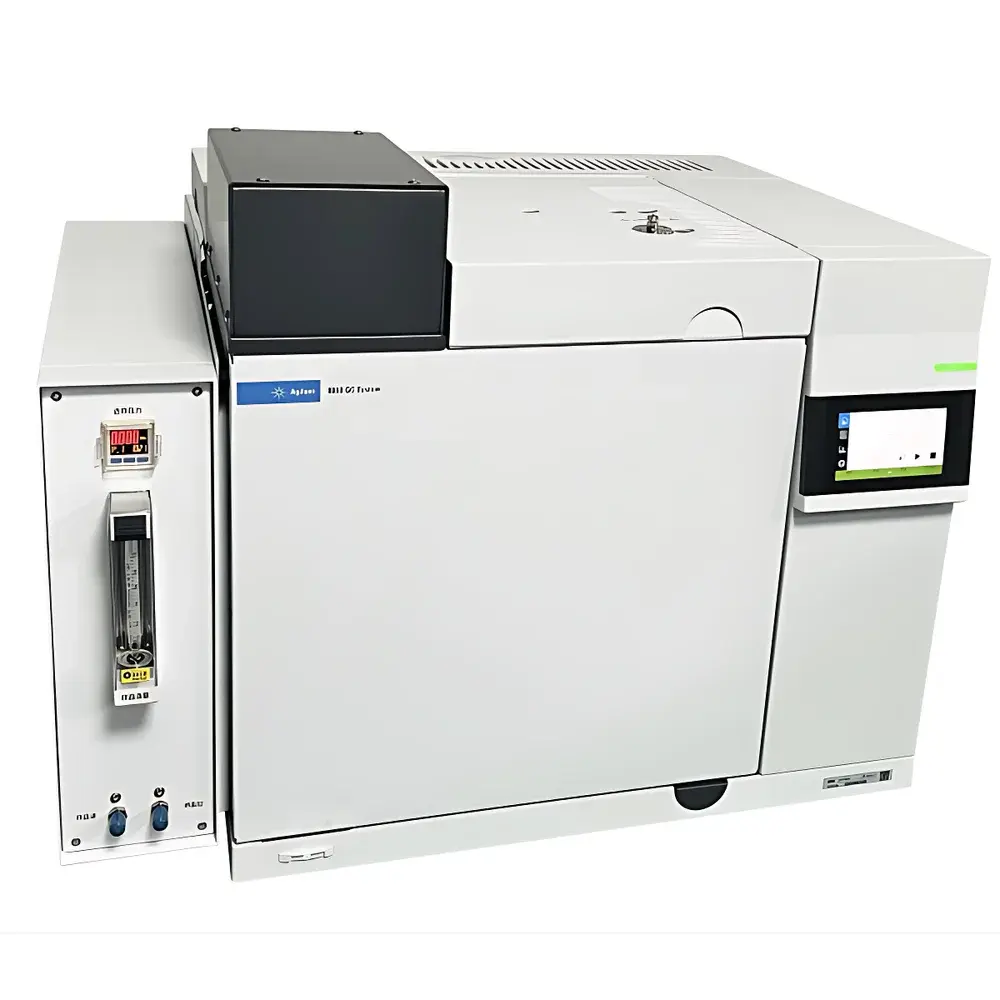
Agilent 8860 PDD Helium Ionization Gas Chromatograph for Fluorinated Electronic Gases
| Brand | Agilent Technologies |
|---|---|
| Origin | Zhejiang, China |
| Manufacturer Type | Authorized Distributor |
| Regional Classification | Domestic (PRC) |
| Model | Agilent 8860 |
| Instrument Type | Laboratory Gas Chromatograph |
| Application Domain | Ultra-High-Purity (UHP) Electronic Specialty Gas Analysis |
| Oven Temperature Range | 8 °C above ambient to 425 °C |
| Maximum Ramp Rate | 75 °C/min |
| Cooling Rate | 300 °C → 50 °C in ≤5.7 min (at 25 °C ambient) |
Overview
The Agilent 8860 PDD Helium Ionization Gas Chromatograph is a purpose-engineered analytical platform designed exclusively for trace-level impurity profiling in fluorinated electronic specialty gases—such as R14, R32, R143a, R22, R12, R21, R116, and related CFC/HFC/HCFC compounds—as well as high-purity helium, hydrogen, nitrogen, oxygen, argon, methane, carbon monoxide, and carbon dioxide. It integrates Agilent’s proven 8860 GC architecture with a pulsed discharge helium ionization detector (PDHID), delivering sub-ppb detection sensitivity and exceptional linearity across five orders of magnitude (10⁵). Unlike conventional thermal conductivity (TCD) or flame ionization (FID) detectors, the PDHID operates via metastable helium plasma generation, enabling universal, non-destructive detection of virtually all permanent gases and volatile inorganic species—including those lacking carbon-hydrogen bonds—without requiring catalytic conversion or post-column reactors. This makes it uniquely suited for semiconductor-grade gas certification, ISO 8573-8 purity validation, and ASTM D7607-compliant analysis of electronic manufacturing gases.
Key Features
- Column oven with precise temperature control: 8 °C above ambient to 425 °C; 0.1 °C setpoint resolution; up to 20 independent temperature ramps (including negative ramps) per method
- Rapid thermal cycling: 75 °C/min maximum heating rate; full cooldown from 300 °C to 50 °C in ≤5.7 minutes (25 °C ambient), minimizing cycle time for high-throughput QC labs
- Dual-zone multi-column oven system (custom-engineered by Krom) enables independent temperature programming for pre-separation, analytical, and guard columns—critical for resolving co-eluting fluorocarbon isomers and low-concentration impurities
- Valco-sourced 316L stainless steel pneumatic manifold: includes one purge-type 10-port valve and two purge-type 6-port valves; all internal tubing, fittings, and flow paths are electropolished, passivated, and oil-free certified
- VCR-sealed chromatographic column set: Molecular Sieve 5A (for H₂, O₂, N₂, CH₄, CO), HayeSep Q (for CO₂, R-gases), and Gel permeation pre-cut column—configured for sequential heart-cutting and back-flush operation without manual column switching
- PDHID detection module (Vici model PDHID-I-8860): LOD ≤10 ppb (as CH₄); linear dynamic range 10⁵; pulse amplifier and HID-specific signal conditioning board integrated with Agilent 8860 electronics
- He carrier gas purification train: dual-stage VICI helium purifier with HP-2 molecular sieve and oxygen/moisture traps, ensuring <0.1 ppb O₂ and H₂O residual in carrier stream
Sample Compatibility & Compliance
The system is validated for analysis of Class 5–6 electronic specialty gases per SEMI F57 and ISO 8573-8 Annex B specifications. It meets ASTM D7607 (Standard Test Method for Trace Impurities in High-Purity Helium by Gas Chromatography) and supports compliance with IEC 60068-2 environmental testing protocols for instrument stability under variable lab conditions (15–35 °C operating range; 5–90% RH non-condensing). All wetted parts—including sample loop, valves, tubing, and column fittings—are constructed from 316L stainless steel and VCR-sealed to prevent adsorption, leaching, or surface-catalyzed decomposition of reactive fluorinated species. The entire gas path undergoes rigorous leak-checking to <1×10⁻⁹ atm·mL/s (helium) and is certified for use with ultra-high-purity (UHP) helium (99.9999%+, <10 ppb total hydrocarbons) and nitrogen (99.999%+, <10 ppb O₂/H₂O).
Software & Data Management
Controlled via Agilent OpenLAB CDS (Chromatography Data System) Single-User Edition, the platform supports full instrument remote control—including oven ramping, valve sequencing, detector parameter adjustment, and event-triggered data acquisition. The software provides 21 CFR Part 11-compliant audit trails, electronic signatures, and role-based access control. All raw chromatograms, method files, calibration curves, and report templates are stored in a secure, timestamped database with automatic backup. Integration with LIMS is supported through ASTM E1381 and ASTM E1467 standard interfaces. Data export formats include .cdf, .csv, and PDF reports compliant with ISO/IEC 17025 documentation requirements for accredited testing laboratories.
Applications
- Trace impurity quantification in bulk and cylinder-grade fluorinated refrigerants (R13, R32, R125, R134a, R143a) per JIS K 1475 and GB/T 31277
- Residual moisture, oxygen, nitrogen, hydrogen, and hydrocarbon verification in electronic-grade helium and argon for semiconductor deposition processes
- CO, CO₂, and CH₄ monitoring in high-purity hydrogen used in fuel cell manufacturing
- Validation of gas purity for EU REACH SVHC screening and EPA Method TO-15 compliance in emissions testing support labs
- Stability testing of fluorinated gas standards during shelf-life qualification (per ISO Guide 35)
FAQ
What detection principle does the PDHID employ?
It utilizes a pulsed DC discharge in high-purity helium to generate metastable He* atoms, which ionize analyte molecules via Penning ionization—enabling universal, quantitative response for permanent gases and halogenated compounds without chemical derivatization.
Can this system analyze both polar and non-polar fluorocarbons simultaneously?
Yes—the dual-column configuration (Molecular Sieve 5A + HayeSep Q) combined with programmable back-flush and heart-cutting allows simultaneous separation of O₂/N₂/CH₄ (polar/non-polar) and R12/R22/R134a (halogenated, higher-boiling) in a single run.
Is the system compliant with pharmaceutical GMP or semiconductor fab environmental controls?
The hardware design meets SEMI S2/S8 safety and ergonomics standards; software functionality supports 21 CFR Part 11, Annex 11, and ISO/IEC 17025 audit readiness when deployed with appropriate SOPs and change control procedures.
What carrier gas purity is required for sub-ppb detection?
Helium must be ≥99.9999% pure, with total hydrocarbons <10 ppb, O₂ <10 ppb, and H₂O <10 ppb—achieved using the included dual-stage VICI HP-2 purifier and inline 2 µm particulate filters.
Does the system support automated calibration and drift correction?
Yes—OpenLAB CDS enables multi-level bracketing calibration with certified reference gas mixtures (e.g., He-balanced 5 ppm R-gas standards), including retention time locking (RTL) and peak area normalization against internal standards.
Related Products




