
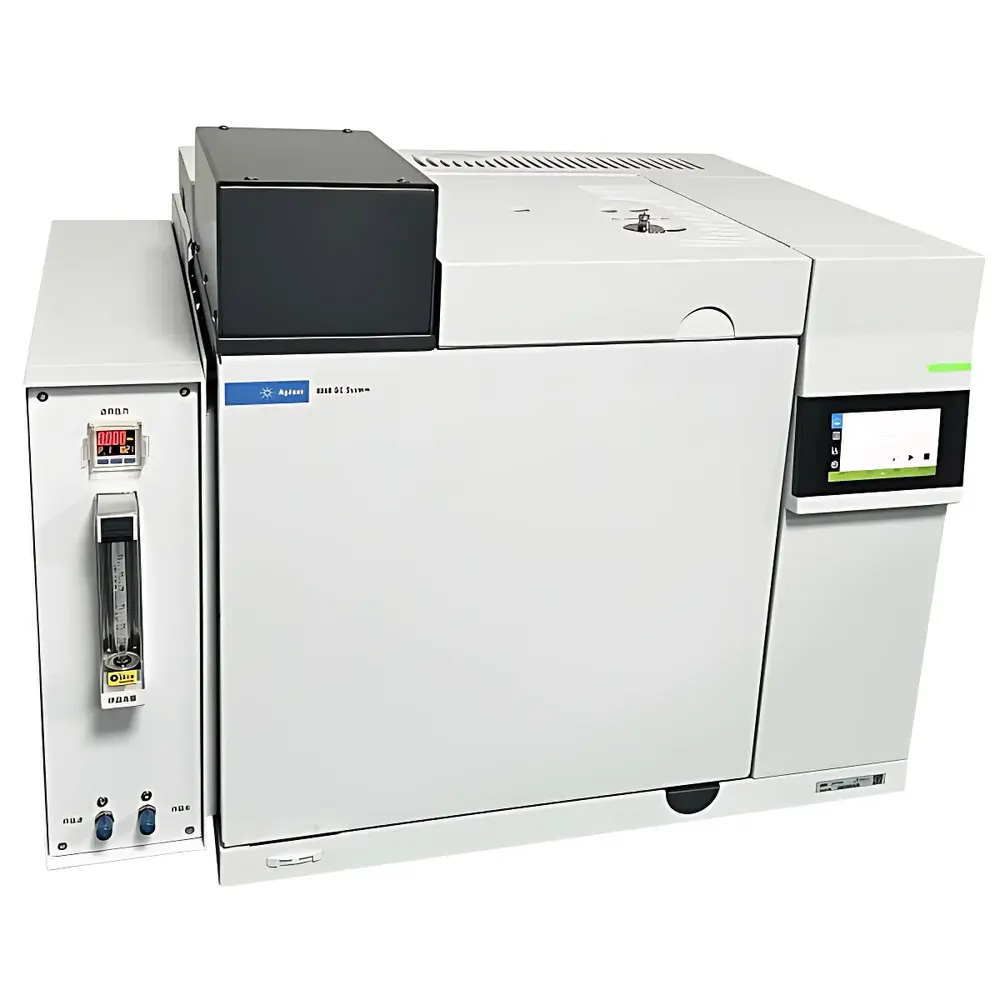
Agilent 8860 PDD Helium Ionization Gas Chromatograph for Ultra-High-Purity Electronic Specialty Gases
| Brand | Agilent Technologies |
|---|---|
| Origin | Zhejiang, China |
| Manufacturer Type | Authorized Distributor |
| Regional Classification | Domestic (China) |
| Model | Agilent 8860 |
| Instrument Type | Laboratory Gas Chromatograph |
| Detection Principle | Pulsed Discharge Helium Ionization Detection (PDHID) |
| Column Oven Dimensions | 28.0 × 30.5 × 16.5 cm |
| Operating Temperature Range | 8 °C above ambient to 425 °C |
| Temperature Setpoint Resolution | 0.1 °C |
| Max Heating Rate | 75 °C/min |
| Cooling Rate | 300 °C → 50 °C in ≤5.7 min (at 25 °C ambient) |
| Max Run Time | 999.99 min |
| Temperature Programming | Up to 20 ramps (including negative ramps) |
| Ambient Temperature Rejection | <0.01 °C per 1 °C ambient change |
| Analog Outputs | Two channels (1 V and 10 V standard) |
| Remote Control | Start/Stop via digital I/O |
| Connectivity | Ethernet (LAN) |
| Flow Selection Valve | BCD-encoded input |
| Operating Environment | 15–35 °C, 5–90% RH (non-condensing) |
| Storage Range | −40 to 70 °C |
| Max Operating Altitude | 4600 m |
| PDHID Detection Limit | ≤10 ppb (as CH₄) |
| Linear Dynamic Range | 10⁵ |
| Measurable Impurities in HBr | H₂, O₂, N₂, CH₄, CO, CO₂, C₂H₆, H₂O, HCl |
| Compliance Standards | GB/T 28726–2012, JJG 700–2016 |
Overview
The Agilent 8860 PDD Helium Ionization Gas Chromatograph is a purpose-engineered analytical platform designed for the trace-level quantification of non-methane impurities in ultra-high-purity (UHP) electronic specialty gases—particularly hydrogen bromide (HBr) with purity ≥99.999%. It employs pulsed discharge helium ionization detection (PDHID), a highly sensitive, universal, and methane-selective detection technique operating in a pure helium carrier environment. Unlike flame ionization detectors (FID), PDHID generates metastable helium species that efficiently ionize nearly all permanent gases and low-molecular-weight hydrocarbons without requiring hydrogen fuel or air supply—making it intrinsically safe, stable, and ideal for inert gas matrix analysis. The system delivers sub-ppb detection limits (≤10 ppb as CH₄) across a linear dynamic range spanning five orders of magnitude (10⁵), enabling reliable measurement of critical contaminants such as H₂, O₂, N₂, CH₄, CO, CO₂, C₂H₆, H₂O, and HCl at specification levels defined by semiconductor-grade gas standards.
Key Features
- Integrated PDHID detector with optimized discharge pulse control, ensuring long-term baseline stability and minimal drift during extended unattended operation.
- High-performance column oven featuring rapid thermal response (75 °C/min heating; 300 → 50 °C in ≤5.7 min), precise temperature resolution (0.1 °C), and active ambient rejection (<0.01 °C per 1 °C ambient fluctuation).
- Modular flow path architecture with BCD-encoded electronic flow selection valves, supporting multi-channel, multi-column configurations for simultaneous or sequential analysis of diverse impurity classes.
- Dual analog output capability (1 V and 10 V ranges) for direct integration with distributed control systems (DCS) or data acquisition units in cleanroom or central utility environments.
- Ethernet-based communication interface compliant with standard TCP/IP protocols, enabling remote instrument monitoring, method deployment, and real-time data streaming via Agilent OpenLab CDS or third-party SCADA platforms.
- Robust mechanical design validated for operation up to 4600 m altitude and storage across −40 to 70 °C, suitable for both on-site lab deployment and mobile analytical service applications.
Sample Compatibility & Compliance
This system is validated for analysis of high-purity hydrogen bromide (HBr) and other UHP electronic gases including helium, nitrogen, argon, oxygen, and silane. It meets the performance requirements specified in GB/T 28726–2012 “Gas Analysis—Helium Ionization Gas Chromatographic Method” and JJG 700–2016 “Verification Regulation for Gas Chromatographs”. While not FDA-cleared, its hardware architecture and data handling capabilities support alignment with GLP and GMP principles when deployed with audit-trail-enabled chromatography data systems (CDS). The absence of combustion gases eliminates explosion risk in Class 1 Div 1 hazardous locations, and helium-only operation ensures compatibility with ISO 8573-1 purity class 1 compressed air infrastructure commonly found in semiconductor fabrication facilities.
Software & Data Management
The Agilent 8860 PDD operates natively with OpenLab CDS 2.x or higher, providing full 21 CFR Part 11 compliance through electronic signatures, role-based access control, and immutable audit trails for method parameters, sequence logs, and raw chromatogram archives. Peak integration algorithms are optimized for narrow, symmetric PDHID peaks generated under high-efficiency capillary separation conditions. Calibration routines support external standard, internal standard, and standard addition methodologies—with automated response factor calculation and uncertainty propagation per ISO/IEC 17025 guidelines. All raw data files (.D format) are stored in vendor-neutral, ASCII-readable formats for third-party reprocessing or statistical process control (SPC) integration.
Applications
- Quality release testing of HBr batches per enterprise specifications (e.g., H₂ <10 ppb, O₂ <1 ppb, HCl <3 ppb).
- Root cause analysis of wafer etch rate variation linked to trace oxygen or moisture ingress in delivery lines.
- Validation of gas purification system performance—including getter bed breakthrough monitoring and membrane filter efficiency assessment.
- Supporting ISO 14644-8 cleanroom gas monitoring programs through scheduled, unattended multi-gas screening sequences.
- Method transfer from R&D to QC labs using identical hardware configuration and retention time locking (RTL) enabled columns.
FAQ
Does this system require hydrogen or air for detector operation?
No. The PDHID operates exclusively with ultrahigh-purity helium (≥99.999%) as both carrier and discharge gas—eliminating flammability hazards and simplifying gas supply infrastructure.
Can the system quantify water vapor (H₂O) at sub-ppm levels?
Yes. When coupled with a dedicated moisture-trap-free pre-column and cryo-focusing, the PDHID achieves ≤1 ppb H₂O detection limit in HBr matrices—validated per GB/T 28726–2012 Annex B.
Is the column oven compatible with backflush and heart-cutting configurations?
Yes. The integrated flow selection valve supports programmable valve actuation synchronized with temperature ramps, enabling comprehensive two-dimensional GC (GC×GC) and selective heart-cutting for co-eluting impurities.
What maintenance intervals are recommended for the PDHID discharge cell?
Under typical UHP gas service, the discharge cell requires cleaning every 6–12 months. No consumable electrodes or filaments are used—only periodic quartz window inspection and helium purity verification are necessary.
Can raw chromatograms be exported for independent processing in MATLAB or Python?
Yes. OpenLab CDS exports peak tables and full-scan chromatograms in CSV and .CDF (NetCDF) formats, fully compatible with scientific computing environments for custom algorithm development and multivariate calibration.





