
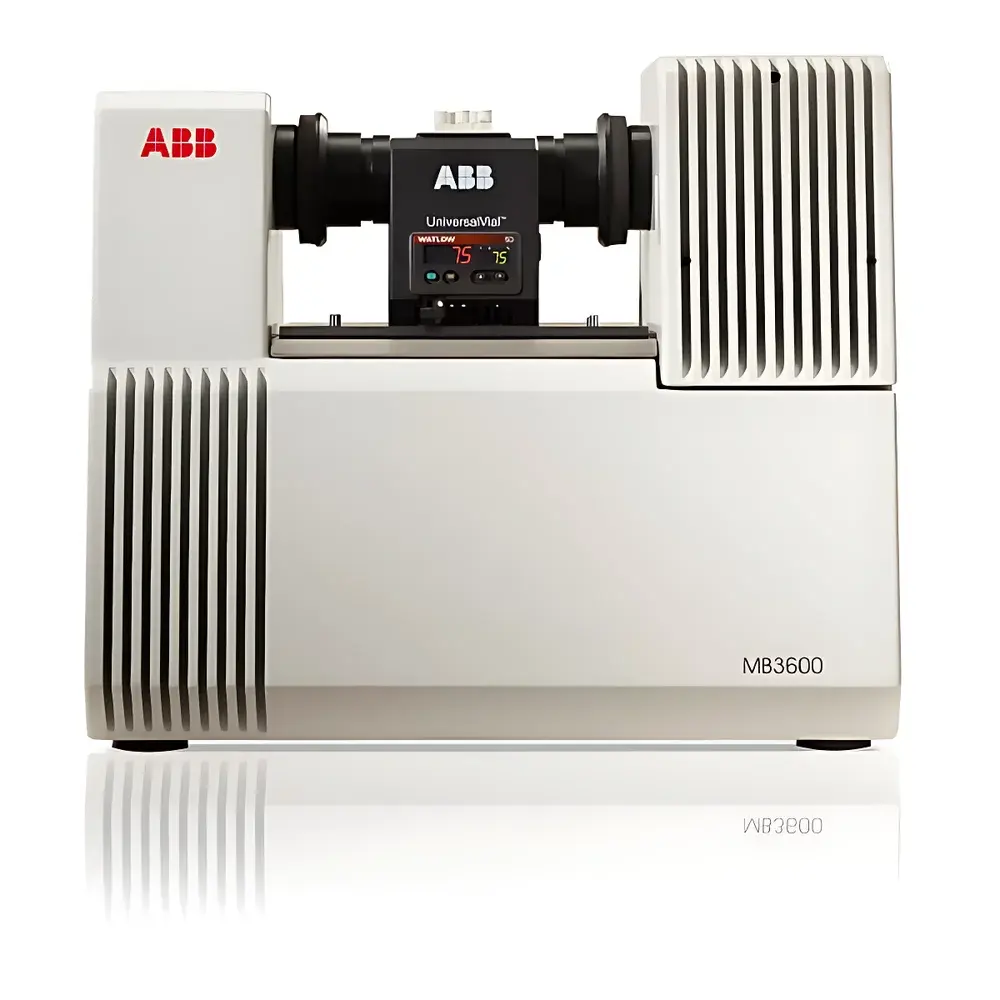
ABB MB3600-CH20 FT-NIR Hydroxyl Value Analyzer
| Brand | ABB |
|---|---|
| Origin | Canada |
| Model | MB3600-CH20 |
| Instrument Type | Laboratory FT-NIR Spectrometer |
| Principle | Fourier Transform Near-Infrared (FT-NIR) |
| Wavelength Range | 3800–14000 cm⁻¹ |
| Data Sampling Interval | < 0.7 cm⁻¹ |
| Measurement Mode | Transmission |
| Chemometrics Software | Horizon MB |
| Compliance | Designed for GLP/GMP-aligned workflows, supports ASTM E1655 and ISO 12099 data handling conventions |
Overview
The ABB MB3600-CH20 FT-NIR Hydroxyl Value Analyzer is a high-performance, laboratory-grade Fourier Transform Near-Infrared spectrometer engineered for rapid, non-destructive quantification of hydroxyl value (OHV) and up to eight complementary chemical parameters—including iodine value, acid number, amine value, saponification number, peroxide value, moisture content, cis/trans ratio, and isocyanate concentration—in organic chemical feedstocks and intermediates. Unlike classical wet-chemistry titration methods (e.g., ASTM D4294, GB/T 12008.3–2009), this instrument employs robust FT-NIR spectroscopy coupled with validated chemometric calibration models to deliver quantitative results in under 60 seconds—without sample digestion, reagents, solvents, or operator-dependent endpoint detection. Its optical architecture features a permanently aligned interferometer, thermoelectrically cooled InGaAs detector, and high-stability light source, ensuring long-term photometric linearity and spectral reproducibility across instrument fleets.
Key Features
- Fourier Transform optics delivering high spectral resolution (≤0.7 cm⁻¹ sampling interval) and exceptional signal-to-noise ratio across the 3800–14000 cm⁻¹ range
- Transmission-mode measurement cell compatible with liquid, viscous, or low-turbidity semi-solid samples—including polyols, fatty alcohols, glycols, ethoxylates, and isocyanate prepolymers
- Horizon MB chemometrics software suite with model development, validation, and deployment tools compliant with ASTM E1655 guidelines for NIR method development
- Factory-established cross-instrument transferability: identical spectral response and photometric linearity across all MB3600-CH20 units enable seamless calibration model migration from lab to pilot or production-line analyzers
- No consumables required—eliminates solvent waste, hazardous reagent disposal, and associated regulatory reporting burdens (aligned with green chemistry principles per ISO 14001)
- Integrated diagnostics and automated wavelength verification using built-in polystyrene reference standard
Sample Compatibility & Compliance
The MB3600-CH20 is routinely deployed for quality control and process monitoring of polyether and polyester polyols, pentaerythritol, ethylene glycol, propylene glycol, EO/PO adducts, alkyd resins, surfactants, and urethane precursors. It meets analytical performance expectations defined in GB/T 12008.3–2009 (hydroxyl value determination) and supports method equivalency validation against ISO 4629, ASTM D1638, and USP . Instrument firmware and Horizon MB software support audit trails, electronic signatures, and user access controls aligned with FDA 21 CFR Part 11 requirements for regulated environments. All calibrations are traceable to NIST-traceable reference materials and documented per ISO/IEC 17025 principles.
Software & Data Management
Horizon MB provides a modular, Windows-based platform for spectral acquisition, preprocessing (Savitzky-Golay smoothing, multiplicative scatter correction, first/second derivative), PLS regression modeling, and statistical validation (RMSEC, RMSEP, bias, slope, R²). Models are stored in encrypted binary format with metadata including date, operator ID, instrument serial number, and validation history. Export options include CSV, XML, and LIMS-compatible ASTM E1384-compliant files. The software supports multi-user role management (administrator, analyst, reviewer), version-controlled model libraries, and automated report generation with embedded spectra and prediction confidence intervals.
Applications
- Raw material acceptance testing of polyols and glycols prior to reactor charging
- In-process monitoring of polyol synthesis reactions—tracking OHV evolution during chain extension or end-capping
- Final product release testing for polyurethane prepolymers, alkyd resins, and ethoxylated surfactants
- Development and validation of orthogonal QC methods replacing titrimetric assays in GMP manufacturing
- Supporting DOE studies for surfactant formulation optimization via rapid multi-parameter profiling
- Enabling PAT (Process Analytical Technology) frameworks per ICH Q8/Q9/Q10 guidelines
FAQ
Can the MB3600-CH20 replace wet-chemistry hydroxyl value testing in regulated environments?
Yes—when validated per ICH Q2(R2) and supported by documented equivalence studies against reference methods (e.g., GB/T 12008.3), it serves as a primary QC method in pharmaceutical excipient and polymer manufacturing.
Is calibration model transfer between instruments supported out-of-the-box?
Yes—the MB3600-CH20 series incorporates ABB’s proprietary photometric matching protocol, enabling direct model portability without re-standardization or spectral preprocessing adjustments.
What sample preparation is required for transmission measurements?
Minimal: liquids are loaded into standardized 0.1–1.0 mm pathlength cells; viscous samples may require temperature-controlled cuvettes (25–40 °C) to ensure consistent flow and optical clarity.
Does Horizon MB support multivariate outlier detection and warning flags?
Yes—it includes Hotelling’s T² and Q-residual analysis for real-time sample validity assessment and automatic flagging of spectra outside training domain boundaries.
How is instrument performance verified over time?
Through daily automated checks using integrated polystyrene film, plus periodic verification with certified NIR reference standards (e.g., NIST SRM 2062), logged within the audit trail.
Related Products






