
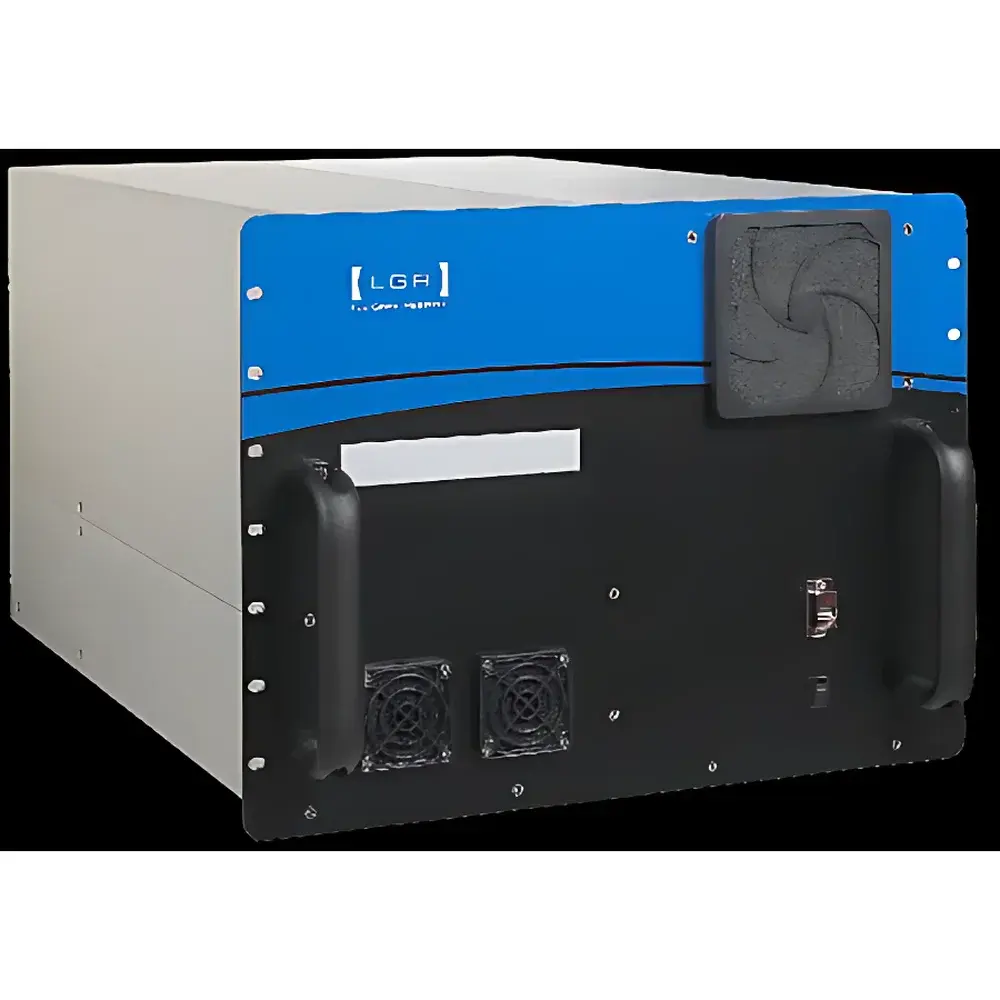
ABB GLA331-GGA Enhanced-Performance Greenhouse Gas Analyzer
| Brand | ABB |
|---|---|
| Origin | Canada |
| Manufacturer Type | Authorized Distributor |
| Origin Category | Imported |
| Model | GLA331-GGA |
| Price | Upon Request |
| Measured Gases & Ranges | CH₄ (0–100 ppm), CO₂ (0–20,000 ppm), H₂O (0–30,000 ppm) |
| Measurement Speed | Up to 10 Hz (GGA configuration) |
| CH₄ Precision (1σ, 1 s / 10 s / 100 s) | 0.6 ppb / 0.2 ppb / 0.1 ppb |
| CO₂ Precision (1σ, 1 s / 10 s / 100 s) | 150 ppb / 50 ppb / 20 ppb |
| H₂O Precision (1σ, 1 s / 10 s / 100 s) | 150 ppm / 50 ppm / 17 ppm |
| Maximum Drift (15-min avg, STP, 24 h) | CH₄ < 3 ppb, CO₂ < 0.2 ppm |
| Flow Response Time (1/e) | <10 s (standard), 0.1 s (with optional ACC-DS35 dry scroll pump) |
Overview
The ABB GLA331-GGA Enhanced-Performance Greenhouse Gas Analyzer is a high-precision, cavity-enhanced laser absorption spectrometer engineered for continuous, real-time quantification of methane (CH₄), carbon dioxide (CO₂), and water vapor (H₂O) in ambient air and controlled atmospheric sampling systems. Utilizing tunable diode laser absorption spectroscopy (TDLAS) with integrated cavity output spectroscopy (ICOS) architecture, the instrument achieves sub-part-per-trillion sensitivity and exceptional spectral selectivity—enabling unambiguous discrimination of target gas absorption features amid complex atmospheric matrices. Designed for deployment in eddy covariance flux towers, atmospheric observatories, calibration laboratories, and mobile monitoring platforms, the GLA331-GGA delivers metrologically traceable measurements compliant with WMO GAW (World Meteorological Organization Global Atmosphere Watch) compatibility requirements and supports long-term trend analysis under ISO 14064-1 and IPCC Tier 3 reporting frameworks.
Key Features
- Simultaneous, independent quantification of CH₄, CO₂, and H₂O at up to 10 Hz sample rate—optimized for turbulent flux applications requiring high temporal resolution.
- Ultra-low drift performance: CH₄ drift < 3 ppb and CO₂ drift < 0.2 ppm over 24 hours (15-minute averaging, STP conditions), minimizing recalibration frequency and enabling multi-week unattended operation.
- Wide dynamic linear range: CH₄ (0–100 ppm), CO₂ (0–20,000 ppm), H₂O (0–30,000 ppm), supporting both background concentration monitoring and localized plume characterization without range switching.
- Exceptional specificity: Spectral line isolation via narrow-linewidth (<1 MHz) lasers and pressure-broadened absorption modeling eliminates cross-sensitivity between CH₄, CO₂, and H₂O—even at high humidity or elevated CO₂ levels.
- Rapid system integration: Factory-calibrated with NIST-traceable gas standards; operational within minutes of power-up and flow stabilization—no user-performed optical alignment or wavelength tuning required.
- Robust mechanical and thermal architecture: Aluminum chassis with passive thermal management and vibration-damped optical bench ensures stable performance across ambient temperatures from −20 °C to +45 °C.
Sample Compatibility & Compliance
The GLA331-GGA accepts standard ¼″ OD stainless steel or PFA sampling lines with inlet pressures between 80–110 kPa (absolute) and flow rates of 0.5–2.0 L/min. It is compatible with common air drying systems (e.g., Nafion™ dryers) and particulate filtration (0.2 µm PTFE membrane). All measurement outputs are fully compatible with EPA Method TO-15 and ASTM D6348-20 data validation protocols. The analyzer meets IEC 61326-1:2013 electromagnetic compatibility requirements and carries CE marking for environmental monitoring use. Firmware supports audit-ready logging per FDA 21 CFR Part 11 when deployed in regulated GHG verification programs.
Software & Data Management
Instrument control, real-time visualization, and data export are managed via ABB’s proprietary GLA Control Suite v4.x—a Windows-based application supporting local Ethernet or RS-232 connectivity. Raw absorbance spectra, calibrated concentration time series, and diagnostic metrics (e.g., cavity mirror reflectivity, laser current stability, pressure/temperature residuals) are logged at user-selectable intervals (10 ms to 1 min). Data files conform to CF-netCDF format with embedded metadata compliant with ICOS Carbon Portal ingestion standards. Optional API integration enables direct ingestion into cloud-based platforms (e.g., AWS IoT Core, Azure Time Series Insights) for centralized fleet monitoring and QA/QC automation.
Applications
- Eddy covariance flux measurements at ecosystem-scale observation sites (FLUXNET, AmeriFlux, ICOS stations)
- Urban and industrial perimeter monitoring for fugitive CH₄ emissions detection and source attribution
- Calibration transfer and reference standard verification in national metrology institutes
- Mobile platform deployment on research aircraft, UAVs, and ground vehicles for spatially resolved GHG mapping
- Long-term atmospheric composition records supporting CMIP6 model evaluation and UNFCCC inventory reconciliation
- Process monitoring in biogas upgrading facilities and landfill gas recovery systems
FAQ
What is the minimum detectable concentration for CH₄ under typical field conditions?
At 1-second integration, the 1σ noise-equivalent concentration is 0.6 ppb; this improves to 0.1 ppb with 100-second averaging—achievable without hardware modification.
Does the GLA331-GGA require periodic zero/span calibration in autonomous operation?
No external zero/span gases are required for routine operation. Built-in cavity ring-down diagnostics and pressure/temperature compensation algorithms maintain accuracy; optional automated calibration modules (e.g., dual-standard cylinder manifold) are available for regulatory-grade validation.
Can the analyzer operate continuously in high-humidity environments (e.g., tropical forests)?
Yes—the H₂O channel actively corrects spectroscopic interference in real time, and the optical cavity design minimizes condensation risk. For sustained >95% RH exposure, integration with a thermoelectrically cooled Nafion™ dryer is recommended.
Is raw spectral data accessible for custom post-processing?
Yes. Full-resolution absorbance spectra (wavenumber vs. intensity) are streamed via TCP/IP and archived alongside concentration outputs for advanced retrieval and re-analysis.
What service and support options are available outside North America?
ABB maintains certified service centers in Germany, Singapore, and Brazil, with remote diagnostics, firmware updates, and on-site calibration support available under annual maintenance agreements.
Related Products







