
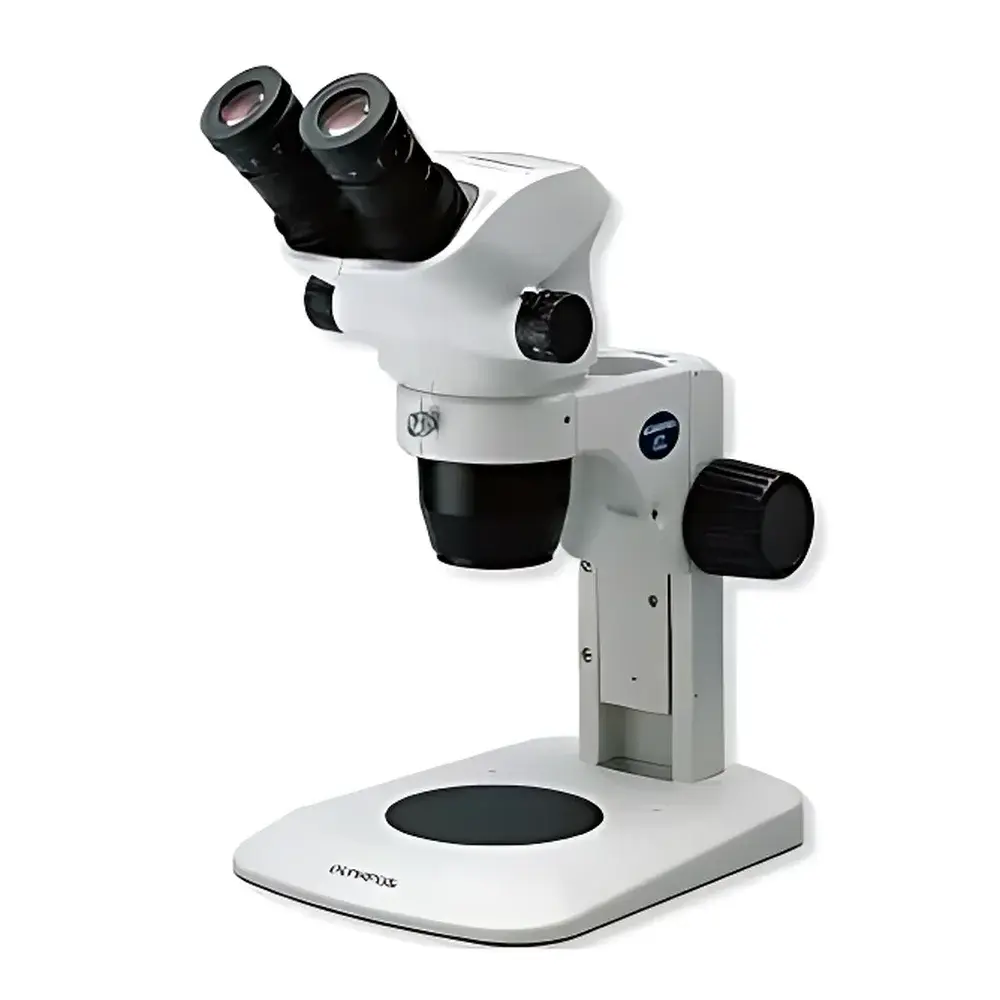
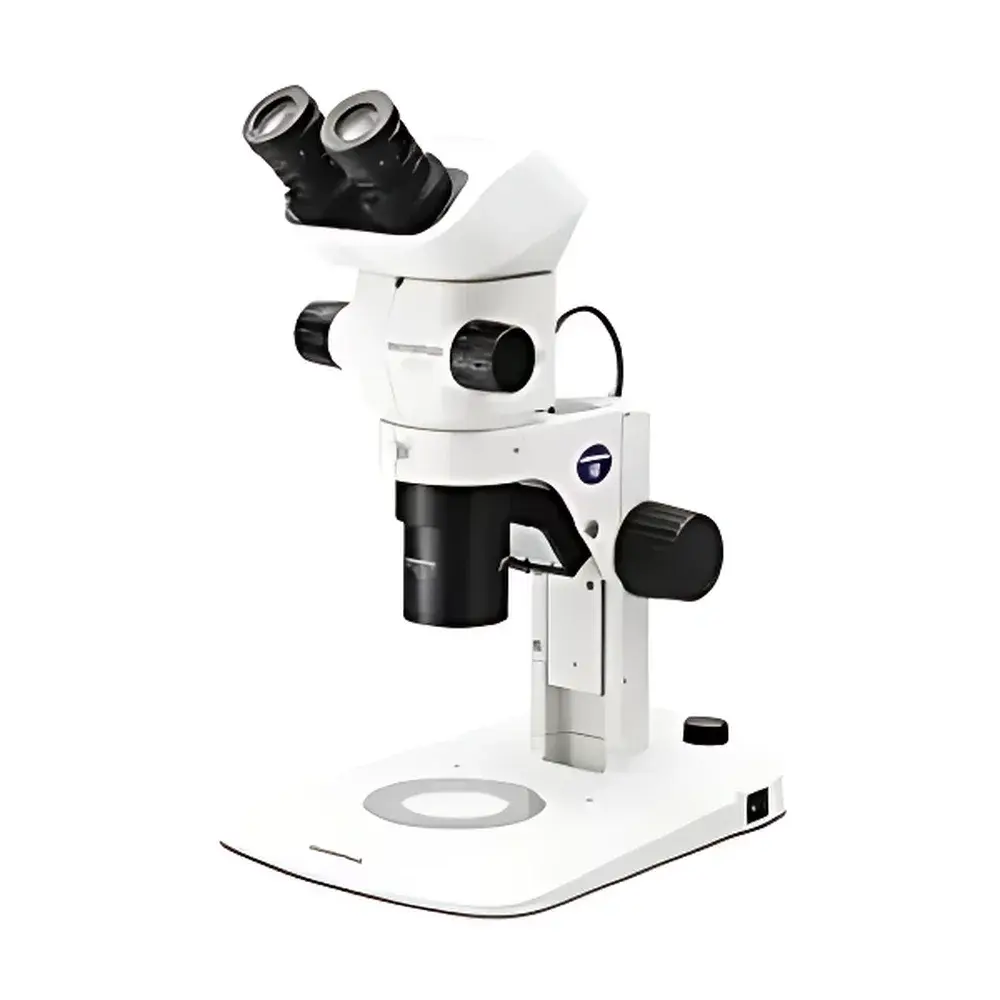
Olympus SZ61 Stereo Microscope
| Brand | Olympus |
|---|---|
| Origin | Japan |
| Model | SZ61 |
| Total Magnification Range | 0.67×–4.5× (with 10× eyepieces: 6.7×–45×) |
| Zoom Ratio | 6.7:1 |
| Working Distance | 110 mm |
| Objective Type | 1× |
| Illumination | Integrated LED (reflected & transmitted, optional) |
| Depth of Field | Compatible with C-mount digital imaging systems (0.5× built-in adapter) |
| Eyepiece Angle | 45° inclined binocular tube |
| Interpupillary Adjustment | 52–76 mm (with WHSZ series eyepieces) |
| Optical System | Greenough stereoscopic design |
| Compliance | RoHS-compliant, lead-free optical components |
| LED Lifetime | ≥6,000 hours |
| Power Input | 100–120 V / 200–240 V AC, 50/60 Hz |
| Weight | 1.3 kg (zoom body only) |
Overview
The Olympus SZ61 Stereo Microscope is an entry-level yet highly engineered stereoscopic instrument designed for routine inspection, educational microscopy, and basic life science applications. It employs a Greenough optical architecture—characterized by two separate, converging optical paths with a 10° convergence angle—to deliver high-fidelity stereoscopic vision, exceptional depth of field, and minimal geometric distortion across the entire field of view. Unlike parallel-optical (Common Main Objective) systems, the Greenough design provides inherent advantages in flat-field performance, contrast uniformity, and natural depth perception at low-to-moderate magnifications. The SZ61 achieves a continuous zoom range of 0.67× to 4.5× (6.7:1 zoom ratio), expandable to 6.7×–45× when paired with standard 10× wide-field eyepieces. Its fixed 1× objective lens ensures consistent working distance (110 mm), facilitating stable sample manipulation and ergonomic workflow—particularly valuable in dissection, PCB inspection, quality control, and classroom instruction.
Key Features
- Greenough stereoscopic optics with optimized chromatic correction and anti-reflective multilayer coatings for accurate color fidelity and high contrast.
- 6.7:1 zoom ratio—the highest in its class—enabling seamless transition from overview to detailed observation without mechanical repositioning.
- Ergonomic 45° inclined binocular tube with coaxial interpupillary adjustment (52–76 mm) and “ComfortView” WHSZ-series eyepieces featuring pupil-difference compensation and optimized eye-point positioning.
- Integrated dual-mode LED illumination base (SZ2-ILST) supporting both reflected and transmitted light; delivers stable color temperature (≈5,500 K) and uniform brightness across intensity levels.
- C-mount compatible trinocular port (0.5× built-in relay lens) for direct coupling to digital cameras—including Olympus DP12 and third-party C-mount sensors—without additional adapters.
- Lead-free optical components compliant with RoHS Directive 2011/65/EU, reflecting Olympus’ commitment to environmentally responsible manufacturing.
- Compact, low-profile mechanical design (zoom body: 1.3 kg) with front-accessible focus and zoom controls to minimize operator fatigue during extended use.
Sample Compatibility & Compliance
The SZ61 accommodates a broad spectrum of opaque, translucent, and semi-transparent specimens—including biological tissues, electronic components, mineral samples, botanical specimens, and industrial assemblies—without requiring sectioning or staining. Its 110 mm working distance permits unobstructed access for tweezers, pipettes, or micro-manipulators. Optional accessories extend functionality: SZ2-ILA transmission illuminator for low-magnification homogeneity; SZ2-LGR ring light for shadow-free surface inspection; and SZ2-ILLC coaxial incident-light module with polarizer and λ/4 plate for stress birefringence analysis. All optical components meet ISO 10934-1 (microscopy terminology) and JIS B 7151 (stereomicroscope performance testing) standards. The LED illumination system conforms to IEC 62471 (photobiological safety) and operates within Class 1 LED hazard classification. No regulatory certification (e.g., FDA 510(k), CE medical device) applies, as the SZ61 is designated for non-diagnostic, non-clinical laboratory use per IEC 61010-1 (safety requirements for electrical equipment).
Software & Data Management
While the SZ61 itself is hardware-only, its C-mount interface enables integration with industry-standard imaging platforms. When coupled with Olympus DP12 or compatible USB 3.0 CMOS cameras, it supports acquisition via Olympus cellSens Entry software (Windows-based), which provides live preview, measurement tools (calibrated length/area), annotation, time-lapse capture, and TIFF/PNG export. For GLP/GMP-aligned environments, the system can be configured with audit-trail-enabled third-party software (e.g., NIS-Elements BR, ZEN Blue) that logs user actions, timestamps, and calibration events—meeting traceability requirements under 21 CFR Part 11 when deployed with appropriate IT validation protocols. Raw image metadata (magnification, illumination mode, exposure settings) is embedded in EXIF headers for full experimental reproducibility.
Applications
The SZ61 serves as a foundational tool in academic teaching laboratories for comparative morphology, plant anatomy, and insect dissection. In industrial QA/QC, it supports solder-joint inspection, component verification, and failure analysis of printed circuit boards and MEMS devices. Its robust mechanical stability and vibration-resistant base make it suitable for benchtop use in cleanrooms (ISO Class 8) and production floors. In materials science, it facilitates grain structure assessment of metals and polymers prior to SEM preparation. Educational institutions value its intuitive operation, durability, and compatibility with student-grade digital imaging solutions—reducing training overhead while maintaining optical integrity across user cohorts.
FAQ
What is the maximum usable magnification with the SZ61?
With standard 10× WHSZ eyepieces and no auxiliary lenses, the system delivers 6.7×–45×. Auxiliary objectives (e.g., 0.5× or 2×) extend this range but reduce working distance and depth of field.
Can the SZ61 be used for photomicrography under GxP conditions?
Yes—when integrated with validated camera hardware and compliant image management software, it satisfies documentation requirements for ISO 9001 and ISO/IEC 17025 accredited labs.
Is the LED illumination intensity adjustable?
Yes—continuous dimming is achieved via rotary control on the base; no discrete steps or PWM flicker.
Does the SZ61 support fluorescence observation?
No—its optical path lacks excitation filters, dichroic mirrors, or barrier filters required for fluorescence; dedicated fluorescence stereo systems (e.g., SZX7 with GFP modules) are recommended instead.
How is calibration maintained over time?
Olympus provides factory calibration certificates for magnification accuracy (±2% tolerance per ISO 10934-2); periodic verification using NIST-traceable stage micrometers is advised every 12 months in regulated environments.






