
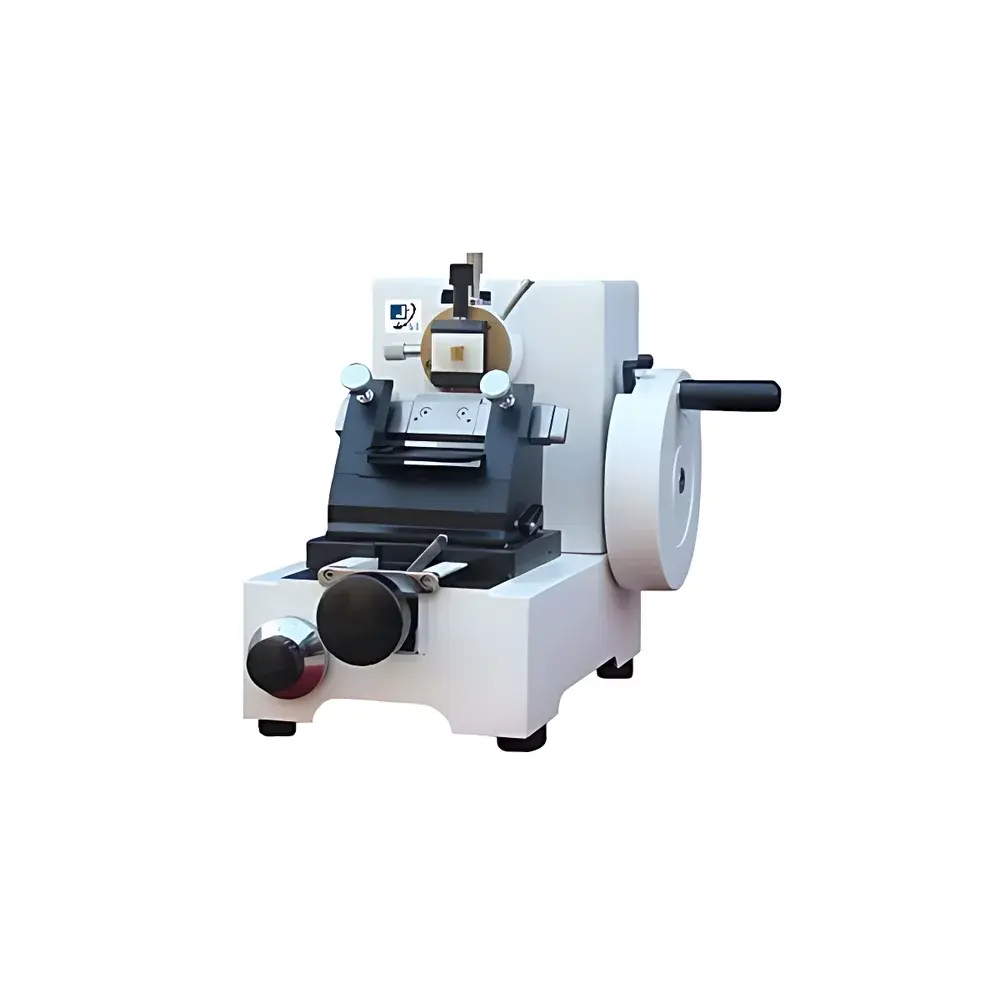
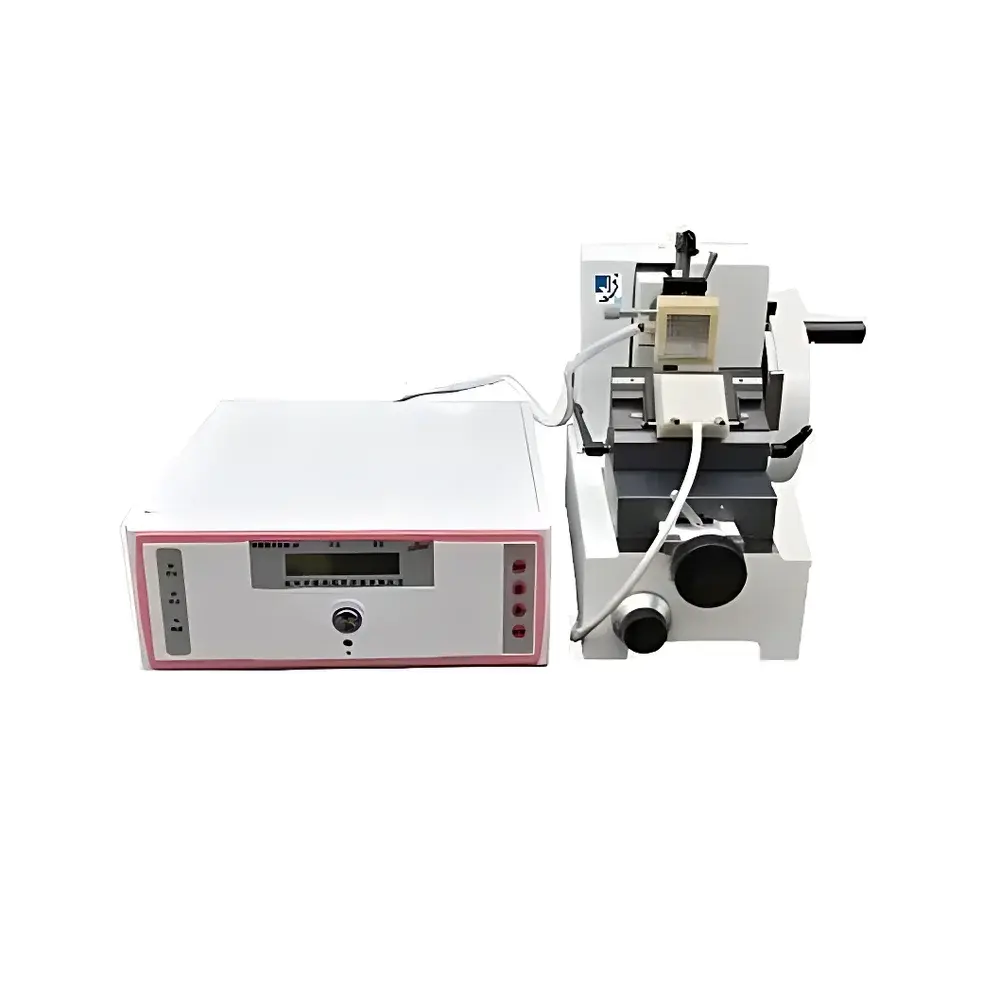
Jiayuan JY-2508 Rotary Microtome
| Brand | Jiayuan |
|---|---|
| Model | JY-2508 |
| Origin | Beijing, China |
| Maximum Sample Section Size | 60×40 mm |
| Section Thickness Range | 1–40 µm |
| Minimum Thickness Increment | 1 µm |
| Sectioning Accuracy | ±5% |
| Dimensions | 400×350×350 mm |
| Knife Holder Compatibility | Disposable blade holder (optional) |
| Guideway System | Precision crossed roller bearing guideways |
| Safety Feature | Right-hand single-hand locking handwheel |
Overview
The Jiayuan JY-2508 Rotary Microtome is a precision-engineered laboratory instrument designed for consistent, high-reproducibility sectioning of biological, botanical, and hard-tissue specimens embedded in paraffin, plastic, or resin matrices. Operating on the fundamental principle of rotary motion—where the specimen advances linearly toward a stationary cutting edge during each revolution of the handwheel—the JY-2508 delivers controlled, repeatable sections across a broad thickness range. Its mechanical architecture prioritizes stability and minimal hysteresis: the precision crossed roller bearing guideways eliminate lateral play and wear, ensuring long-term dimensional fidelity without lubrication or routine maintenance. Unlike entry-level microtomes relying on plain bearings or polymer sliders, this system maintains micron-level positional repeatability over thousands of cuts—critical for serial section reconstruction, histopathological grading, and correlative light-electron microscopy workflows.
Key Features
- Adjustable section thickness from 1 to 40 µm in 1 µm increments, calibrated via a vernier scale with tactile feedback and positive detent positioning.
- Dual-axis knife holder adjustment (X/Y translation) enables precise alignment of blade bevel angle and clearance angle relative to the specimen block face—essential for minimizing chatter, compression, and knife marks in brittle or heterogeneous tissues.
- Interchangeable sample chucks accommodate standard aluminum or brass specimen holders (e.g., Leica-compatible base plates), supporting rapid block changes without realignment.
- Ergonomic right-hand handwheel with integrated single-point locking mechanism allows secure pausing at any rotational position without releasing grip—reducing operator fatigue and mitigating accidental movement during block trimming or reorientation.
- Modular disposable blade holder (optional accessory) accepts both narrow (20 mm) and wide (30 mm) single-use steel blades, eliminating manual sharpening cycles and reducing cross-contamination risk between samples.
- Stainless-steel construction with powder-coated chassis ensures chemical resistance against xylene, ethanol, and chloroform used in routine deparaffinization and clearing steps.
Sample Compatibility & Compliance
The JY-2508 demonstrates exceptional versatility across specimen categories requiring differential hardness handling: soft mammalian tissues (e.g., liver, brain), semi-rigid plant stems and seeds, mineralized bone and calcified cartilage, polymer-embedded dental composites, carbon-fiber-reinforced resins, and keratin-rich structures such as hair shafts and nail plates. Its robust feed mechanism and optimized blade geometry suppress fragmentation in brittle specimens while maintaining ribbon integrity for ribbons ≥50 mm in length. The instrument complies with ISO 13485 design control principles for medical device manufacturing environments and supports GLP-compliant documentation when paired with external logbooks or LIMS-integrated tracking. While not FDA-cleared as a diagnostic device, its performance aligns with ASTM E112-22 (standard test methods for determining average grain size) and USP (microscopic examination of dosage forms) for qualitative morphological analysis.
Software & Data Management
The JY-2508 operates as a fully manual, non-motorized platform with no embedded electronics or digital interface—intentionally engineered to maximize mechanical reliability and minimize electromagnetic interference in sensitive imaging labs. All operational parameters (thickness setting, number of sections, blade change timestamp) are recorded manually per institutional SOPs. For laboratories requiring audit trails, the microtome integrates seamlessly with electronic lab notebooks (ELNs) such as LabArchives or Benchling via standardized metadata templates (e.g., “Instrument ID: JY-2508-07”, “Section Thickness: 5 µm”, “Block ID: H23-0442”). Optional barcode-labeled specimen holders facilitate traceability in high-throughput histology cores compliant with CAP and CLIA requirements.
Applications
- Routine histology: Paraffin-embedded tissue sectioning for H&E, IHC, and special stains in clinical pathology and academic research.
- Botanical morphology: Transverse and longitudinal sections of lignified vascular bundles, seed coats, and root nodules without collapse or shearing.
- Hard-tissue histology: Undecalcified bone and teeth sections for dynamic histomorphometry, fluorochrome labeling analysis, and cement line visualization.
- Materials science: Sectioning of epoxy-embedded composites, thermoset polymers, and fiber-reinforced laminates for SEM/EDS interface characterization.
- Forensic anthropology: Precise slicing of fragmented skeletal elements for micro-CT correlation and porosity mapping.
- Quality control: Final inspection of pharmaceutical tablet coatings, transdermal patch layers, and hydrogel matrix uniformity.
FAQ
What types of disposable blades are compatible with the JY-2508?
The optional disposable blade holder accepts standard 20 mm narrow and 30 mm wide steel blades conforming to DIN 69000 dimensions.
Is the JY-2508 suitable for cryosectioning?
No—it is designed exclusively for room-temperature sectioning of embedded specimens; cryogenic operation requires a dedicated freezing microtome with thermal stabilization.
Can the section thickness calibration be verified independently?
Yes—users may validate accuracy using NIST-traceable stage micrometers or interferometric thickness standards per ISO 8596.
Does the microtome include vibration-damping feet?
Standard configuration includes adjustable rubber-isolated leveling feet; optional granite base plates are available for ultra-stable mounting on optical tables.
What maintenance schedule is recommended?
Biannual visual inspection of guideway cleanliness and handwheel gear meshing; no scheduled lubrication required due to sealed roller bearing design.
Related Products



