
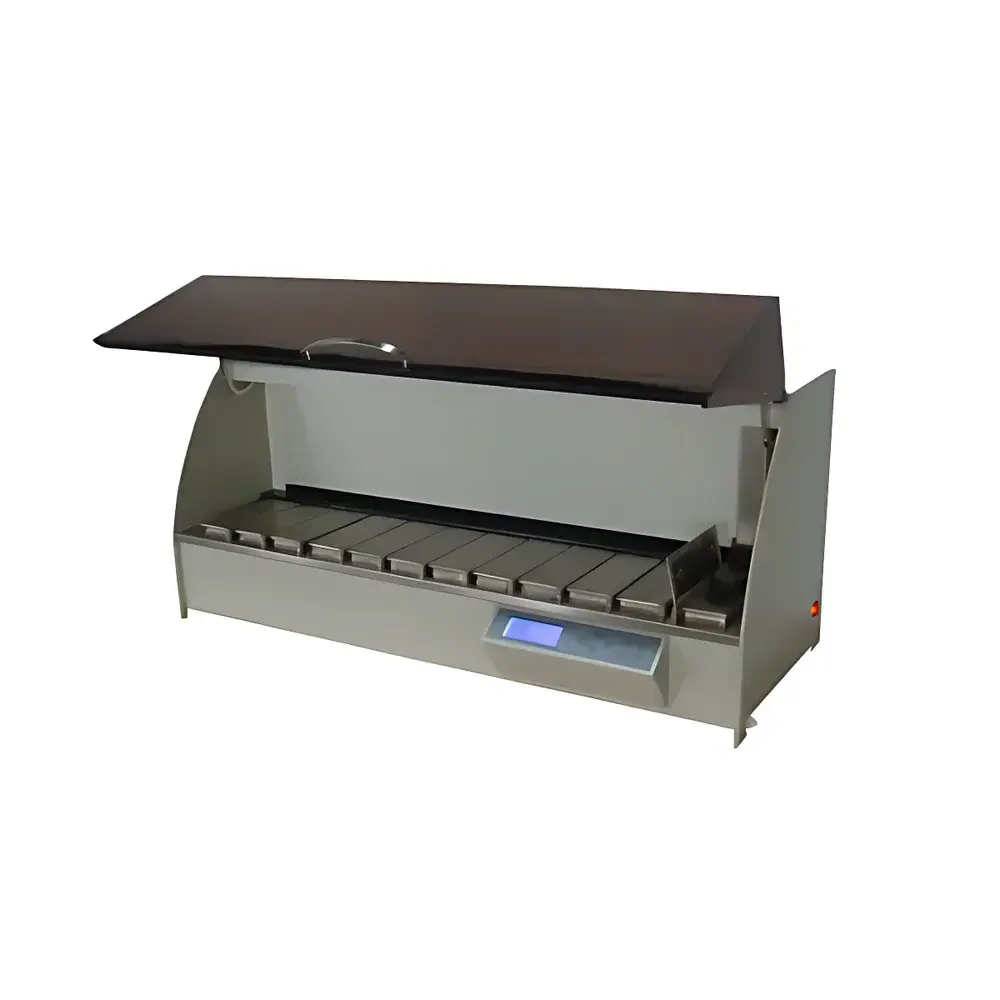
ZEEDO HS-1000 Fully Automated Tissue Dehydrator
| Brand | ZEEDO |
|---|---|
| Origin | Zhejiang, China |
| Manufacturer Type | Authorized Distributor |
| Country of Origin | China |
| Model | HS-1000 |
| Price | USD 5,500 (FOB) |
| Number of Reagent Stations | 12 (9 reagent jars + 3 paraffin wax baths) |
| Processing Time per Station | Stations 1–9: 0–99 hrs adjustable |
| Stations 10–12 | 0–24 hrs adjustable |
| Wax Bath Temperature Range | Ambient to 99 °C, digitally controlled |
| Heating Method | Dry-type internal heating |
| Single Jar Capacity | 1000 mL |
| Temperature Control Accuracy | ±2 °C |
| Agitation Frequency | 2 cycles/min |
| Power Failure Protection | >6 hrs autonomous operation without external battery backup |
| Operating Ambient Temperature | 0–40 °C |
| Input Voltage | 220 VAC, 50 Hz |
| Rated Power | 800 W |
| Dimensions (W×D×H) | 1000 × 420 × 450 mm |
| Net Weight | 80 kg |
Overview
The ZEEDO HS-1000 Fully Automated Tissue Dehydrator is a microprocessor-controlled, vacuum-assisted tissue processor engineered for high-fidelity histological specimen preparation in clinical pathology, academic research, and pharmaceutical preclinical laboratories. It implements a sequential solvent exchange protocol—typically progressing through graded ethanol concentrations (e.g., 70%, 80%, 95%, 100%), xylene or xylene substitutes, and molten paraffin wax—to replace water in fixed biological tissues with infiltrating media compatible with subsequent microtomy. The system integrates vacuum-assisted infiltration to enhance penetration kinetics and reduce processing time while minimizing structural distortion. Designed for ISO 13485-aligned manufacturing environments and compliant with GLP documentation requirements, the HS-1000 supports traceable, repeatable dehydration cycles essential for diagnostic-grade sectioning and IHC/ISH compatibility.
Key Features
- Vacuum-enhanced fluid exchange across 12 independently programmable stations (9 reagent jars + 3 paraffin baths), enabling precise control over dehydration, clearing, and infiltration phases
- Dry-type internal heating system with ±2 °C thermal stability across all wax baths, eliminating water bath contamination risks and ensuring consistent paraffin viscosity
- Programmable agitation at 2 cycles per minute per station to promote uniform reagent diffusion and prevent tissue settling
- Integrated activated carbon–based closed-loop air purification system that continuously recirculates and filters volatile organic compounds (VOCs), including xylene and alcohol vapors, meeting OSHA PEL and EU Directive 2004/37/EC occupational exposure limits
- Intelligent fault detection and self-recovery logic: automatically pauses on sensor anomaly (e.g., temperature drift, lid open, low fluid level), logs event timestamp, and resumes from last valid step upon correction
- Large-format backlit monochrome LCD interface with Chinese/English bilingual menu navigation, supporting up to 10 user-defined protocols with cycle name, step duration, temperature, and agitation parameters
- Uninterruptible operation capability: onboard power management sustains active processing for >6 hours during grid failure—no external UPS or battery required
Sample Compatibility & Compliance
The HS-1000 accommodates standard histology cassettes (e.g., 30 × 25 × 5 mm), biopsy specimens (up to 2 cm³ volume), and whole-organ slices (max. thickness 5 mm). It supports common fixatives (10% neutral buffered formalin, Bouin’s, Zenker’s) and alternative clearing agents (limonene, chloroform, d-limonene-based substitutes). All wetted components are constructed from chemically resistant polypropylene and stainless steel 316, certified per ASTM F2102 for repeated exposure to alcohols, aromatic hydrocarbons, and molten paraffin (≤65 °C). The device meets CE marking requirements under the EU In Vitro Diagnostic Medical Devices Regulation (IVDR) Annex I General Safety and Performance Requirements and is validated for use in laboratories operating under CAP-accredited, CLIA-certified, or ISO/IEC 17025-compliant quality systems.
Software & Data Management
While the HS-1000 operates via embedded firmware without PC connectivity, it maintains full-cycle audit trails stored in non-volatile memory: each run logs start/end timestamps, executed protocol ID, real-time temperature readings per wax bath, vacuum pressure events, agitation confirmation signals, and any operator-initiated overrides. Export is supported via USB flash drive (FAT32 formatted) in CSV format, compatible with LIMS integration (e.g., Sunquest, Cerner CoPath, QIAGEN QIAreach). All data records include digital signatures per FDA 21 CFR Part 11–compliant electronic record architecture—user authentication, immutable timestamps, and change history tracking ensure compliance with GLP/GMP documentation standards.
Applications
- Routine surgical pathology: high-throughput dehydration of biopsy and resection specimens prior to paraffin embedding
- Academic morphology studies: standardized processing of murine, porcine, or botanical tissues for comparative histology
- Toxicologic pathology: batch processing of multi-dose animal study tissues under SOP-controlled conditions
- Biobanking: archival-quality dehydration for long-term tissue preservation where RNA/DNA integrity must be preserved post-fixation
- Diagnostic immunohistochemistry: optimized dehydration minimizes epitope masking and ensures uniform antibody penetration
FAQ
What vacuum level does the HS-1000 achieve during infiltration cycles?
The system generates a stable vacuum of –0.085 MPa (–640 mmHg) using an oil-free diaphragm pump, sufficient for efficient removal of interstitial air without cellular collapse.
Can the HS-1000 be integrated into a fully automated histology line?
Yes—its RS-485 serial interface supports Modbus RTU communication for handshake signaling with downstream embedding stations (e.g., ZEEDO ATB-300) and LIMS dispatch triggers.
Is validation documentation (IQ/OQ/PQ) available?
Comprehensive validation kits—including test protocols, blank forms, and acceptance criteria aligned with ASTM E2500 and ISO 13485—are provided with each unit and updated annually via secure customer portal access.
How often must the activated carbon filter be replaced?
Under typical usage (15–20 cycles/week), replacement is recommended every 6 months; filter life is monitored via integrated pressure-drop sensor and logged in the audit trail.
Does the HS-1000 support xylene-free processing workflows?
Yes—the reagent scheduling logic accommodates alcohol–limonene–paraffin sequences, and temperature profiles are adjustable to match low-toxicity clearing agent volatility curves.




