
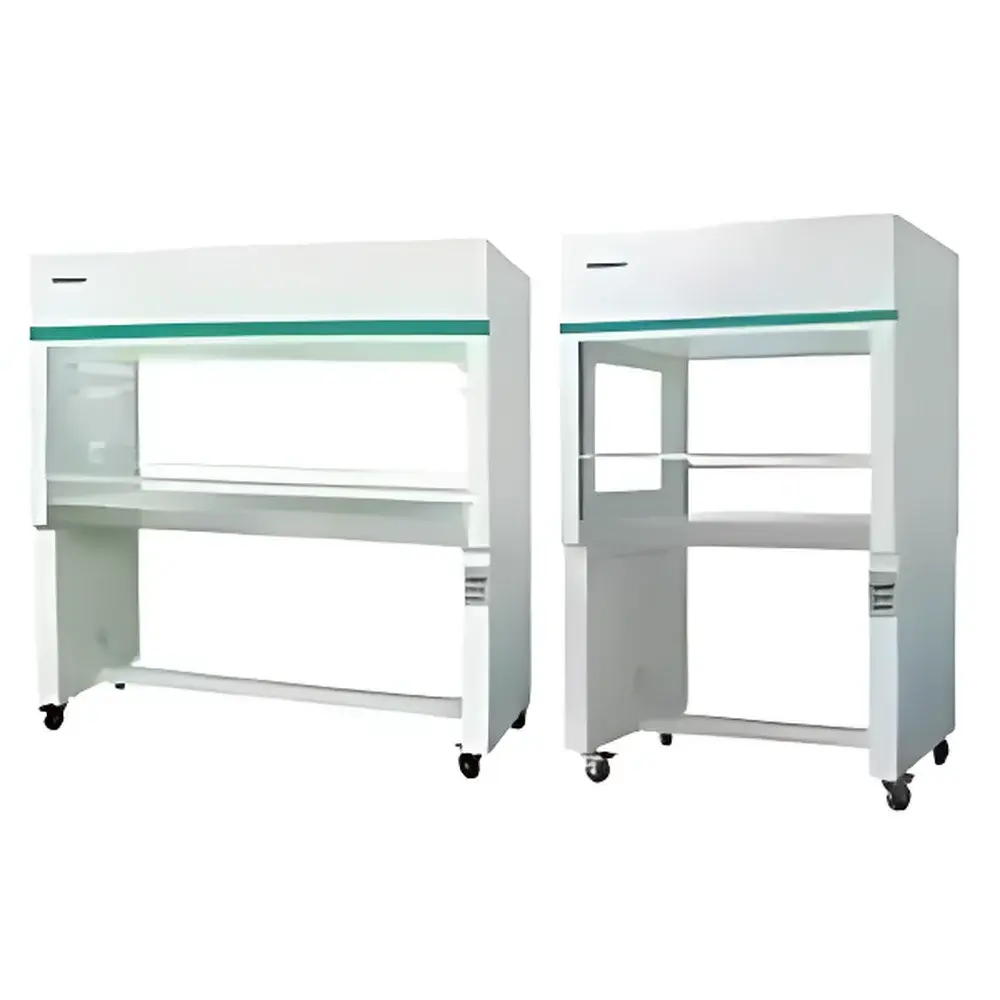
SW-CJ-2F Vertical Laminar Flow Clean Bench
| Origin | Jiangsu, China |
|---|---|
| Manufacturer Type | Authorized Distributor |
| Product Origin | Domestic (China) |
| Model | SW-CJ-2F |
| Instrument Category | Vertical Flow Clean Bench |
| Cleanliness Class | ISO 5 (Class 100 per US Federal Standard 209E) |
| Noise Level | ≤62 dB(A) |
| User Capacity | Dual-user, dual-sided operation |
| Airflow Pattern | Vertical unidirectional laminar flow |
| Work Surface | Seamless stainless steel |
| Lighting & UV Interlock | Yes |
| Compliance | Meets GB/T 25915.1–2021 (ISO 14644-1), YY 0569–2011 (for clean bench safety), and general medical device electrical safety requirements (IEC 61010-1) |
Overview
The SW-CJ-2F Vertical Laminar Flow Clean Bench is an ISO 5-certified (Class 100 per US Federal Standard 209E) laboratory containment system engineered for non-hazardous applications requiring particulate-free environments. It operates on the principle of vertical unidirectional laminar airflow: air is drawn through a pre-filter, conditioned by a centrifugal fan, and then passed through a high-efficiency particulate air (HEPA) filter (≥99.995% @ 0.3 µm) before being delivered downward at a uniform velocity across the work surface. This airflow pattern creates a sterile barrier that protects samples from ambient contamination—ideal for aseptic techniques in cell culture, microbiological media preparation, pharmaceutical weighing, and precision electronics assembly. Unlike biological safety cabinets, the SW-CJ-2F does not protect personnel or the environment from biohazards; it is strictly a product-protection device compliant with ISO 14644-1 and Chinese national standard GB/T 25915.1–2021.
Key Features
- Seamless one-piece stainless steel work surface — corrosion-resistant, non-porous, and validated for easy decontamination using ethanol, isopropanol, or low-concentration sodium hypochlorite solutions.
- Dual-user, dual-sided configuration — optimized for collaborative workflows with symmetrical access, independent lighting/UV controls per side, and balanced airflow distribution.
- Adjustable centrifugal blower system — equipped with touch-sensitive voltage control enabling continuous wind speed modulation within the certified operational range (≥0.3 m/s average, ISO 5-compliant).
- Interlocked UV germicidal lamp (14 W) and fluorescent task lighting (14 W × 2) — prevents accidental UV exposure during operation and ensures ≥300 lux illumination at the working plane per ISO 8596 and GB 50034.
- Robust enclosure construction — powder-coated cold-rolled steel frame with integrated acoustic dampening to maintain noise levels ≤62 dB(A) at 1 m distance, meeting ISO 7779 and GB/T 2888–2013 criteria.
- Integrated HEPA filtration — single 820 × 650 × 50 mm filter with validated retention efficiency and documented filter integrity test (DOP/PAO scan report available upon request).
Sample Compatibility & Compliance
The SW-CJ-2F supports open-vessel handling of non-pathogenic samples, including Petri dishes, tissue culture flasks, vials, syringes, and microcentrifuge tubes. Its vertical laminar flow architecture ensures minimal turbulence and consistent particle removal—validated via airborne particle counters (e.g., Met One GT-526) per ISO 14644-1:2015 Annex B. The unit complies with YY 0569–2011 (Chinese standard for clean benches), GB/T 25915.1–2021 (equivalent to ISO 14644-1), and general electrical safety requirements per IEC 61010-1:2010. While not certified to NSF/ANSI 49 or EN 12469, it is suitable for GLP-aligned laboratories performing non-regulated aseptic procedures. Documentation includes factory calibration certificates for airflow velocity and filter integrity.
Software & Data Management
The SW-CJ-2F is a standalone mechanical system with no embedded microprocessor or digital interface. All operational parameters—including fan speed, lighting, and UV activation—are controlled via tactile switches with physical feedback. For laboratories requiring auditability, optional analog-to-digital data loggers (e.g., Testo 176 H2) can be externally mounted to record real-time airflow velocity, ambient temperature, and relative humidity. No firmware, cloud connectivity, or FDA 21 CFR Part 11 compliance is provided, as the device falls outside regulated instrument classification per ICH Q7 and EU GMP Annex 1 (2022) definitions for “critical process equipment.”
Applications
- Aseptic transfer of mammalian and insect cell lines in academic and biotech R&D labs.
- Preparation of culture media, reagents, and buffers under controlled particulate conditions.
- Weighing of active pharmaceutical ingredients (APIs) where cross-contamination must be avoided.
- Assembly and testing of microelectromechanical systems (MEMS) and optical components sensitive to sub-micron debris.
- Seed propagation and plant tissue culture in horticultural research facilities.
- Quality control sampling in food and beverage production environments aligned with ISO 22000 hygiene prerequisites.
FAQ
What is the difference between a clean bench and a biological safety cabinet?
A clean bench provides unidirectional laminar airflow to protect samples only; it does not protect users from aerosolized biological agents. A biological safety cabinet (BSC) uses recirculated and exhausted airflow with negative pressure containment to protect personnel, product, and environment—required for work with Risk Group 2+ agents.
Does the SW-CJ-2F require ducted exhaust installation?
No. It is a recirculating system: >70% of filtered air is redirected into the work area; no external venting or make-up air system is needed.
Can this unit be used for handling antibiotics or cytotoxic drugs?
No. It offers no personnel protection against hazardous vapors or aerosols. Such applications require a ventilated balance enclosure or a Type II BSC.
What maintenance is required for HEPA filter longevity?
Pre-filters should be cleaned weekly with isopropyl alcohol; HEPA filters are typically replaced every 12–24 months depending on usage intensity and ambient particulate load—verified via in-situ filter integrity testing.
Is third-party certification available for ISO 5 validation?
Yes. Accredited ISO 17025 laboratories (e.g., SGS, TÜV Rheinland, or CNAS-recognized domestic providers) can perform on-site particle count, airflow uniformity, and filter leak testing per ISO 14644-3.



