
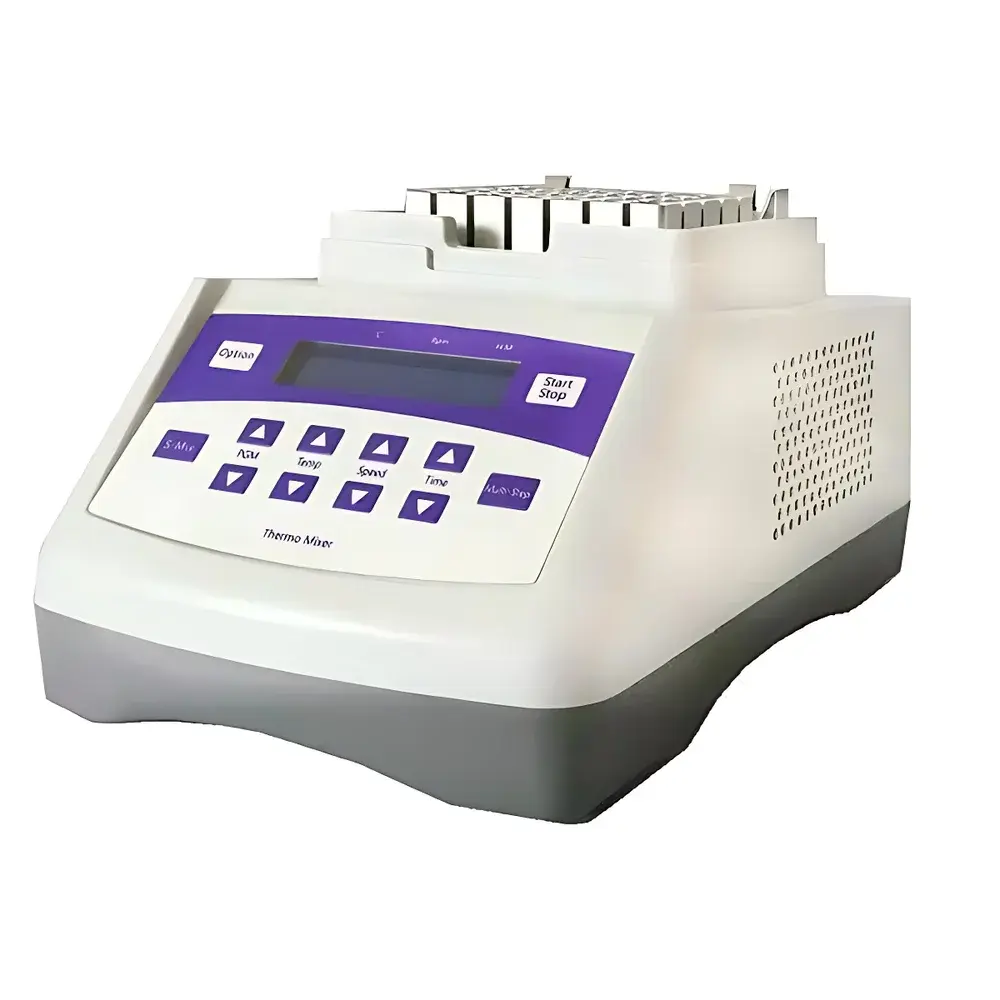
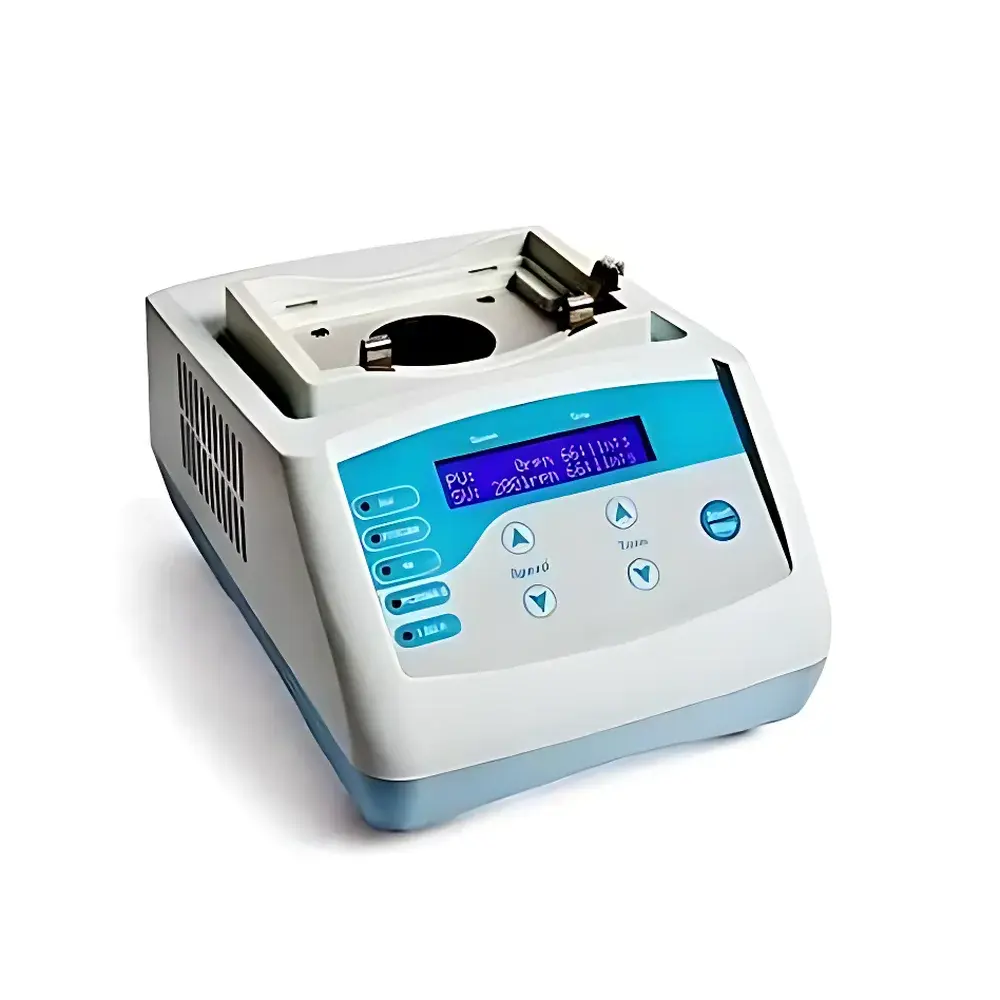
Deers DS MS-100 Heated Oscillating Metal Block Incubator Shaker
| Brand | Deers/DS |
|---|---|
| Origin | Beijing, China |
| Manufacturer Type | Authorized Distributor |
| Product Category | Domestic |
| Model | MS-100 Heated |
| Pricing | USD 980 (FOB) |
| Instrument Type | Compact Programmable Temperature-Controlled Shaker |
| Timer Range | 0–99 h 59 min |
| Oscillation Speed | 300–2000 rpm |
| Oscillation Amplitude | 3 mm (Horizontal Orbital) |
| Temperature Range | Ambient +5°C to 100°C |
| Temperature Uniformity | ≤ ±0.3°C |
| Temperature Stability | ±0.3°C |
| Display Resolution | 0.1°C |
| Heating Rate | <15 min (20°C → 100°C) |
| Power Consumption | 200 W |
| Dimensions (W×D×H) | 270 × 190 × 170 mm |
| Net Weight | 8.3 kg |
| Plate Configuration | Single interchangeable aluminum block platform |
Overview
The Deers DS MS-100 Heated Oscillating Metal Block Incubator Shaker is an integrated thermal and mechanical platform engineered for precise, reproducible sample incubation, mixing, and temperature-controlled agitation in molecular biology, clinical diagnostics, and pharmaceutical R&D workflows. Unlike conventional water baths or standalone shakers, the MS-100 employs direct-contact conductive heating via a solid aluminum metal block—eliminating liquid medium variability and enabling rapid, uniform thermal response across all mounted sample formats. Its horizontal orbital oscillation mechanism operates on the principle of controlled centrifugal force generation at defined amplitude and frequency, ensuring homogeneous suspension of viscous or particulate samples without vortexing-induced shear damage. Designed for benchtop use in ISO 13485-aligned labs and GLP-compliant environments, the instrument supports traceable temperature control and programmable agitation profiles essential for enzyme kinetics, cell lysis optimization, immunoassay incubation, and nucleic acid hybridization protocols.
Key Features
- Microprocessor-controlled PID temperature regulation with real-time feedback loop, delivering ≤ ±0.3°C uniformity across the entire block surface.
- High-torque DC brushless motor ensures stable rotational speed (300–2000 rpm) with <±2% speed deviation under load, even during extended operation.
- Programmable timer with 1-second resolution and memory retention; supports up to 99 hours 59 minutes continuous run time with auto-shutdown.
- Power-fail recovery function automatically resumes pre-interruption settings—including temperature setpoint, rpm, and remaining time—upon power restoration.
- Interchangeable aluminum modules (A–N series) accommodate standard labware: 0.2 mL PCR tubes, 96-well PCR plates (full/skirted/non-skirted), 1.5/2.0 mL microcentrifuge tubes, deep-well plates (96-/384-well), MTPs, and custom-sized vessels (e.g., 5 mL, 15 mL, 50 mL tubes).
- Onboard calibration mode enables user-initiated temperature offset adjustment per module type, supporting metrological traceability per ISO/IEC 17025 requirements.
- Integrated safety architecture includes overtemperature cutoff, motor stall protection, lid-open detection, and CE-certified electrical insulation compliant with IEC 61010-1.
Sample Compatibility & Compliance
The MS-100 accommodates a broad spectrum of consumables used in life science laboratories—including thin-walled PCR tubes, skirted and non-skirted 96-well plates, enzymatic assay microplates, and conical-bottom deep-well plates—without requiring adapter accessories. Its modular design allows users to select thermally optimized blocks based on thermal mass and heat transfer efficiency for specific applications (e.g., A96 for high-throughput qPCR setup; K24 for low-speed 5 mL tube homogenization). The device meets CE marking requirements for laboratory equipment (2014/30/EU EMC Directive and 2014/35/EU LVD Directive) and adheres to RoHS 2011/65/EU material restrictions. While not FDA 21 CFR Part 11–validated out-of-the-box, its audit-ready operational logs (accessible via USB export) support integration into GxP environments when paired with documented SOPs and periodic verification per ASTM E2500 and USP .
Software & Data Management
The MS-100 operates autonomously via its front-panel keypad and dual-line LCD display, eliminating dependency on external computers. All critical parameters—including setpoints, elapsed time, current temperature, and actual rpm—are continuously logged in non-volatile memory. A dedicated USB port enables export of session records (CSV format) for post-run analysis and quality documentation. Optional firmware updates (distributed via Deers technical support portal) maintain compatibility with evolving regulatory expectations, including enhanced timestamping granularity and password-protected parameter locking for QA/QC personnel. For laboratories implementing electronic lab notebooks (ELNs), exported logs can be imported directly into platforms such as LabArchives or Benchling for full experimental provenance tracking.
Applications
- Thermal cycling support for hot-start PCR and touchdown amplification protocols requiring simultaneous heating and gentle mixing.
- Enzyme-linked immunosorbent assay (ELISA) plate incubation with agitation to reduce nonspecific binding and improve signal-to-noise ratios.
- Bacterial transformation recovery steps where temperature-sensitive plasmid uptake benefits from synchronized warming and resuspension.
- Protein solubilization and antigen retrieval in histopathology workflows using heated agitation instead of static incubation.
- Cell culture reagent preparation involving viscous buffers (e.g., methylcellulose-based media), where orbital shaking prevents sedimentation without foaming.
- Quality control testing of diagnostic kits under standardized temperature-and-agitation conditions per CLSI EP23-A guidelines.
FAQ
Is the MS-100 compatible with refrigerated operation?
No—the MS-100 is a heated-only model. For combined heating/cooling functionality, refer to the MSC-100 dual-temperature variant.
Can multiple modules be installed simultaneously?
No—the unit features a single-platform configuration. Modules are manually swapped depending on application requirements.
What is the maximum recommended load for the 50 mL tube module (M6×50mL)?
For optimal thermal uniformity and mechanical stability, do not exceed 40 mL fill volume per tube when operating above 60°C or at speeds >600 rpm.
Does the instrument support remote monitoring or network connectivity?
Not natively. Remote access requires third-party serial-to-Ethernet gateways configured per local IT security policy.
How often should temperature calibration be performed?
Per ISO/IEC 17025 best practices, perform initial verification upon installation, then annually—or after any physical impact or maintenance event—with NIST-traceable reference thermometers.




