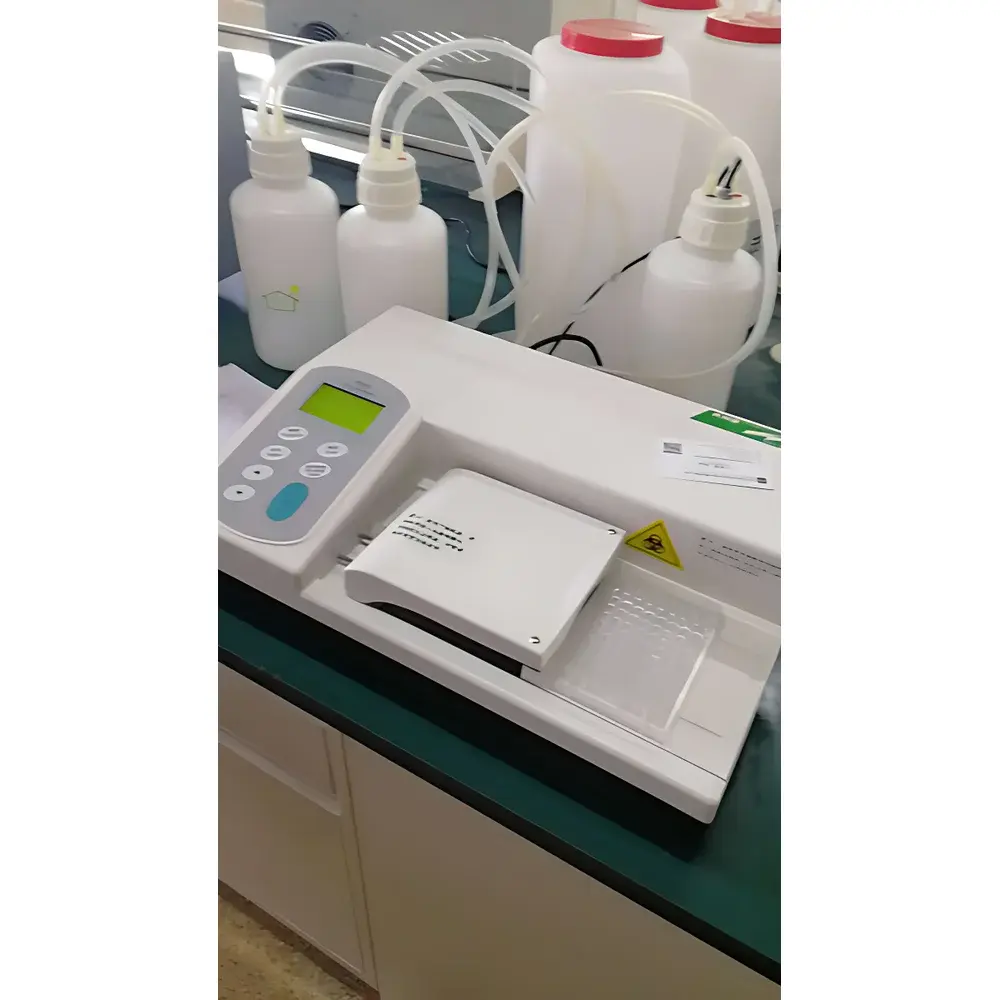
Kehua ST-36WT Automated Microplate Washer
| Origin | Shanghai, China |
|---|---|
| Manufacturer Type | Authorized Distributor |
| Origin Category | Domestic (PRC) |
| Model | ST-36WT |
| Price | USD 2,250 (FOB Shanghai) |
| Instrument Type | Multifunctional Plate Washer |
| Wash Head Configuration | 1×8 or 1×12 disposable tip manifold |
| Wash Channels | 3 independent fluid paths |
| Soak Time Range | 0–19 min 59 s (adjustable in 1-s increments) |
| Wash Cycles | 0–99 (programmable) |
| Residual Liquid Volume | ≤0.5 µL per well after aspiration |
| Plate Shaking Function | Yes |
| Plate Compatibility | 96-well and 48-well microplates (U-, V-, and flat-bottom formats) |
| Aspiration/Dispense Mechanism | Dual diaphragm pump system |
| Liquid Level Sensing | Integrated optical liquid level detection with real-time alarm output |
| Onboard Memory | ≥100 user-defined wash protocols |
| Fluid Reservoirs | 2 L wash solution bottle, 2 L waste bottle, 2 L rinse/buffer bottle |
| Dispense Volume Range | 0–4200 µL per cycle (incremental step ≤50 µL) |
| Dispense Precision | CV ≤2% (at 300 µL/well, 96-well plate) |
| Aspiration Mode | Standard or sweep mode |
| Plate Positioning | Vertically and horizontally adjustable wash head |
| Power Supply | 200–240 VAC, 50/60 Hz |
Overview
The Kehua ST-36WT Automated Microplate Washer is an engineered solution for high-reproducibility plate washing in ELISA, immunoassay, cell-based assay, and molecular biology workflows. Designed to meet the operational rigor of clinical diagnostics laboratories, blood banks, and public health testing centers, it employs a dual-diaphragm pump architecture to deliver precise, low-variability aspiration and dispense cycles across 96- or 48-well microplates. Its core functionality adheres to standardized microplate washing principles defined in CLSI EP25-A and ISO 15197:2013 Annex B—ensuring consistent removal of unbound reagents while minimizing cross-well carryover and residual volume. The instrument operates on a fixed-tip manifold platform (1×8 or 1×12 configuration), eliminating nozzle clogging risks associated with capillary-based systems and enabling robust handling of viscous or particulate-containing buffers.
Key Features
- Three independent wash fluid channels support sequential or parallel delivery of wash buffer, rinse solution, and deionized water—enabling multi-step protocols without manual intervention.
- Adjustable vertical and horizontal wash head positioning ensures optimal tip immersion depth and alignment across plate batches, critical for maintaining uniform aspiration efficiency across all wells.
- Programmable soak time (0–19 min 59 s) and wash cycles (0–99) allow fine-tuned optimization for diverse assay chemistries—including high-affinity antibody binding steps requiring extended incubation before washing.
- Optical liquid level sensing continuously monitors reservoir volumes and triggers audible/visual alerts upon low-fluid or overflow conditions—supporting uninterrupted operation during overnight runs.
- Integrated plate shaking function (orbital oscillation, 300–900 rpm selectable) enhances removal of loosely bound antigens or cellular debris prior to final aspiration.
- Dual-pump aspiration system delivers ≤0.5 µL residual volume per well under validated conditions, meeting performance benchmarks cited in USP for assay reproducibility in quantitative immunoassays.
Sample Compatibility & Compliance
The ST-36WT accommodates standard ANSI/SBS-compliant 96-well and 48-well microplates with U-, V-, and flat-bottom geometries. It supports plates made from polystyrene, polypropylene, and surface-treated polymers used in coated ELISA plates. All fluid pathways are chemically resistant to common assay buffers (e.g., PBS, Tris-HCl, Tween-20 solutions, 0.1 M HCl, and 0.1 M NaOH). The system complies with IEC 61010-1:2010 for laboratory equipment safety and meets electromagnetic compatibility requirements per EN 61326-1:2013. While not pre-certified for FDA 21 CFR Part 11, its protocol memory (≥100 programs), timestamped run logs, and non-volatile parameter storage provide foundational traceability required for GLP/GMP-aligned environments when paired with appropriate lab SOPs.
Software & Data Management
Operation is managed via a 5.7-inch monochrome LCD interface with tactile membrane keys—designed for glove-compatible use in biosafety cabinets and cleanroom settings. No external PC or proprietary software is required; all parameters—including dispense volume per channel, soak duration, aspiration speed, and shake amplitude—are configured directly on-device. Protocol recall supports rapid switching between assay-specific wash methods (e.g., “ELISA Standard,” “Neutralizing Antibody Wash,” “Cell-Based Assay Rinse”). Each executed wash cycle stores metadata (date/time, protocol ID, operator code if entered, plate barcode if scanned via optional USB barcode reader), facilitating audit-ready documentation. Export of run logs is available via USB flash drive in CSV format for integration into LIMS or quality management systems.
Applications
- Routine ELISA processing in clinical diagnostic labs, including infectious disease serology (HBV, HIV, HCV), autoimmune marker screening (ANA, RF), and allergy IgE testing.
- Preparation of microplates for chemiluminescent and fluorescent immunoassays where low background and minimal residual enzyme activity are essential.
- Cell culture plate washing prior to fixation/permeabilization in flow cytometry and immunofluorescence workflows.
- High-throughput screening support in academic and contract research organizations performing cytokine profiling or phospho-protein detection.
- Quality control washing in biomanufacturing environments for residual host-cell protein removal validation studies.
FAQ
Does the ST-36WT support barcoded plate identification?
Yes—when equipped with an optional USB barcode scanner, the instrument can log plate IDs and associate them with protocol execution records.
Can wash parameters be locked to prevent unauthorized modification?
Yes—administrator-level password protection is available for critical parameters including dispense volume limits, maximum soak time, and aspiration pressure thresholds.
Is calibration verification supported?
The device includes built-in self-test routines for pump priming, valve sequencing, and sensor response validation; users may perform volumetric verification using gravimetric methods per ISO 8655-6 guidelines.
What maintenance is required for long-term reliability?
Daily wiping of the wash head and aspiration manifold, weekly cleaning of fluid path filters, and quarterly inspection of diaphragm pump integrity constitute the recommended preventive maintenance schedule.
Is the ST-36WT compatible with third-party microplate sealers or stackers?
It features standard ANSI/SBS footprint dimensions and programmable pause/resume signaling, enabling integration into semi-automated benchtop workflows with compatible peripheral devices.
Related Products