
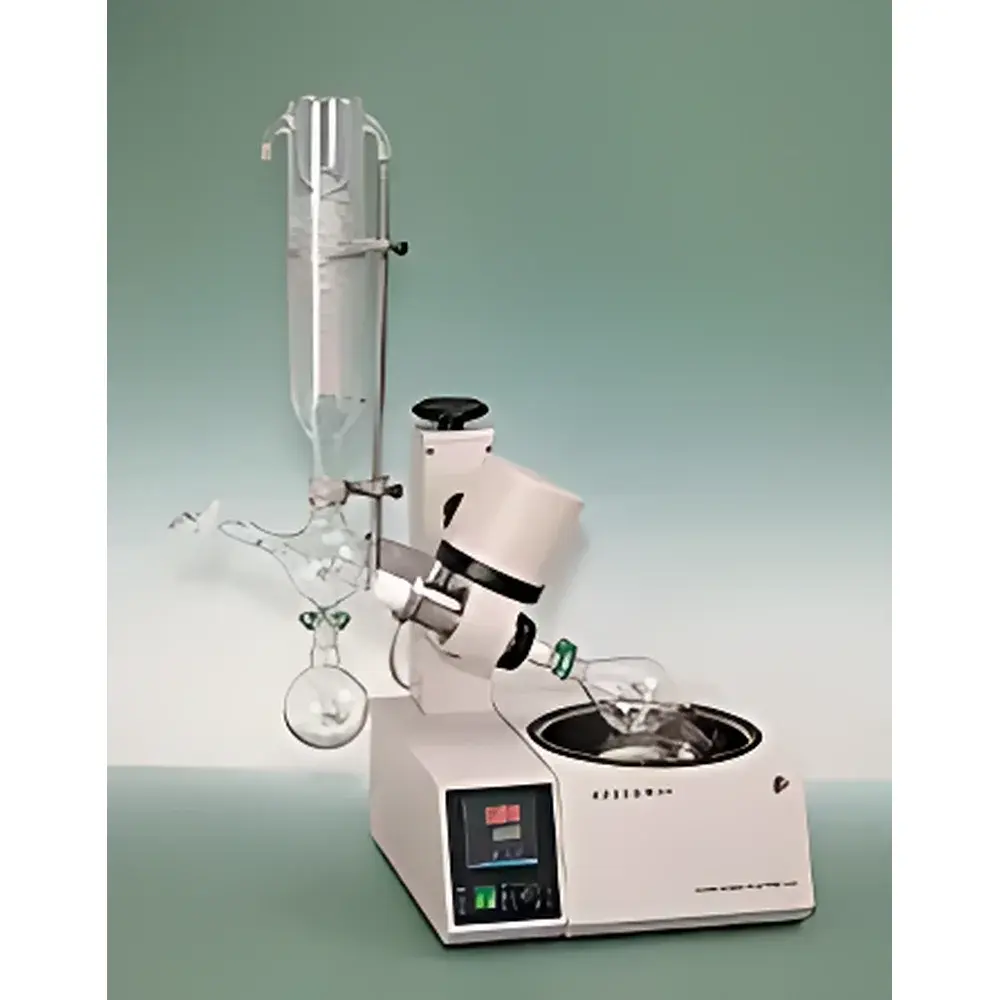
Zhenjie RE-52AA Rotary Evaporator
| Origin | Shanghai, China |
|---|---|
| Manufacturer Type | Authorized Distributor |
| Origin Category | Domestic (PRC) |
| Model | RE-52AA |
| Rotational Speed Range | 0–120 rpm |
| Heating Bath Temperature Range | Ambient to 100 °C |
| Condenser Type | Vertical large-bore dual coiled condenser |
| Max Rotating Flask Capacity | 2 L |
| Max Collecting Flask Capacity | 2 L |
| Lifting Mechanism | Motorized vertical lift |
| Total Power Consumption | 1.2 kW |
Overview
The Zhenjie RE-52AA Rotary Evaporator is an engineered solution for efficient, controlled solvent removal under reduced pressure in research laboratories, quality control environments, and pilot-scale synthesis workflows. Operating on the principle of rotary evaporation—where a rotating flask increases surface area and promotes uniform thin-film formation while vacuum lowers boiling points—the RE-52AA enables gentle, reproducible concentration and purification of heat-sensitive compounds. Its design prioritizes operational stability, thermal consistency, and mechanical reliability across extended duty cycles. The system integrates a motor-driven lifting mechanism for precise vertical positioning of the rotating assembly relative to the heating bath, minimizing manual intervention and enhancing repeatability during batch processing. With a maximum rotating flask capacity of 2 L and matching 2 L ground-glass joint collecting flask, the RE-52AA bridges the gap between benchtop versatility and scalable sample throughput—making it suitable for synthetic chemistry, natural product isolation, pharmaceutical intermediate purification, and academic teaching applications where consistent vacuum distillation performance is required.
Key Features
- Motorized vertical lift mechanism ensures smooth, repeatable flask immersion and retraction—critical for maintaining consistent bath contact and preventing thermal shock or mechanical stress on glassware.
- Adjustable rotational speed range of 0–120 rpm allows optimization of film thickness and evaporation kinetics for diverse solvent viscosities and boiling points.
- Heating bath with digitally regulated temperature control (ambient to 100 °C) provides stable thermal input; silicone oil or water bath compatibility supports both high- and low-temperature evaporation protocols.
- Vertical large-bore dual coiled condenser maximizes condensation surface area and improves cooling efficiency—especially beneficial for low-boiling solvents such as diethyl ether, dichloromethane, or ethyl acetate.
- All critical joints feature standardized ground-glass interfaces (typically 24/29 or 29/32 taper), ensuring vacuum integrity and interchangeability with common laboratory glassware.
- Robust aluminum alloy frame and corrosion-resistant stainless-steel bath housing contribute to long-term structural integrity and resistance to chemical exposure.
Sample Compatibility & Compliance
The RE-52AA accommodates a broad spectrum of organic and aqueous solutions, including polar and non-polar solvents, reaction mixtures, crude extracts, and polymer solutions—provided vapor pressure and thermal stability permit safe operation within its specified temperature and vacuum envelope. It is compatible with standard rotary evaporation accessories: vacuum controllers (mechanical or electronic), cold traps, chiller units, and inert gas manifolds. While not certified to specific regulatory standards (e.g., ISO/IEC 17025 or FDA 21 CFR Part 11) as a standalone instrument, its mechanical and thermal performance aligns with general laboratory good practice (GLP) requirements for documentation of operating parameters (bath temp, rotation speed, vacuum level) during purification steps. Users are advised to validate method-specific performance per internal SOPs or applicable pharmacopeial guidelines (e.g., USP <467> residual solvents).
Software & Data Management
The RE-52AA operates as a manually configured, analog-digital hybrid system: temperature setpoint and rotation speed are adjusted via front-panel dials with LED readouts; no embedded microprocessor or data logging capability is included. For traceable process documentation, integration with external digital vacuum controllers (e.g., Vacuubrand VACUU·SELECT or KNF NVP series) and standalone temperature/data loggers is recommended. When deployed in GMP-regulated environments, users typically implement procedural controls—including pre-run checklists, calibrated thermometer verification, and manual logbook entries—to satisfy audit requirements for equipment use history and parameter consistency.
Applications
- Solvent removal from reaction products prior to chromatographic analysis or crystallization.
- Concentration of natural product extracts (e.g., plant alkaloids, essential oils) without thermal degradation.
- Recovery and recycling of high-value solvents in multi-step synthesis.
- Preparative-scale dehydration of moisture-sensitive intermediates under nitrogen sweep.
- Teaching laboratory demonstrations of phase equilibria, vapor pressure depression, and thin-film evaporation dynamics.
- Pilot-scale batch processing of APIs and fine chemicals where 1–2 L batch volumes represent optimal throughput-to-footprint ratio.
FAQ
What vacuum level is recommended for optimal performance with the RE-52AA?
A vacuum range of 10–100 mbar is generally appropriate; final selection depends on solvent boiling point and thermal sensitivity of the sample. A two-stage rotary vane pump or diaphragm pump is typically sufficient.
Can the RE-52AA be used with corrosive solvents such as HCl-containing mixtures?
Direct exposure to highly corrosive vapors is not advised. Use of an inline cold trap and chemically resistant vacuum tubing (e.g., Viton or PTFE) is strongly recommended; glass components should be inspected regularly for etching or stress cracking.
Is the heating bath compatible with silicone oil and water?
Yes—the bath is designed for both media. Silicone oil extends usable temperature range above 100 °C if modified externally (though the unit’s rated max remains 100 °C); water is preferred for sub-80 °C operations due to safety and clean-up considerations.
What maintenance intervals are recommended for long-term reliability?
Inspect O-rings and ground-glass joints monthly; lubricate lift mechanism gears quarterly; verify temperature sensor calibration annually using a traceable reference thermometer.
Does the RE-52AA support inert gas purging during evaporation?
Yes—via standard inlet port on the rotary flask adapter. Integration with a regulated nitrogen or argon supply enables oxygen-sensitive work, provided appropriate flow control and venting are implemented.
Related Products



