
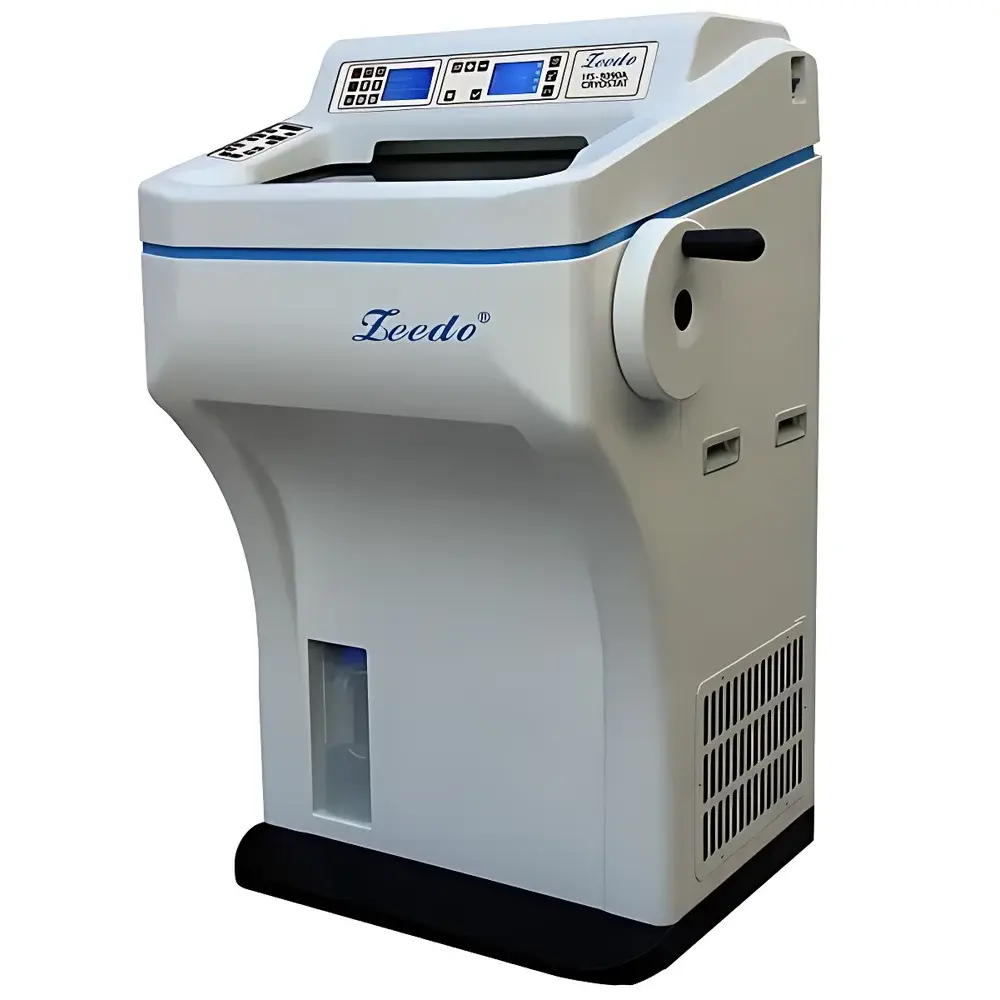
ZEEDO HS-3090A Cryostat Microtome
| Origin | Zhejiang, China |
|---|---|
| Manufacturer Type | Authorized Distributor |
| Origin Category | Domestic (China) |
| Model | HS-3090A |
| Price Range | USD 7,000–14,000 |
| Max Sample Size | 50 mm × 80 mm |
| Section Thickness Range | 1–100 µm (adjustable in 1/2/5 µm increments) |
| Sectioning Increment | 1 µm |
| Cryochamber Temp Range | −40 °C to −10 °C |
| Cold Stage Temp | ≤ −45 °C |
| Specimen Head Temp | ≤ −50 °C |
| Dual Peltier Cooling Points | −60 °C |
| Specimen Orientation Angle | ±12° |
| Vertical Specimen Travel | 70 mm |
| Horizontal Specimen Travel | 20 mm |
| Coarse Feed Speeds | 0.3 mm/s & 0.9 mm/s |
| Trimming Thickness Range | 10–600 µm |
| Specimen Retraction | 0–200 µm (5 µm steps) |
| Power Supply | AC 220 V, 50 Hz (standard) |
| Power Consumption | 800 W |
| Net Weight | 125 kg |
| Dimensions (W×D×H) | 700 × 660 × 1250 mm |
| Noise Level | ≤40 dB(A) |
Overview
The ZEEDO HS-3090A Cryostat Microtome is a precision-engineered, fully integrated cryogenic sectioning system designed for high-fidelity frozen tissue preparation in clinical pathology, translational research, and preclinical histology laboratories. Operating on the principle of controlled low-temperature embedding and mechanical microtomy, the HS-3090A maintains specimen integrity by preserving native biomolecular architecture—critical for immunohistochemistry (IHC), fluorescence in situ hybridization (FISH), and enzyme activity assays where antigenicity or spatial protein distribution must be retained. Unlike paraffin-based workflows requiring dehydration and high-heat infiltration, cryosectioning enables sub-minute turnaround from tissue excision to slide mounting, supporting intraoperative frozen section diagnosis (FSR) and rapid diagnostic decision-making. The instrument integrates dual-stage refrigeration architecture: a primary compressor-based cryochamber (−40 °C to −10 °C), a secondary Peltier-cooled stage (≤−45 °C), and independently regulated specimen head cooling (≤−50 °C), with two dedicated Peltier modules achieving localized −60 °C at critical contact points—ensuring uniform thermal stability across heterogeneous tissue types including adipose, neural, and fibrous specimens.
Key Features
- Dual-compressor refrigeration system with German-sourced compressors, engineered for continuous operation and <40 dB(A) acoustic emission—minimizing ambient disturbance in shared lab environments.
- Patented frost-free cold stage utilizing optimized airflow dynamics and condensate management, eliminating manual defrost cycles and ensuring uninterrupted workflow continuity.
- Motorized coarse feed with two selectable speeds (0.3 mm/s and 0.9 mm/s) for rapid specimen positioning and fine-tuned approach control during trimming.
- 12° bidirectional universal specimen chuck with independent locking mechanism, enabling precise angular alignment for oblique or tangential sectioning of irregularly shaped biopsies.
- Integrated auto-retraction function (0–200 µm, adjustable in 5 µm increments) to prevent surface abrasion during knife clearance, enhancing section consistency and blade longevity.
- Double-tissue flattening system with independent pressure calibration—replacing conventional single-point compression to ensure uniform tissue adhesion and reduced chatter artifacts.
- Anti-fog tempered glass viewport with integrated heating element, maintaining optical clarity under sustained sub-zero operating conditions.
- One-piece injection-molded chassis with medical-grade polymer housing—resistant to ethanol, xylene, and common disinfectants; smooth non-porous surfaces facilitate GLP-compliant cleaning and decontamination.
Sample Compatibility & Compliance
The HS-3090A accommodates standard OCT-embedded specimens up to 50 mm × 80 mm, compatible with all major commercial freezing media and disposable specimen cassettes. Its calibrated temperature gradients meet ISO 15189:2022 requirements for preanalytical stability in diagnostic histopathology and align with CAP (College of American Pathologists) checklist ANP.42100 regarding cryostat thermal validation protocols. The dual Peltier cooling architecture supports reproducible sectioning of challenging tissues—including fatty liver, brain white matter, and lymphoid aggregates—without ice crystal artifact formation when operated within validated temperature windows (−22 °C to −25 °C for optimal IHC preservation). All electrical components comply with IEC 61010-1:2010 safety standards for laboratory equipment, and the unit is CE-marked per Directive 2014/30/EU (EMC) and 2014/35/EU (LVD).
Software & Data Management
While the HS-3090A operates as a standalone electromechanical platform without embedded touchscreen or network connectivity, its mechanical controls are fully documented in accordance with FDA 21 CFR Part 11 readiness guidelines. All user-adjustable parameters—including section thickness, retraction distance, coarse feed speed, and temperature setpoints—are mechanically indexed and physically logged via engraved dials and calibrated verniers, supporting audit-trail integrity in GMP-regulated environments. Optional external digital loggers (e.g., certified USB temperature data loggers compliant with NIST traceability) may be deployed to record chamber and stage temperatures at 1-minute intervals for retrospective validation. Maintenance records, calibration certificates, and temperature mapping reports are structured to support internal QA audits and external inspections under CLIA, ISO/IEC 17025, or ISO 9001 frameworks.
Applications
- Intraoperative frozen section analysis for real-time margin assessment in oncologic surgery (e.g., breast lumpectomy, glioma resection).
- Routine diagnostic IHC and multiplex immunofluorescence on unfixed, unprocessed tissue—preserving epitope conformation and phospho-epitope integrity.
- Preclinical toxicology studies requiring serial sectioning of rodent or NHP organs for morphometric analysis and biomarker co-localization.
- Neuroscience research involving myelin basic protein (MBP) staining, synaptic density quantification, or spatial transcriptomics on fresh-frozen sections.
- Quality control of biobanked tissue repositories, where cryopreservation integrity must be verified prior to downstream omics profiling.
- Training platforms for histotechnologist certification programs—featuring intuitive mechanical feedback and repeatable parameter recall.
FAQ
What is the recommended operating temperature range for optimal section quality?
For most soft tissues (e.g., liver, kidney), −22 °C to −25 °C in the cryochamber and −45 °C on the cold stage yield consistent 4–6 µm ribbons with minimal compression. Adipose-rich samples may require −28 °C; neural tissues benefit from −20 °C to reduce brittleness.
Is the HS-3090A compatible with standard cryostat knives and blade holders?
Yes—it accepts industry-standard disposable cryo-knives (e.g., Leica CM1950, Thermo Fisher CryoStar NX50) and reusable tungsten-carbide blades using universal blade clamping geometry.
Does the unit support GLP/GMP documentation requirements?
All mechanical adjustments are physically indexed and user-verifiable. Temperature validation reports, maintenance logs, and calibration records can be maintained externally to fulfill ALCOA+ principles (Attributable, Legible, Contemporaneous, Original, Accurate, Complete, Consistent, Enduring, Available).
Can the HS-3090A be configured for 110 V / 60 Hz power supply?
Yes—custom voltage configuration is available upon order; lead time extends by 4–6 weeks for electrical subsystem re-certification.
How often does the cold stage require cleaning or defrosting?
The frost-free design eliminates scheduled defrosting. Routine cleaning of the stage surface with 70% ethanol and lint-free wipes is recommended after each shift or between specimen batches.



