
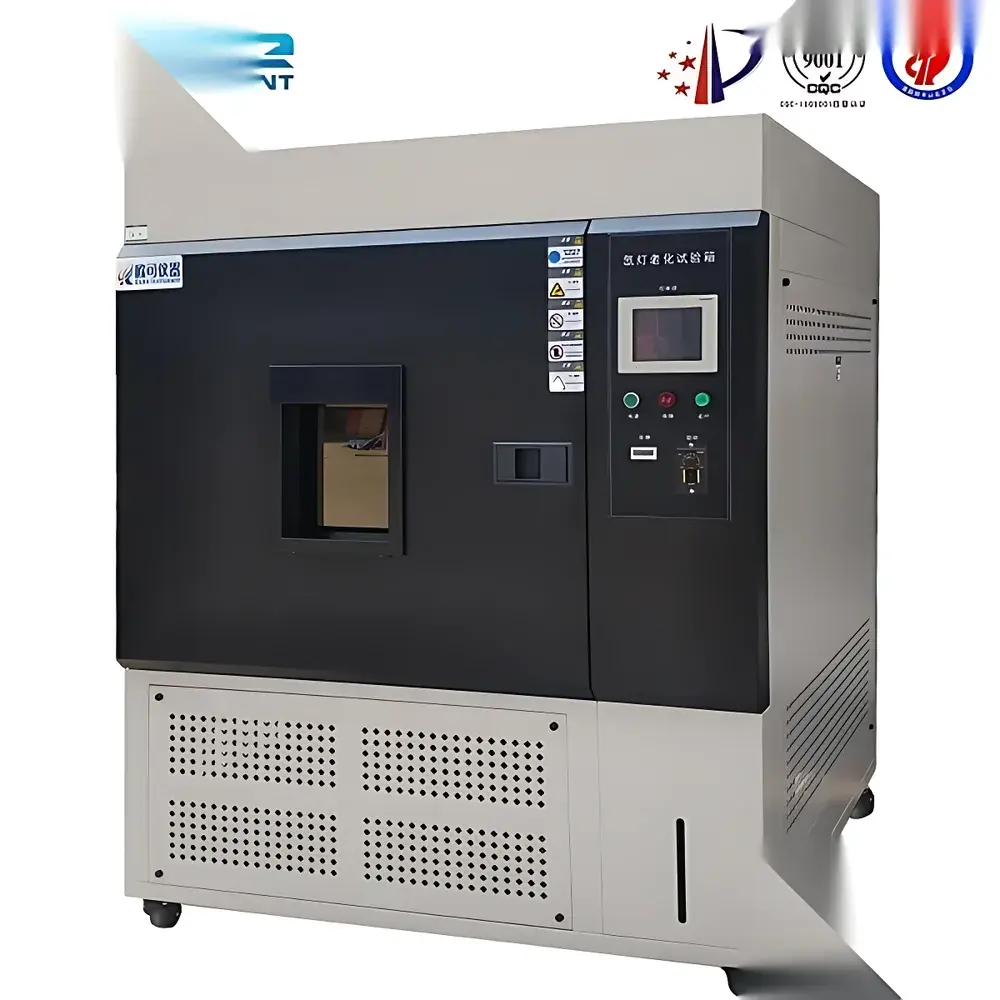
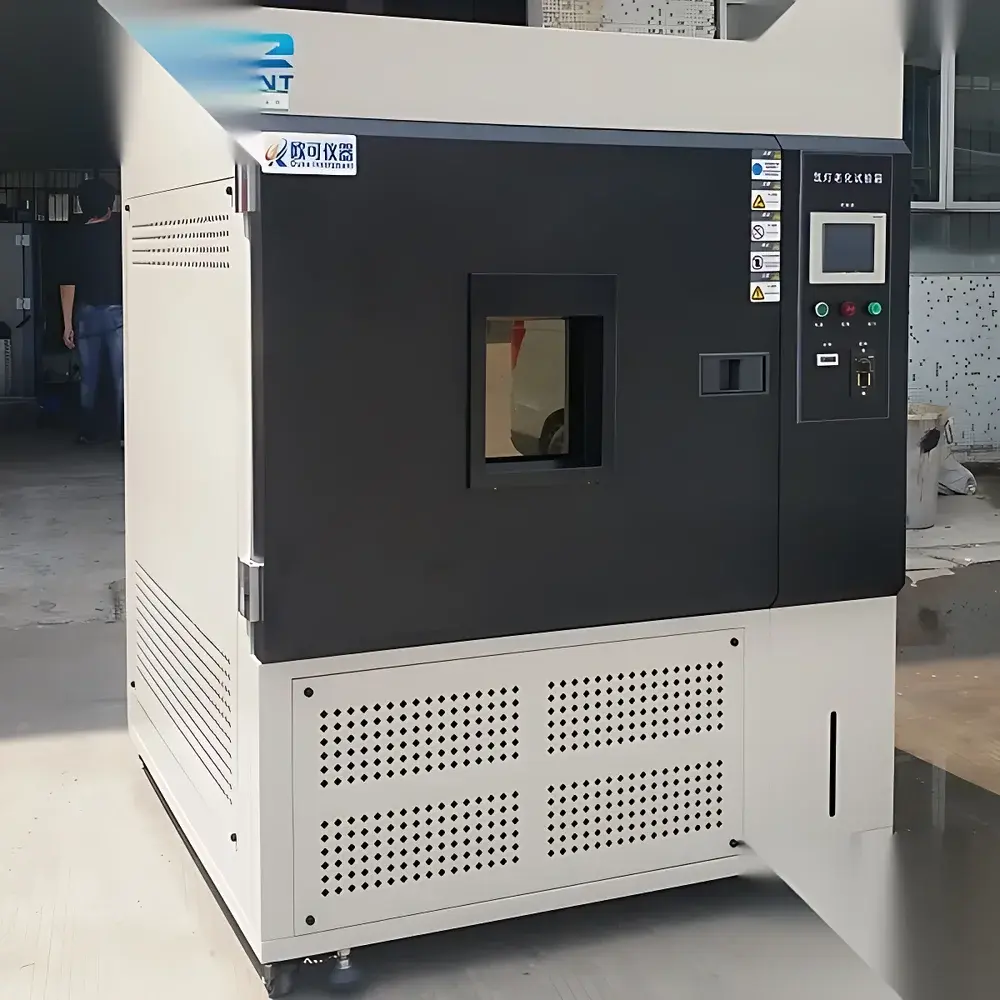
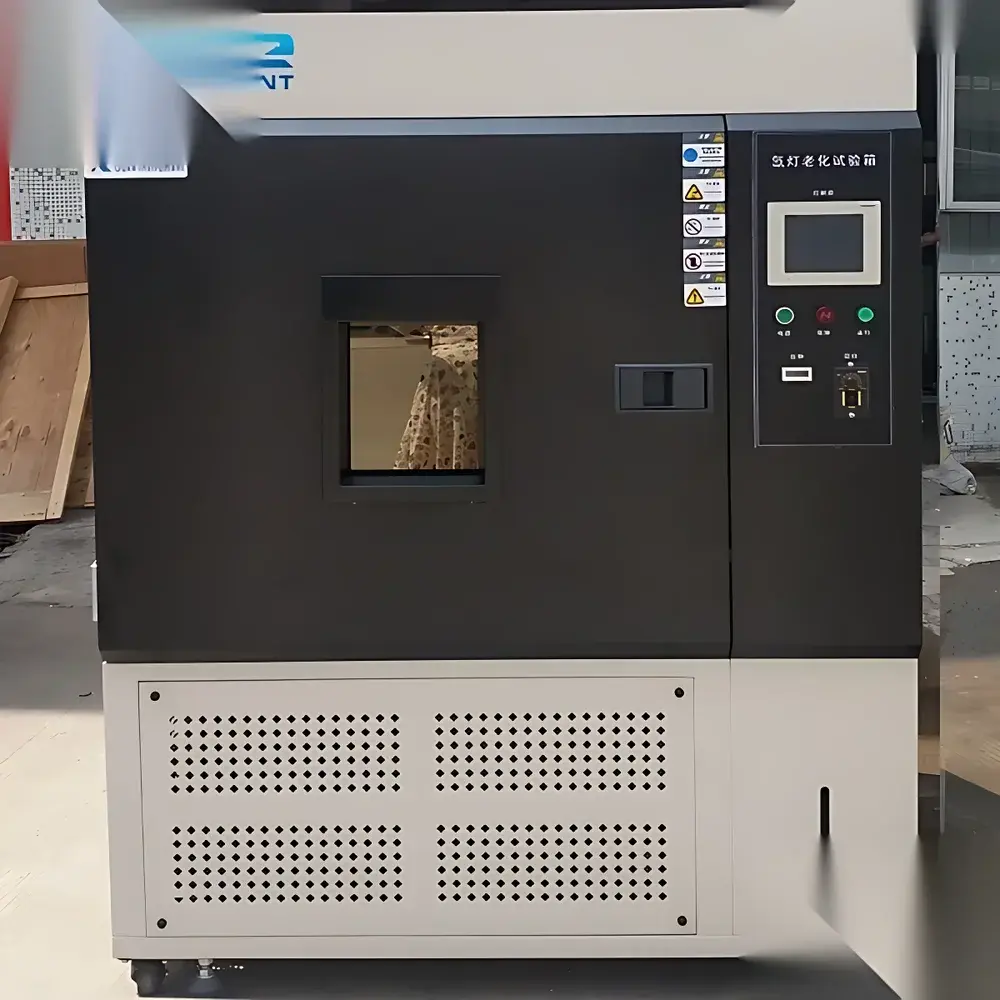
Xenon Arc Ozone-Resistant Aging Test Chamber
| Brand | OEM |
|---|---|
| Origin | Imported |
| Manufacturer Type | Authorized Distributor |
| Price | USD 5,300 (FOB) |
| Standards Compliance | GB/T 8427, GB/T 16422-2, ISO 4892-2, ASTM D529, GB/T 14576, GB/T 15102-2006, GB/T 15104-2006 |
| Chamber Models | OK-XD-100 / OK-XD-225 / OK-XD-500 / OK-XD-1000 |
| Internal Dimensions (W×D×H, cm) | 50×50×40 |
| Temperature Range | 0–150°C (chamber), 40–85°C (black panel) |
| Humidity Range | 20–75% RH (light cycle), 20–98% RH (dark cycle) |
| Control Accuracy | ±0.5°C (temp), ±2.0% RH (humidity) |
| Uniformity | ±2.0°C (temp), ±3.0% RH (humidity) |
| Irradiance | 550 W/m² ±10% (300–800 nm), 1000 W/m² ±10% (300–1200 nm) |
| Xenon Lamp Power | 1.8 kW / 2.5 kW / 6 kW |
| Lamp Life | ~1,500 h |
| Spray Cycle | 1–999 min (intermittent or continuous) |
| Spray Pressure | 70–127 kPa |
| Sample Holder | Dual-layer mesh tray or 500 mm diameter rotating turntable (0–3 rpm) |
| Construction | Interior — SUS304 stainless steel |
| Power Supply | AC 380 V ±5%, 50 Hz ±0.5 Hz |
Overview
The Xenon Arc Ozone-Resistant Aging Test Chamber is a precision-engineered environmental simulation system designed to evaluate material degradation under controlled exposure to full-spectrum solar radiation, thermal stress, humidity cycling, and ozone-rich atmospheric conditions. Unlike UV-only testers, this chamber employs long-arc, air-cooled xenon lamps filtered to replicate the terrestrial solar spectrum (300–1200 nm), enabling realistic assessment of photochemical aging mechanisms—including photolysis, oxidation, and polymer chain scission—common in outdoor service environments. The integrated ozone-resistance capability distinguishes it from standard xenon weatherometers, allowing concurrent evaluation of synergistic effects between UV irradiation, elevated temperature, cyclic humidity, mechanical stress (via sample rotation), and oxidative attack. It is widely deployed in R&D labs and QC departments for qualifying textiles, automotive exterior components, architectural coatings, rubber compounds, and plastic enclosures per internationally harmonized test protocols.
Key Features
- Full-spectrum xenon arc light source with calibrated spectral output matching CIE No. 85 reference solar irradiance, maintained via high-stability optical filters ensuring long-term spectral fidelity.
- Independent control of black panel temperature (40–85°C) and chamber air temperature (0–150°C), enabling precise simulation of surface heating effects observed in real-world exposure.
- Dual-mode humidity control supporting both light-cycle (20–75% RH) and dark-cycle (20–98% RH) profiles, critical for replicating diurnal condensation and dew formation per ISO 4892-2 Annex B.
- Programmable water spray system with adjustable duration (1–999 min), pressure regulation (70–127 kPa), and selectable intermittent/continuous modes to simulate rainfall, dew washout, or humidity shock.
- Rotating sample holder (0–3 rpm, Ø500 mm) or dual-layer static mesh trays—engineered for non-uniform specimen geometries without requiring custom fixtures.
- Robust SUS304 stainless steel construction throughout internal chamber and critical wetted components, ensuring corrosion resistance during prolonged humid and saline spray operation.
- Modular lamp assembly with tool-free replacement; average operational life of 1,500 hours at nominal irradiance, with built-in lamp hour meter and irradiance decay compensation algorithms.
Sample Compatibility & Compliance
This chamber accommodates flat, curved, or irregularly shaped specimens up to 100 × 100 × 100 cm (OK-XD-1000 model), including fabric swatches, painted panels, molded elastomers, and composite laminates. Sample mounting does not require clamping hardware—gravity-based positioning on perforated trays ensures uniform exposure while minimizing shadowing artifacts. All models are certified to meet the radiometric, thermal, and hygric performance criteria defined in ISO 4892-2:2013, ASTM G155-22, and GB/T 16422.2-2014. Optional ozone injection modules (not included by default) can be integrated to extend testing scope to ISO 1431-1 (ozone cracking resistance of vulcanized rubber) and ASTM D1149. The system architecture supports GLP-compliant validation documentation packages, including IQ/OQ protocols aligned with ISO/IEC 17025 requirements.
Software & Data Management
Equipped with an industrial-grade programmable logic controller (PLC) and 7-inch TFT touchscreen HMI, the chamber supports multi-step test programs with up to 99 segments, each defining irradiance setpoint, temperature ramp rate, humidity profile, spray timing, and rotation parameters. Real-time logging records all critical variables at 1-second intervals, stored internally for ≥30 days and exportable via USB or Ethernet to CSV/Excel format. Audit trail functionality complies with FDA 21 CFR Part 11 requirements when paired with optional user access control and electronic signature modules. Remote monitoring is supported via Modbus TCP or optional OPC UA gateway for integration into enterprise LIMS or MES platforms.
Applications
- Accelerated lightfastness and colorfastness evaluation of dyed textiles and leather per GB/T 8427 and ISO 105-B02.
- Weathering resistance validation of automotive clearcoats, bumpers, and interior trims under SAE J2527 and GMW14124.
- Photostability screening of pharmaceutical packaging materials per ICH Q1B guidelines.
- Oxidative aging studies of EPDM, NBR, and silicone elastomers under combined UV/heat/humidity/ozone stress.
- Outdoor durability qualification of architectural PVC cladding, roofing membranes, and fiber-cement composites.
- Correlation studies between laboratory xenon exposure and natural outdoor exposure using ASTM G167-21 practice.
FAQ
What standards does this chamber support out-of-the-box?
It natively executes test methods per ISO 4892-2, ASTM D529, GB/T 16422.2, and GB/T 8427 without hardware modification.
Can the chamber operate without water spray or rotation?
Yes—each function (spray, rotation, humidity, irradiance) is independently programmable and may be disabled per test sequence.
Is calibration traceable to national metrology institutes?
Radiometric and thermal sensors are supplied with factory calibration certificates traceable to NIM (China) or NIST (USA); on-site recalibration services available.
What maintenance is required beyond lamp replacement?
Routine tasks include quarterly filter inspection, monthly spray nozzle cleaning, and annual verification of humidity sensor drift—no daily operator intervention needed.
Are custom chamber sizes or extended UV spectra (e.g., <300 nm) available?
Yes—OEM engineering support enables bespoke configurations including larger volumes, quartz-filtered short-wave UV enhancement, and ozone dosing systems.



