
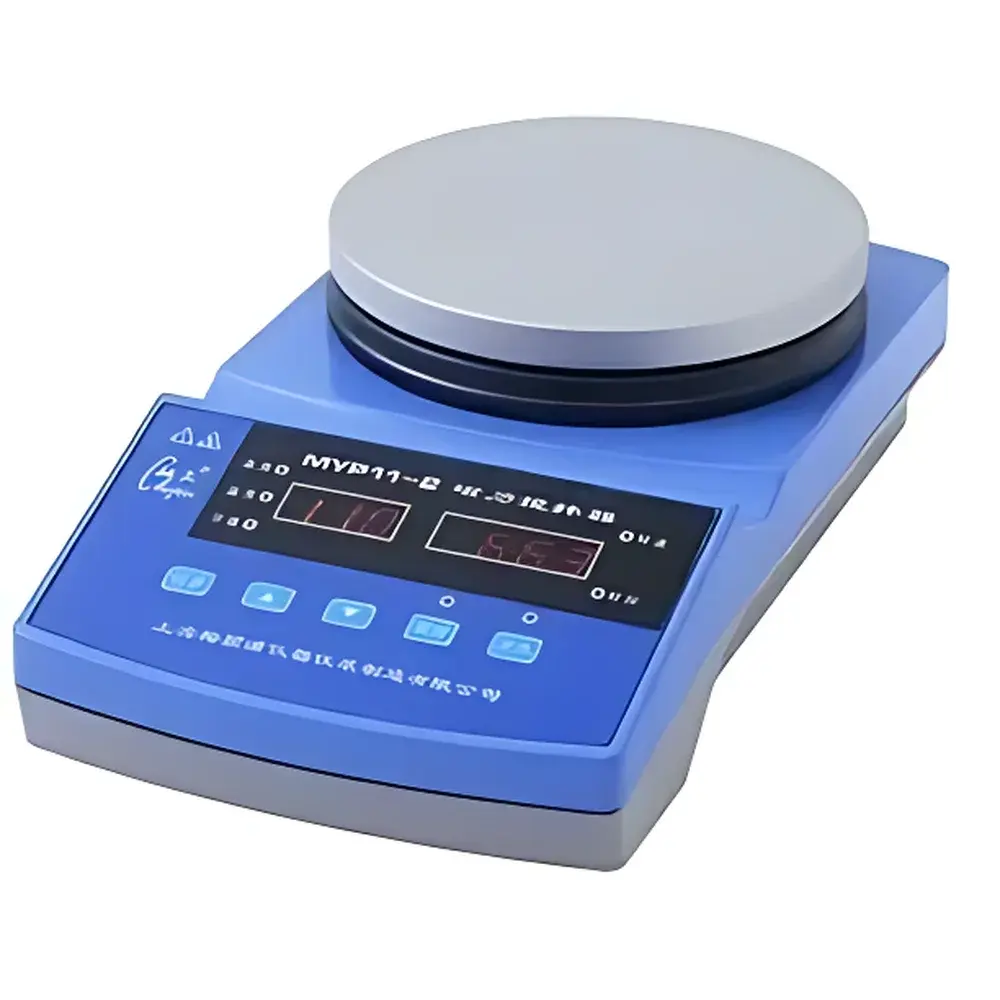
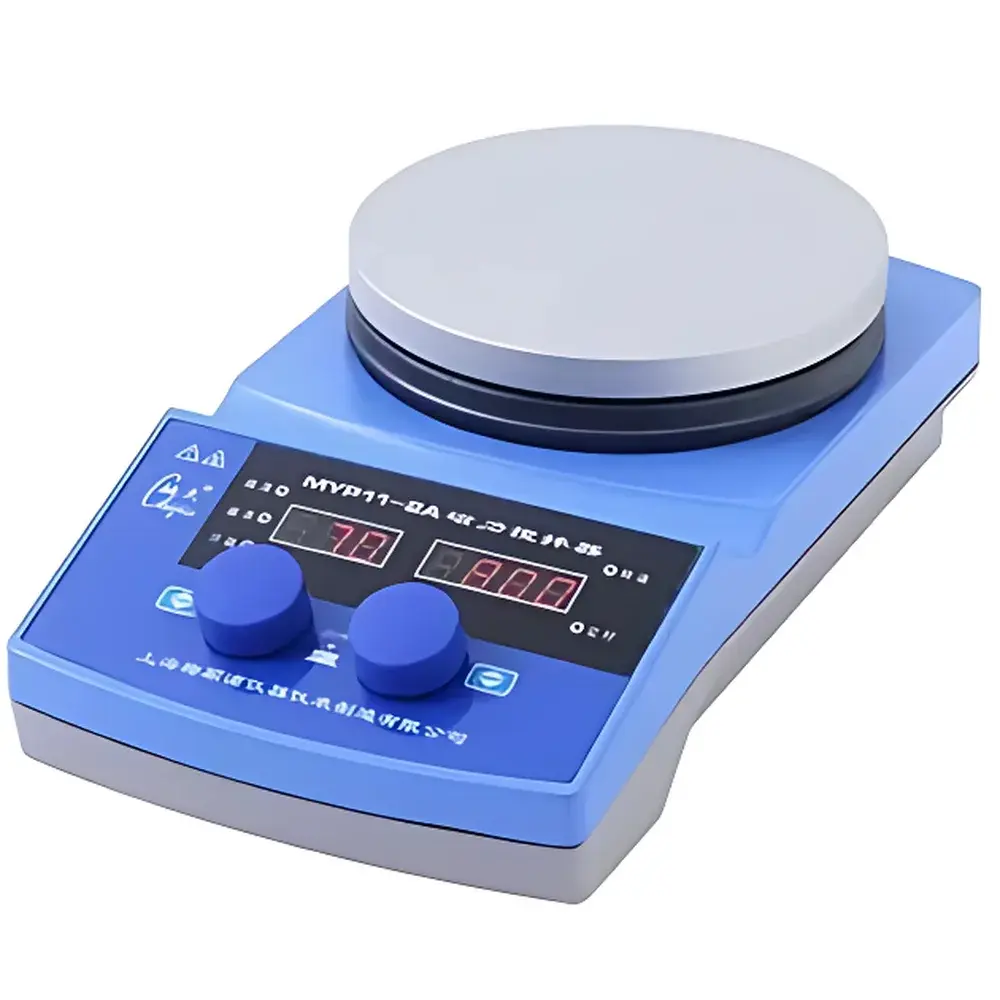
MYP11-2 Magnetic Stirrer with Integrated Heating and PID Temperature Control
| Brand | Jiayuan |
|---|---|
| Model | MYP11-2 |
| Max Stirring Volume | 10 L (H₂O) |
| Speed Range | 50–1500 rpm |
| Heating Plate Temp Range | Ambient to 320 °C |
| Liquid Temperature Control Accuracy | ≤ ±1 °C |
| Heating Power | 600 W |
| Motor Type | Three-phase Brushless DC |
| Display | Dual LED (Speed & Temp/Timer) |
| Timer Range | 1–9999 min |
| Plate Diameter | Ø145 mm |
| Protection Cut-off Temp | 340 °C |
| Power Supply | AC 220 V, 50 Hz |
| Rated Power | 620 W |
| Net Weight | 2.7 kg |
| Dimensions (W×D×H) | 280 × 160 × 90 mm |
Overview
The MYP11-2 Magnetic Stirrer is an integrated benchtop laboratory instrument engineered for precision mixing and temperature-controlled heating in routine and research-grade applications. Unlike basic stir-only units, this model combines a high-torque magnetic drive system with a digitally regulated heating plate and dual-parameter feedback control—enabling simultaneous, independent monitoring and regulation of both heating plate surface temperature and actual liquid-phase temperature via a built-in Pt100 resistance thermometer. Its operation relies on the principle of magnetic coupling: rotation of internal permanent magnets beneath the ceramic-coated aluminum heating plate induces synchronous motion in PTFE- or glass-coated magnetic stir bars immersed in the sample vessel. The brushless DC motor ensures low electromagnetic interference, minimal thermal drift, and long-term rotational stability—even at the lower end of its speed range (50 rpm), where many competitive units exhibit torque drop or oscillation.
Key Features
- Integrated PID temperature control with dual-sensor architecture: one Pt100 sensor embedded in the heating plate, another immersed directly in solution—enabling real-time liquid temperature feedback and correction.
- High-strength neodymium magnet array with soft-start activation, eliminating “jumping” of stir bars during acceleration and ensuring reliable engagement even with larger (up to 80 mm) or high-viscosity-compatible stir elements.
- Dual LED display interface: left window shows rotational speed (rpm) or elapsed timer; right window toggles between setpoint temperature, actual liquid temperature, heating plate temperature, and remaining timer duration.
- Microprocessor-based control system with non-volatile memory—retains user-defined parameters (speed, temp, timer) across power cycles for repeatable experimental protocols.
- Ceramic-coated aluminum heating plate (Ø145 mm) offering uniform thermal distribution, rapid heat-up response (<60 s to reach 100 °C from ambient), and chemical resistance to common solvents and mild acids.
- Over-temperature safety cutoff at 340 °C prevents thermal runaway and complies with IEC 61010-1 requirements for laboratory electrical equipment safety.
- Ergonomic front-panel layout with tactile membrane keys and wide viewing-angle display—designed for glove-compatible operation and unambiguous parameter adjustment under varied lighting conditions.
Sample Compatibility & Compliance
The MYP11-2 accommodates standard laboratory glassware including beakers (50 mL–2000 mL), Erlenmeyer flasks, and round-bottom flasks up to 10 L volume when used with appropriately sized stir bars (max. 80 mm length). It supports aqueous, organic, and mildly corrosive media—but is not rated for use with hydrofluoric acid, molten alkali metals, or highly exothermic reactions without external thermal management. The unit conforms to IEC 61010-1:2010 (Safety Requirements for Electrical Equipment for Measurement, Control, and Laboratory Use) and carries CE marking for EMC and Low Voltage Directive compliance. While not validated for GxP environments out-of-the-box, its stable temperature control (≤±1 °C accuracy) and programmable timer support GLP-aligned documentation when paired with external audit-trail-capable logging systems.
Software & Data Management
The MYP11-2 operates as a standalone instrument with no proprietary software dependency. All operational parameters are configured and monitored locally via the front-panel interface. For integration into automated workflows, optional RS-232 or analog 0–5 V output modules (sold separately) enable connection to data acquisition systems or SCADA platforms. When used in regulated settings, users may implement manual logbook entries or third-party electronic lab notebook (ELN) templates aligned with 21 CFR Part 11 principles—though the device itself does not provide electronic signature, audit trail, or user-role authentication capabilities.
Applications
- Preparation of homogeneous buffer solutions and reagent stocks in molecular biology and clinical diagnostics labs.
- Controlled dissolution testing of pharmaceutical powders under USP and guidelines (when combined with calibrated thermometry).
- Accelerated aging studies requiring stable thermal-mechanical stress (e.g., polymer solubilization, catalyst activation, nanoparticle dispersion).
- Chemical synthesis steps involving reflux, esterification, or condensation reactions where precise thermal input and mixing intensity must be maintained over extended durations (up to 166 hours).
- Quality control testing in food, cosmetics, and coatings industries—particularly for viscosity-sensitive formulations where shear history must remain consistent across replicates.
FAQ
Does the MYP11-2 support external temperature probes?
No—the system uses only its integrated Pt100 sensors. External probe inputs are not supported.
Can it maintain temperature setpoints in open vessels under airflow?
Yes, but ambient drafts may reduce effective liquid temperature stability; use of lids or draft shields is recommended for sub-±0.5 °C consistency.
Is calibration traceable to national standards?
The unit ships with factory calibration certificates; field recalibration of the Pt100 sensors requires certified reference thermometers and ISO/IEC 17025-accredited service providers.
What stir bar materials are compatible?
PTFE-coated, glass-coated, and polypropylene-coated stir bars are recommended; avoid bare stainless steel in chloride-rich or acidic media to prevent corrosion-induced contamination.
Does the timer function pause during power interruption?
No—the timer resets upon power loss; however, speed and temperature setpoints are retained in non-volatile memory and resume automatically after restoration.



