
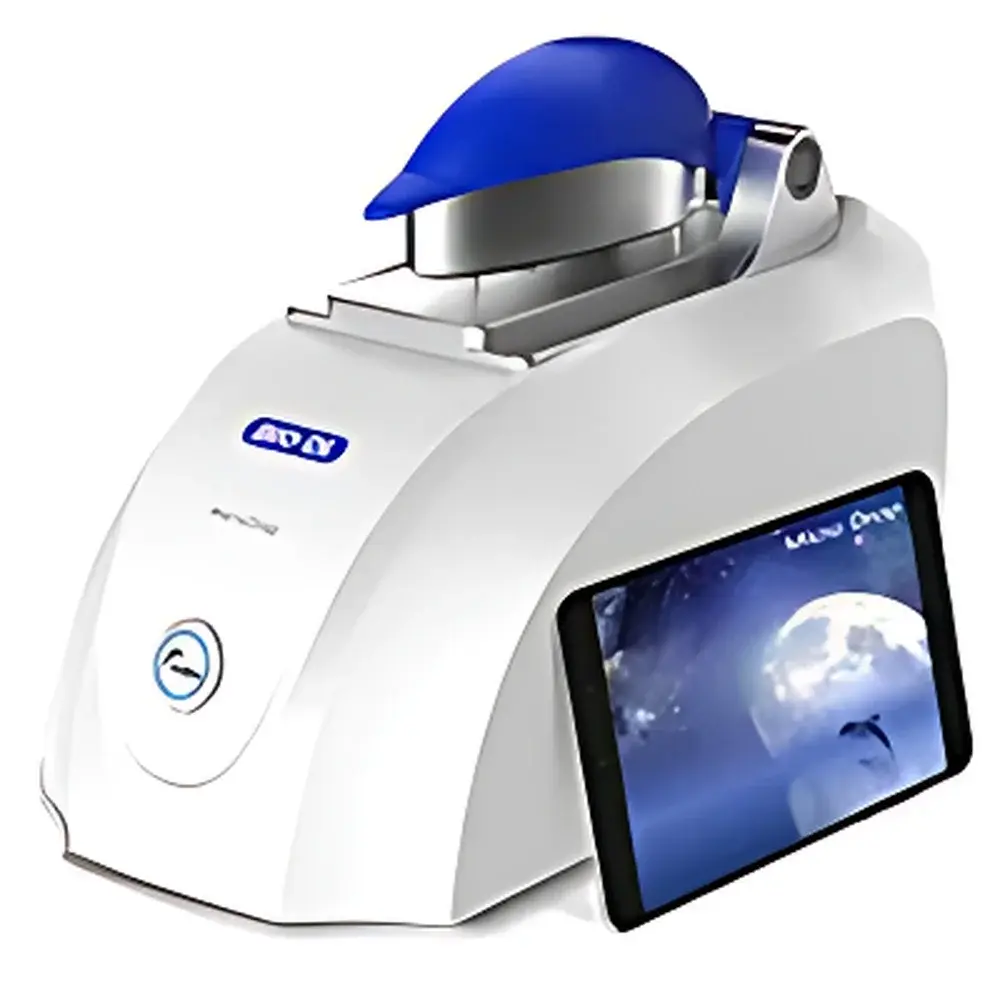
BIO-DL Micro Drop Ultra-Micro Volume Spectrophotometer
| Brand | BIO-DL |
|---|---|
| Origin | Shanghai, China |
| Model | Micro Drop |
| Wavelength Range | 185–910 nm |
| Minimum Sample Volume | 0.5 µL |
| Pathlength Adjustment | 0.05–1 mm (automated) |
| dsDNA Detection Range | 2–15,000 ng/µL |
| Absorbance Accuracy | ±3% at 0.65 Abs (350 nm) |
| Absorbance Precision | 0.002 Abs (1 mm pathlength) |
| Spectral Resolution | <1.8 nm FWHM (Hg 253.7 nm) |
| Wavelength Accuracy | ±1 nm |
| Absorbance Range | 0.02–300 (equivalent to 10 mm pathlength) |
| Cuvette Mode Temperature Control | 37 ± 0.5 °C |
| Cuvette Pathlength Options | 1, 2, 5, 10 mm |
| Wireless Connectivity | Wi-Fi enabled |
| Dimensions | 220 × 135 × 180 mm |
| Weight | 2.1 kg |
Overview
The BIO-DL Micro Drop Ultra-Micro Volume Spectrophotometer is a dual-mode analytical instrument engineered for high-precision nucleic acid, protein, and cell suspension quantification in resource-constrained or high-throughput laboratory environments. Operating on the principle of UV-Vis absorbance spectroscopy, it employs a collimated xenon lamp light source and a high-resolution CCD spectrometer to deliver full-spectrum acquisition across 185–910 nm. Its core innovation lies in the automated variable-pathlength measurement system: by dynamically adjusting the optical path from 0.05 mm to 1 mm via precision-machined quartz pedestals, the instrument eliminates manual dilution while maintaining photometric linearity across an exceptionally broad dynamic range—enabling direct quantification of dsDNA from 2 ng/µL to 15,000 ng/µL without sample pre-treatment. This architecture conforms to fundamental Beer-Lambert law requirements while mitigating errors associated with fixed-pathlength limitations and meniscus variability common in traditional microvolume platforms.
Key Features
- Ultra-low sample consumption: Quantifies nucleic acids and proteins using only 0.5 µL of undiluted sample—critical for precious clinical isolates, single-cell lysates, or limited CRISPR editing products.
- Automated pathlength calibration: Real-time adjustment ensures optimal signal-to-noise ratio and photometric accuracy across concentration extremes; validated against NIST-traceable standards.
- Dual operational modes: Integrated microvolume pedestal and temperature-controlled cuvette compartment (37 ± 0.5 °C) support both rapid screening and kinetic assays requiring thermal stability.
- Full-spectrum acquisition: Captures absorption profiles between 185–910 nm with <1.8 nm spectral resolution (FWHM at Hg 253.7 nm), facilitating A260/A280, A260/A230, and custom peak-ratio analyses.
- Embedded computing interface: High-resolution touchscreen tablet enables standalone operation, method storage, and real-time curve visualization—no external PC required.
- Wi-Fi-enabled data handling: Secure wireless transfer of spectra, concentration reports, and audit logs to networked LIMS or ELN systems; supports TLS 1.2 encryption.
Sample Compatibility & Compliance
The Micro Drop accommodates diverse biological matrices including purified dsDNA, ssDNA, RNA, oligonucleotides, fluorescently labeled probes, recombinant proteins (via A280 or colorimetric BCA/Bradford/Pierce 660 nm assays), bacterial cultures (OD600), and mammalian suspension cells. Its optical design minimizes scattering artifacts in turbid samples through optimized beam geometry and background subtraction algorithms. The instrument meets essential performance criteria outlined in ISO 8570:2021 (spectrophotometer verification), ASTM E275-22 (UV-Vis spectrophotometry practices), and supports GLP/GMP workflows via timestamped, user-authenticated measurement records. Firmware and software updates are delivered remotely and comply with FDA 21 CFR Part 11 requirements for electronic signatures and audit trail retention.
Software & Data Management
The embedded firmware runs on a Linux-based OS with dedicated application software supporting method creation, calibration validation, and customizable reporting templates. Users define wavelength-specific extinction coefficients, establish custom formulas (e.g., RNA integrity ratios), and set pass/fail thresholds for QC release. All raw spectra and processed results are stored locally with SHA-256 hashing for integrity verification. Data export options include CSV, PDF, and XML formats compatible with downstream statistical tools (e.g., GraphPad Prism, R). Remote software updates preserve configuration integrity and introduce new assay protocols—fully documented in version-controlled release notes accessible via the instrument’s web interface.
Applications
- Nucleic acid quality control: Rapid assessment of purity (A260/A280, A260/A230), concentration, and degradation status prior to NGS library prep or qPCR.
- Protein quantification and buffer compatibility testing: Simultaneous evaluation of A280 absorbance and detergent interference in His-tagged or GST-fusion eluates.
- Probe labeling efficiency analysis: Discrimination of labeled vs. unlabeled oligonucleotides via differential absorbance at excitation wavelengths.
- Microbial growth monitoring: OD600 tracking across time-series experiments with auto-zero referencing between readings.
- Enzyme kinetics: Initial-rate determination using continuous absorbance monitoring at defined wavelengths (e.g., NADH oxidation at 340 nm).
- Educational laboratories: Modular teaching modules for Beer-Lambert law validation, pathlength effects, and spectral deconvolution principles.
FAQ
What is the minimum detectable dsDNA concentration in microvolume mode?
The lower limit of detection is 2 ng/µL for double-stranded DNA, verified using Lambda DNA reference material per ISO 8570 Annex B.
Can the instrument perform kinetic measurements in cuvette mode?
Yes—cuvette compartment supports temperature-regulated (37 ± 0.5 °C) and stir-controlled (150–850 rpm) kinetic assays with user-defined time intervals and wavelength selection.
Is spectral data export compliant with LIMS integration standards?
All exported files include embedded metadata (instrument ID, operator, timestamp, calibration status) and conform to ASTM E1384-20 digital data interchange specifications.
How is pathlength accuracy maintained over time?
The pedestal mechanism undergoes factory calibration using interferometric distance metrology; field verification is supported via optional NIST-traceable pathlength standards.
Does the software support multi-user authentication and role-based access control?
Yes—administrator, technician, and viewer roles are configurable with password policies aligned with NIST SP 800-63B guidelines.





