
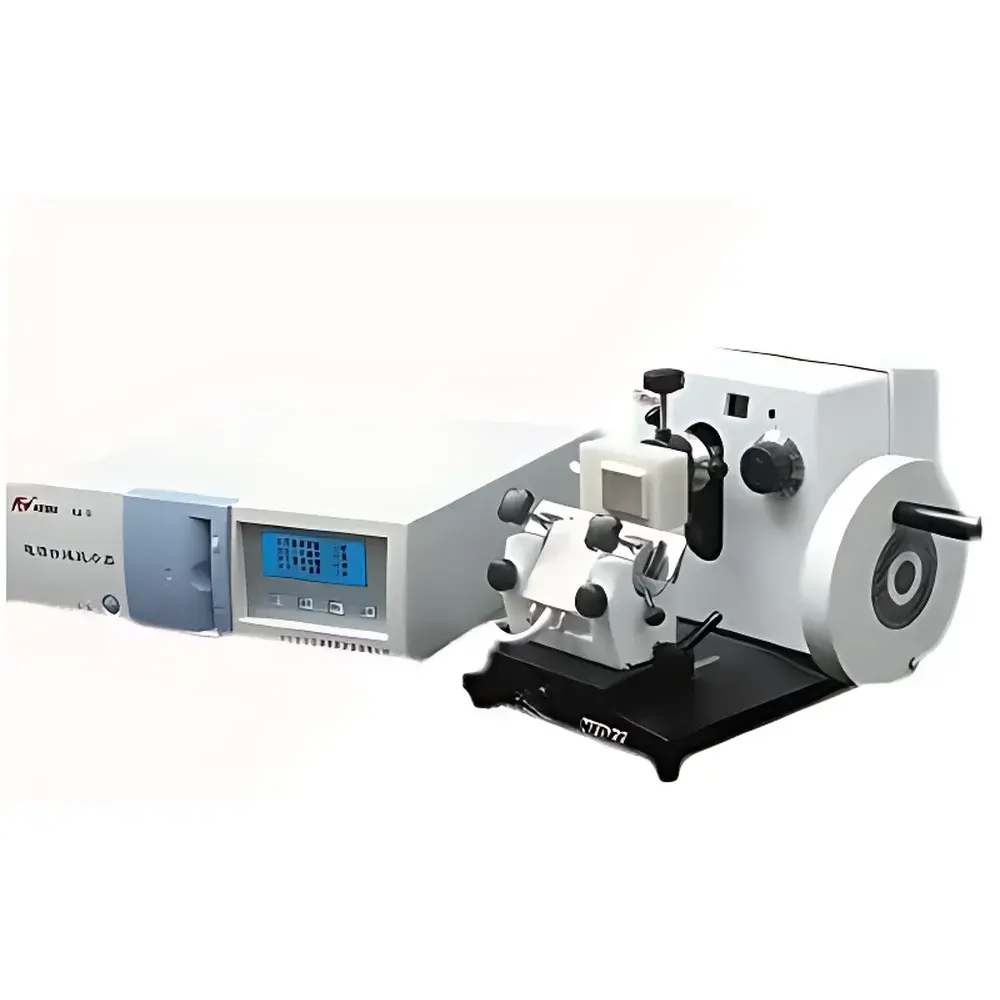
KD-202-VI Cryostat Microtome
| Origin | Zhejiang, China |
|---|---|
| Manufacturer Type | Authorized Distributor |
| Country of Origin | PRC |
| Model | KD-202-VI |
| Price | USD 3,780 (FOB) |
| Section Thickness Range | 1–25 µm |
| Minimum Thickness Adjustment Increment | 1 µm |
| Max Specimen Area (Paraffin) | 35 × 25 mm |
| Sectioning Accuracy | ±10% |
| Refrigeration Delta-T (Stage) | ≥60 °C below ambient |
| Refrigeration Delta-T (Knife Holder) | ≥50 °C below ambient |
| Stage Surface Area | 45 × 40 mm |
| Blade-to-Stage Angle | 60° |
| Precooling Time to Operating Temperature | 4–7 min |
| Display | Dual-zone LCD (set/real-time temp for stage & knife separately) |
| Blade Translation | Adjustable in X- and Y-axes (KD-202A-VI) |
Overview
The KD-202-VI Cryostat Microtome is an engineered solution for precise, reproducible frozen sectioning in histopathology, neuroscience, and preclinical research laboratories. Unlike conventional rotary microtomes, this instrument integrates semiconductor-based thermoelectric cooling (Peltier) with nanomaterial-enhanced thermal conductivity to achieve rapid, stable cryogenic specimen conditioning—eliminating reliance on external cryogens such as liquid nitrogen or compressed CO₂. Its core operational principle relies on maintaining a precisely controlled thermal gradient between the specimen stage and cutting knife, ensuring optimal tissue hardness and minimizing ice crystal artifact formation during sectioning. Designed for routine diagnostic workflows and high-throughput lab environments, the KD-202-VI delivers consistent 1–25 µm sections across biological tissues—including brain, liver, kidney, tumor biopsies, and embedded soft specimens—without requiring cryoprotectant infiltration or prolonged equilibration.
Key Features
- High-efficiency thermoelectric refrigeration system capable of achieving ≥60 °C temperature differential between ambient and specimen stage within 4–7 minutes
- Dual independent temperature control zones: specimen stage and knife holder, each with dedicated setpoint and real-time monitoring via high-resolution blue-backlit LCD
- Fixed 60° blade-to-stage geometry optimized for reduced compression artifact and enhanced ribbon formation in frozen sections
- Motorized rapid trimming mode with adjustable speed and positional memory for efficient block face preparation
- Section thickness adjustment from 1 µm to 25 µm in 1 µm increments; extended range (>25 µm) available in KD-202A-VI variant
- Sealed enclosure design (standard on KD-202A-VI) minimizes condensation ingress and improves operator safety during prolonged use
- Intelligent defrost cycle with automatic thermal recovery—no manual intervention required post-defrost
- Non-volatile parameter memory retains user-defined settings including target temperatures, section count, and thickness presets across power cycles
- Quick-release specimen head system compatible with standard OCT-embedded cassettes and metal chucks (ISO 8601-compliant mounting interface)
Sample Compatibility & Compliance
The KD-202-VI accommodates standard-sized tissue blocks up to 35 × 25 mm (or 40 × 30 mm in KD-202A-VI configuration), supporting both unfixed fresh-frozen and formalin-fixed paraffin-processed (FFPE) specimens after rehydration. It meets essential mechanical and thermal performance benchmarks referenced in ISO 13795:2018 (Medical laboratories — Requirements for the validation of cryostat microtomes) and aligns with CLIA and CAP preanalytical guidelines for frozen section integrity. While not certified to FDA 21 CFR Part 11 out-of-the-box, its audit-ready features—including timestamped section counters, parameter logging history, and tamper-resistant memory—support GLP/GMP documentation requirements when integrated into validated laboratory information management systems (LIMS). All electrical components comply with IEC 61010-1:2010 safety standards for laboratory equipment.
Software & Data Management
The KD-202-VI operates via embedded firmware without external PC dependency. All operational parameters—including section count, current thickness setting, stage/knife temperatures (setpoint and real-time), defrost status, and error codes—are stored in non-volatile memory with time-stamped logs accessible via on-device navigation. The LCD interface supports multilingual menu options (English, Spanish, German, Chinese) and provides audible/visual alerts for overtemperature, low refrigeration efficiency, or misaligned blade engagement. For labs requiring digital traceability, optional RS-232 or USB-C serial output enables integration with third-party data acquisition platforms or LIMS via ASCII protocol—facilitating automated record retention per ISO/IEC 17025 clause 7.5.2.
Applications
- Routine intraoperative frozen section diagnosis in surgical pathology departments
- Neuroanatomical mapping studies requiring serial coronal/sagittal sections of rodent or primate brain tissue
- Immunohistochemistry (IHC) and fluorescence in situ hybridization (FISH) sample preparation where antigen preservation is critical
- Quality control of biobanked tissue repositories requiring standardized sectioning protocols
- Preclinical toxicology studies involving multi-organ frozen section analysis under GLP conditions
- Training laboratories seeking robust, low-maintenance cryostats for undergraduate and graduate histotechnology instruction
FAQ
What is the minimum achievable section thickness, and how is accuracy verified?
The KD-202-VI achieves 1 µm nominal thickness with ±10% tolerance per ISO 13795 Annex B test methodology using calibrated micrometer gauges and optical interferometry on standardized polymer test blocks.
Does the unit require external coolant or gas supply?
No. It uses solid-state Peltier modules with passive heat dissipation and requires only standard 100–240 VAC, 50/60 Hz power input.
Can the instrument be validated for ISO 15189 or CAP accreditation?
Yes. Its repeatable thermal performance, parameter logging, and mechanical stability support IQ/OQ/PQ protocols when paired with documented calibration procedures and third-party thermocouple verification.
Is the 60° blade angle adjustable?
No. This fixed geometry is factory-calibrated to optimize cutting force distribution and minimize chatter—consistent with recommendations in the Royal College of Pathologists’ Cryostat Best Practice Guidelines (2022 edition).
How often does the defrost cycle activate under continuous operation?
Defrost initiates automatically every 90–120 minutes during sustained use at ≤−25 °C; duration is typically <90 seconds, with full thermal recovery within 2 minutes.



