
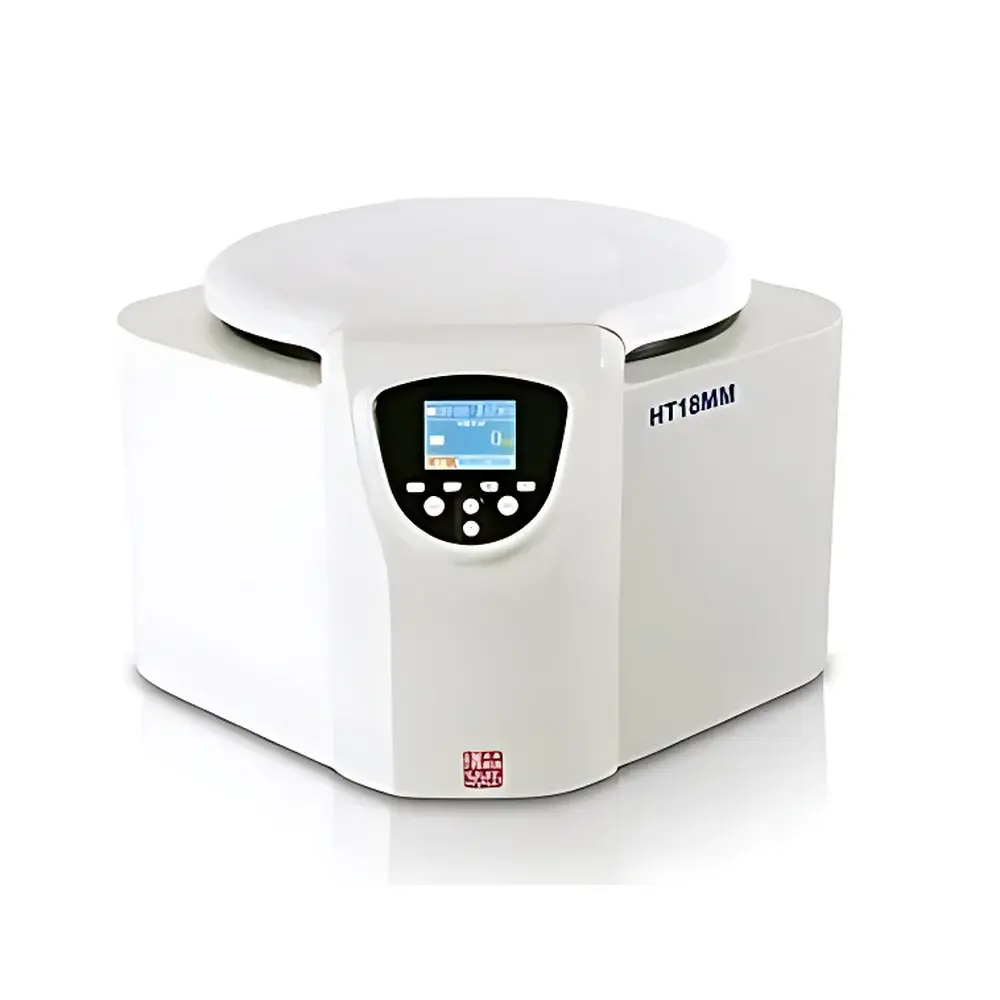
H/T16MM High-Speed Centrifuge
| Origin | Hunan, China |
|---|---|
| Manufacturer Type | Distributor |
| Origin Category | Domestic |
| Model | H/T16MM |
| Price | ¥4,600 |
| Centrifugation Class | Biomacromolecules |
| Max Capacity | 6 × 50 mL |
| Max Speed | 16,500 rpm |
| Dimensions | 500 × 440 × 330 mm |
| Max RCF | 18,780 × g |
| Timer Range | 0–99 h 59 min |
| Programs Stored | 20 |
| Power | 350 W |
| Noise Level | ≤65 dB(A) |
| Weight | 35 kg |
| Voltage/Frequency | AC 220 V, 50 Hz |
| Rotor Options | Fixed-angle (e.g., 12 × 1.5/2.0 mL, 6 × 50 mL), Swing-bucket (e.g., 12 × 10 mL, 2 × 48-well microplate) |
Overview
The H/T16MM High-Speed Centrifuge is a benchtop, non-refrigerated centrifugal separation system engineered for precision and reliability in routine and advanced laboratory workflows requiring high relative centrifugal force (RCF) without active temperature control. Operating on the principle of sedimentation under rotational acceleration, it enables rapid separation of biomacromolecules—including nucleic acids, proteins, subcellular organelles, and viral particles—based on differences in density, size, and shape. Designed for applications where thermal management is secondary to speed and reproducibility, the H/T16MM delivers up to 18,780 × g at its maximum rated speed of 16,500 rpm. Its robust all-steel construction, stainless-steel centrifuge chamber, and integrated vibration-damping system ensure mechanical stability during extended high-speed runs, minimizing sample disturbance and enhancing operational safety.
Key Features
- Brushless frequency-controlled motor ensures consistent torque delivery, low maintenance, and silent operation (≤65 dB[A] at full speed).
- TFT true-color touchscreen interface displays real-time setpoints and actual values—including speed (rpm), RCF (×g), time remaining, and rotor-specific parameters—enabling intuitive, error-resistant operation.
- Dedicated RCF calculation key allows immediate conversion between rotational speed and gravitational force, supporting method transfer across instruments and compliance with protocol documentation requirements.
- Electromechanical door lock with automatic engagement guarantees lid integrity during operation; interlock system halts rotation instantly upon lid opening.
- Human-centered ergonomic design includes streamlined housing, optimized footprint (500 × 440 × 330 mm), and front-accessible rotor chamber for efficient workflow integration in crowded lab environments.
- 20 programmable user protocols support method standardization across shifts or operators; parameters—including acceleration/deceleration profiles, hold times, and rotor identification—are saved and recalled with one touch.
Sample Compatibility & Compliance
The H/T16MM accommodates a broad range of sample formats via interchangeable fixed-angle and swing-bucket rotors. Standard configurations include 6 × 50 mL conical tubes (max 11,000 rpm / 11,610 × g), 24 × 1.5/2.0 mL microtubes (14,000 rpm / 18,180 × g), and dual 48-well microplate carriers (3,000 rpm / 1,400 × g). All rotors are precision-balanced and certified for use within specified speed and load limits per ISO 15195:2021 (laboratory centrifuges — requirements and test methods). While the unit lacks active refrigeration, its thermally stable cavity and low-power motor minimize heat generation, making it suitable for short-duration biomolecular separations aligned with CLSI EP17-A2 guidelines for centrifugation validation. It supports GLP-compliant recordkeeping when paired with external audit-trail-capable LIMS or ELN systems.
Software & Data Management
The embedded firmware supports full parameter logging for each run—including start/stop timestamps, final speed, elapsed time, and rotor ID—exportable via USB interface in CSV format for traceability and QA review. Though no proprietary PC software is bundled, the device’s standardized data structure enables seamless ingestion into third-party laboratory informatics platforms compliant with FDA 21 CFR Part 11 (electronic records and signatures) when deployed with appropriate access controls and audit trail configuration. User program storage adheres to IEC 62304 Class B software safety requirements for medical device-related laboratory equipment.
Applications
- Pelleting of bacterial and yeast cells prior to lysis in molecular biology workflows.
- Clarification of crude lysates and removal of cellular debris before chromatography or electrophoresis.
- Isolation of mitochondria, nuclei, and plasma membranes using differential centrifugation protocols (e.g., adapted from Alberts et al., Molecular Biology of the Cell).
- Concentration of dilute protein or nucleic acid solutions in diagnostic assay development.
- Preparative separation of lipoprotein fractions in clinical chemistry research.
- High-throughput processing of blood serum or plasma samples in epidemiological studies.
FAQ
Does the H/T16MM support refrigerated operation?
No—it is a non-refrigerated high-speed centrifuge designed for ambient-temperature applications where thermal control is not critical.
Can I use this centrifuge for clinical diagnostics under CLIA or CAP requirements?
Yes, provided rotor calibration, preventive maintenance logs, and run records are maintained per your laboratory’s quality management system (QMS); however, confirm local regulatory acceptance of non-refrigerated units for specific analyte stability requirements.
What safety certifications does the H/T16MM meet?
It conforms to IEC 61010-1:2010 for electrical safety and IEC 61010-2-020:2016 for centrifuge-specific mechanical safety; CE marking is applicable for EU export under the Low Voltage and EMC Directives.
Is rotor imbalance detection built into the system?
Yes—the control system continuously monitors vibration signatures and will automatically decelerate and halt operation if abnormal imbalance exceeds preset thresholds.
How often should the centrifuge undergo preventive maintenance?
We recommend biannual inspection of rotor threads, drive coupling, and brake assembly by authorized service personnel; annual verification of speed and timer accuracy against NIST-traceable standards is advised for regulated environments.



