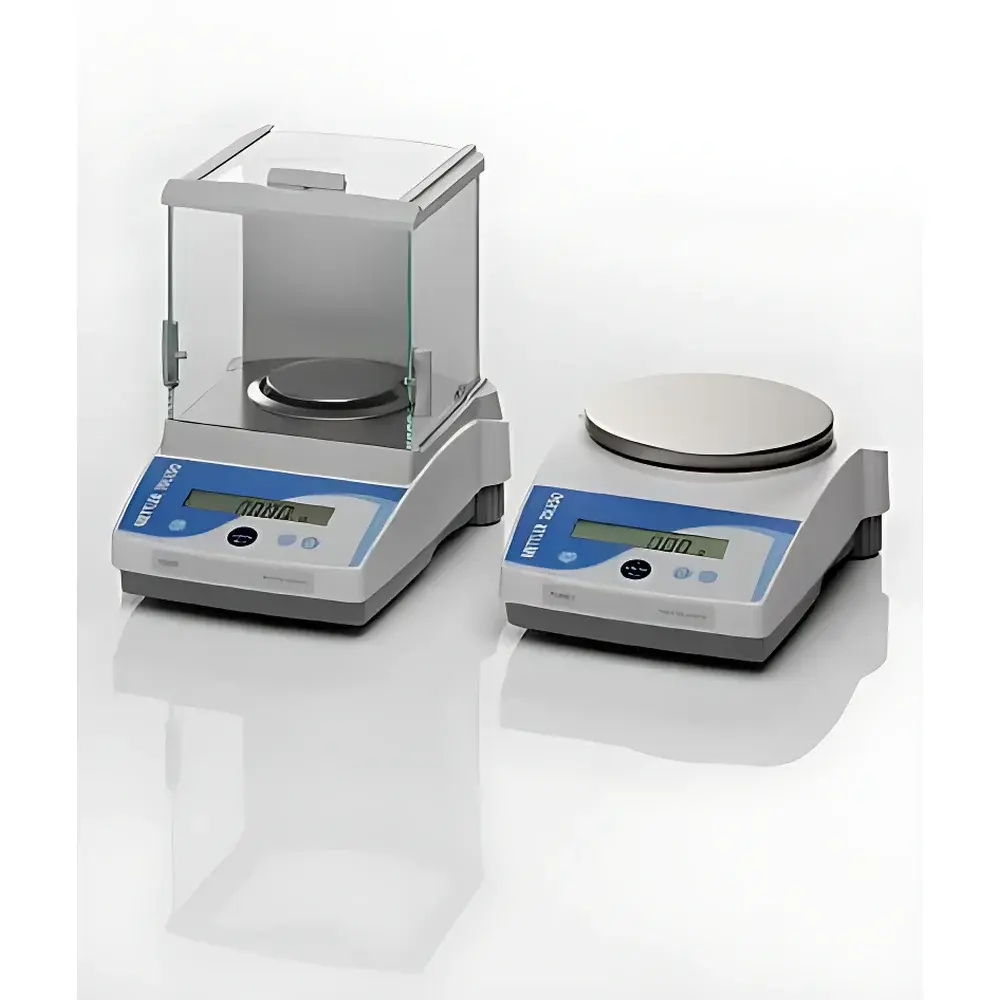
Metler Toledo PL2002 Precision Balance
| Origin | Shanghai, China |
|---|---|
| Manufacturer Type | Authorized Distributor |
| Origin Category | Domestic (China) |
| Model | PL2002 |
| Price | USD 1,090 (FOB Shanghai) |
| Readability | 0.01 g |
| Max Capacity | 2100 g |
| Repeatability (SD) | 0.01 g |
| Linearity Error | ±0.02 g |
| Stabilization Time | ≤3.0 s |
| Calibration | External, 2000 g weight required |
| Pan Dimensions (W×D) | 180 mm × 180 mm |
| Clear Height Above Pan | 150 mm |
| Overall Dimensions (W×D×H) | 238 mm × 335 mm × 287 mm |
| Interface | RS232 |
| Standard Accessories | In-use plastic draft shield, AC adapter, calibration certificate |
Overview
The Mettler Toledo PL2002 Precision Balance is a robust, entry-level analytical-grade weighing instrument engineered for routine laboratory and quality control environments where reliability, ease of operation, and regulatory traceability are essential. Built upon Mettler Toledo’s decades-long heritage in mass metrology, the PL2002 employs electromagnetic force compensation (EMFC) technology — the industry-standard transduction principle for high-stability precision balances — to deliver consistent, drift-resistant measurements under variable ambient conditions. With a 2100 g maximum capacity and 0.01 g readability, it bridges the functional gap between analytical and top-loading balances, supporting applications requiring higher load tolerance without sacrificing repeatability or linearity compliance. Its compact footprint and vertical design optimize bench space in regulated labs, while its structural architecture — constructed from impact- and corrosion-resistant ABS engineering plastic — ensures mechanical integrity across multi-shift operations and diverse chemical exposure scenarios.
Key Features
- Electromagnetic force compensation (EMFC) sensor with auto-zero tracking and temperature compensation algorithms for long-term stability
- Large, backlit LCD display (128 × 64 pixels) with intuitive icon-driven interface and adjustable contrast for low-light or glare-prone workspaces
- Dedicated function keys for rapid access to built-in weighing modes: standard weighing, percentage weighing, piece counting (PCS), dynamic (animal) weighing, and accumulation (add/subtract)
- RS232 serial interface compliant with EIA/TIA-232-E standards, enabling direct connection to label printers, PCs, LIMS, or ERP systems without additional adapters
- Integrated in-use plastic draft shield (standard) minimizes air current interference and protects internal mechanisms from particulate contamination and corrosive residue
- External calibration capability using certified Class M2 or better weights (2000 g recommended); calibration status logged with timestamp and user ID when connected to compatible software
- Auto-power-off and sleep-mode functions reduce energy consumption and extend component service life in unattended operation
Sample Compatibility & Compliance
The PL2002 accommodates a broad range of sample types — including powders, granules, liquids in tared containers, and small solid components — within its 180 mm × 180 mm stainless steel pan and 150 mm clearance height. Its design conforms to international metrological requirements defined in OIML R76-1 (2021) and supports GLP/GMP documentation workflows via optional audit-trail-enabled software integration. While not intrinsically rated for hazardous locations, the balance meets IEC 61000-4 electromagnetic compatibility standards and carries CE marking per EU Directive 2014/30/EU (EMC) and 2014/35/EU (LVD). Routine verification protocols align with ASTM E898–22 (Standard Guide for Selection and Use of Laboratory Balances) and ISO/IEC 17025:2017 clause 6.4.3 on equipment suitability and calibration traceability.
Software & Data Management
Data export and remote control are supported through Mettler Toledo’s free LabX Lite software (Windows-compatible), which provides real-time data streaming, customizable report templates (PDF/CSV), and basic electronic signature functionality. When paired with full LabX software (licensed separately), the PL2002 can be integrated into enterprise-wide data governance frameworks compliant with FDA 21 CFR Part 11 — including user authentication, audit trail generation, and electronic record retention. All RS232 transmissions follow ASCII-based command syntax (e.g., “S” for stable weight readout, “I” for identification), ensuring interoperability with legacy lab automation systems and custom-developed middleware.
Applications
- Raw material receipt inspection and batch release testing in pharmaceutical and food manufacturing facilities
- Formulation preparation and intermediate checks in R&D laboratories performing excipient blending or catalyst dosing
- Quality assurance sampling in contract manufacturing organizations (CMOs) operating under ISO 9001 or ICH Q7 guidelines
- Educational use in university chemistry and materials science teaching labs due to its fault-tolerant design and pedagogical interface clarity
- Inventory management and parts counting in electronics assembly and metal fabrication QA departments
- Environmental testing labs conducting soil/sediment dry-weight analysis and filter mass determination prior to gravimetric TOC or TSS assays
FAQ
Is the PL2002 suitable for GxP-regulated environments?
Yes — when used with documented calibration procedures, environmental monitoring, and appropriate software (e.g., LabX with Part 11 modules), it fulfills core requirements for data integrity and instrument qualification per ALCOA+ principles.
Does it support internal calibration?
No — the PL2002 requires external calibration using traceable weights; internal motorized calibration is available only on higher-tier models (e.g., ME/MS/XP series).
Can the draft shield be removed for large-volume container weighing?
Yes — the snap-fit plastic cover is fully detachable and storable; however, removal invalidates repeatability specifications under draft-sensitive conditions.
What is the recommended recalibration frequency?
Per ISO/IEC 17025, initial verification should occur at installation; subsequent intervals depend on usage intensity, risk assessment, and SOP-defined criteria — typically daily zero-checks and weekly full calibration in QC labs.
Is RS232 the only communication option?
Yes — USB or Ethernet interfaces are not natively supported; RS232 remains the sole standard port, though USB-to-serial adapters may be used with driver validation.