
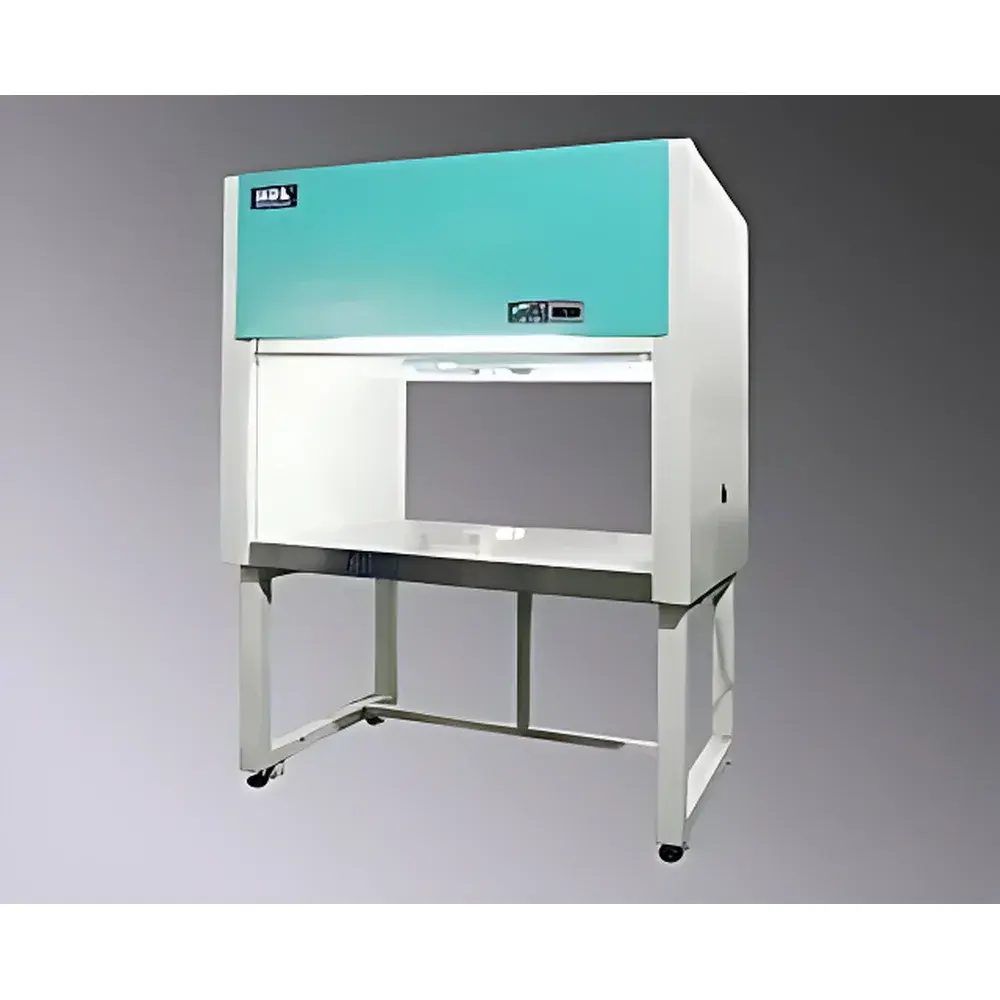
Har Dong Lian DL-CJ-1N Vertical Laminar Flow Clean Bench
| Brand | Har Dong Lian |
|---|---|
| Origin | Beijing, China |
| Model | DL-CJ-1N |
| Instrument Type | Vertical Laminar Flow Clean Bench |
| Cleanliness Class | ISO Class 5 (equivalent to Federal Standard 209E Class 100 @ ≥0.5 µm) |
| Airflow Pattern | Vertical Downward Laminar Flow |
| User Configuration | Single-Operator, Single-Face |
| Average Air Velocity | 0.25–0.51 m/s |
| Noise Level | ≤63 dBA |
| Work Area Dimensions (W×D×H) | 880 × 750 × 600 mm |
| Cabinet Construction | Cold-Rolled Steel with Epoxy Powder Coating |
| Work Surface | 304 Stainless Steel |
| Pre-filter | Replaceable Synthetic Fiber |
| HEPA Filter | 820 × 600 × 50 mm, ≥99.995% efficiency @ 0.3 µm |
| Lighting | 20 W Fluorescent Lamp (≥400 lux) |
| UV Lamp | 20 W Germicidal Lamp |
| Power Supply | 220 V AC / 50 Hz |
| Total Power Consumption | ≤660 W |
| Vibration (Half-Peak Amplitude) | ≤5 µm |
| Control Interface | LED Bar-Graph Display + Touch-Sensitive Switches |
| Air Recirculation Rate | 70% |
| Safety Design | Counterweight-Balanced Sliding Sash with Intrinsic Safety Mechanism |
Overview
The Har Dong Lian DL-CJ-1N Vertical Laminar Flow Clean Bench is an ISO Class 5-certified laboratory workstation engineered for routine aseptic procedures requiring particle-free environments. It operates on the principle of vertical laminar airflow: ambient air is drawn through a pre-filter, then forced downward through a certified HEPA filter (≥99.995% efficient at 0.3 µm), delivering unidirectional, low-turbulence airflow across the work surface. This design ensures consistent removal of airborne particulates ≥0.5 µm—meeting the stringent requirements of Federal Standard 209E Class 100 and its modern ISO 14644-1 equivalent. Unlike biological safety cabinets, the DL-CJ-1N provides personnel and product protection only—not environmental protection—making it suitable for non-hazardous applications such as media preparation, plant tissue culture, microbiological plating, and general sterile assembly where containment of biohazards is not required.
Key Features
- Vertical laminar flow architecture with adjustable air velocity (0.25–0.51 m/s) across six calibrated settings, enabling optimization for diverse procedural sensitivities and operator comfort.
- 304 stainless steel work surface—non-porous, corrosion-resistant, and compliant with ISO 14644-1 surface cleanliness validation protocols.
- Seamless, screw-free interior chamber constructed from cold-rolled steel with epoxy powder coating; eliminates microbial harborage points and supports routine disinfection under GLP-compliant cleaning SOPs.
- Intrinsically safe counterbalanced sash mechanism: prevents uncontrolled descent during mechanical failure and allows precise, tool-free positioning at any height between 100–400 mm above the work surface.
- Dual-stage filtration system: replaceable coarse pre-filter extends HEPA service life by capturing >95% of macro-particulates before they reach the final barrier; reduces long-term operational cost and maintenance frequency.
- Integrated LED bar-graph display and tactile control interface provide real-time feedback on fan speed, UV status, and lighting—designed for intuitive operation without compromising glove compatibility or workflow continuity.
Sample Compatibility & Compliance
The DL-CJ-1N accommodates standard Petri dishes, test tubes, flasks, pipette racks, and small-scale bioreactors within its 880 × 750 × 600 mm work area. Its 70% air recirculation ratio minimizes thermal load and energy consumption while maintaining ISO Class 5 integrity under steady-state conditions. The unit complies with ISO 14644-1:2015 for cleanroom performance verification and meets the structural and functional criteria outlined in ISO 14644-3 for clean bench testing methodologies. While not certified to NSF/ANSI 49 or EN 12469 (as it lacks exhaust ducting and containment features), it is routinely deployed in teaching laboratories, QC/QA environments, and pilot-scale production facilities operating under ISO 9001 or ISO 13485 quality management systems. All electrical components conform to IEC 61010-1 for laboratory equipment safety.
Software & Data Management
The DL-CJ-1N is a hardware-only platform with no embedded firmware or network connectivity. Operational parameters—including fan speed setting, UV exposure duration, and lighting state—are manually controlled and not logged. For laboratories requiring audit trails or electronic recordkeeping, integration with external environmental monitoring systems (e.g., Vaisala viewLinc or DeltaTrak BlueView) is supported via analog voltage outputs (0–10 V DC) for airflow velocity and digital relay contacts for UV/lamp status. These interfaces enable linkage to LIMS or ELN platforms under FDA 21 CFR Part 11-compliant configurations when paired with validated data acquisition modules and user access controls.
Applications
- Microbiological techniques including streak plating, serial dilution, and colony isolation in academic and industrial microbiology labs.
- Preparation of cell culture media, reagents, and buffers in upstream bioprocessing workflows prior to transfer into biosafety cabinets or isolators.
- Assembly and handling of sterile medical devices, pharmaceutical packaging components, and diagnostic kits under GMP Annex 1-aligned cleanroom practices.
- Botanical research involving meristem excision, callus induction, and in vitro propagation where low particulate burden is critical to explant survival.
- Electronics manufacturing support tasks such as precision soldering of sensitive components and optical alignment under particle-controlled conditions.
FAQ
What is the difference between a clean bench and a biological safety cabinet?
A clean bench provides only product protection via unidirectional laminar airflow—it does not protect the operator or environment from hazardous aerosols. A biological safety cabinet (BSC) offers combined personnel, product, and environmental protection through directional airflow, negative pressure containment, and ducted exhaust, making it mandatory for work with Risk Group 2+ agents.
Does the DL-CJ-1N require ducted exhaust installation?
No. It is a recirculating (non-ducted) system. Ambient air enters the unit, passes through filtration, and returns to the lab. No external venting or make-up air systems are needed.
Can this unit be validated for ISO Class 5 compliance?
Yes. When operated per manufacturer specifications—including proper pre-use UV decontamination, sash height adjustment, and routine HEPA integrity testing (e.g., DOP/PAO scanning per ISO 14644-3)—it achieves and sustains ISO Class 5 particle concentration limits (<3,520 particles/m³ @ ≥0.5 µm). Qualification should follow ISO 14644-2 surveillance protocols.
Is the HEPA filter certified to EN 1822 standards?
The supplied HEPA filter meets minimum efficiency requirements for ISO Class 5 but is not individually tested to EN 1822-1:2019 classification thresholds. Third-party certification can be arranged upon request for traceable H13-grade units.
What maintenance intervals are recommended?
Pre-filters should be replaced every 3–6 months depending on ambient dust load; HEPA filters typically last 3–5 years under continuous operation with scheduled pre-filter maintenance. Annual airflow velocity mapping and light intensity verification are advised per ISO 14644-3 Annex B.



