
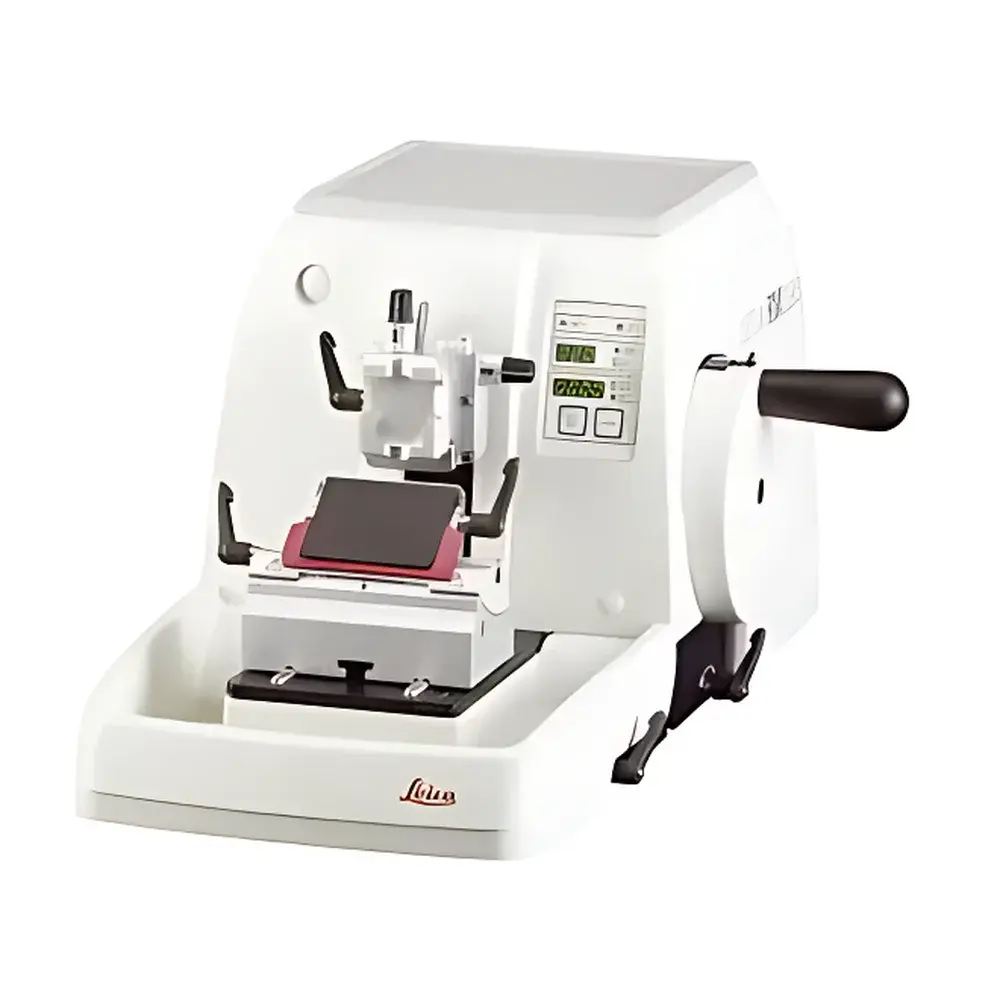
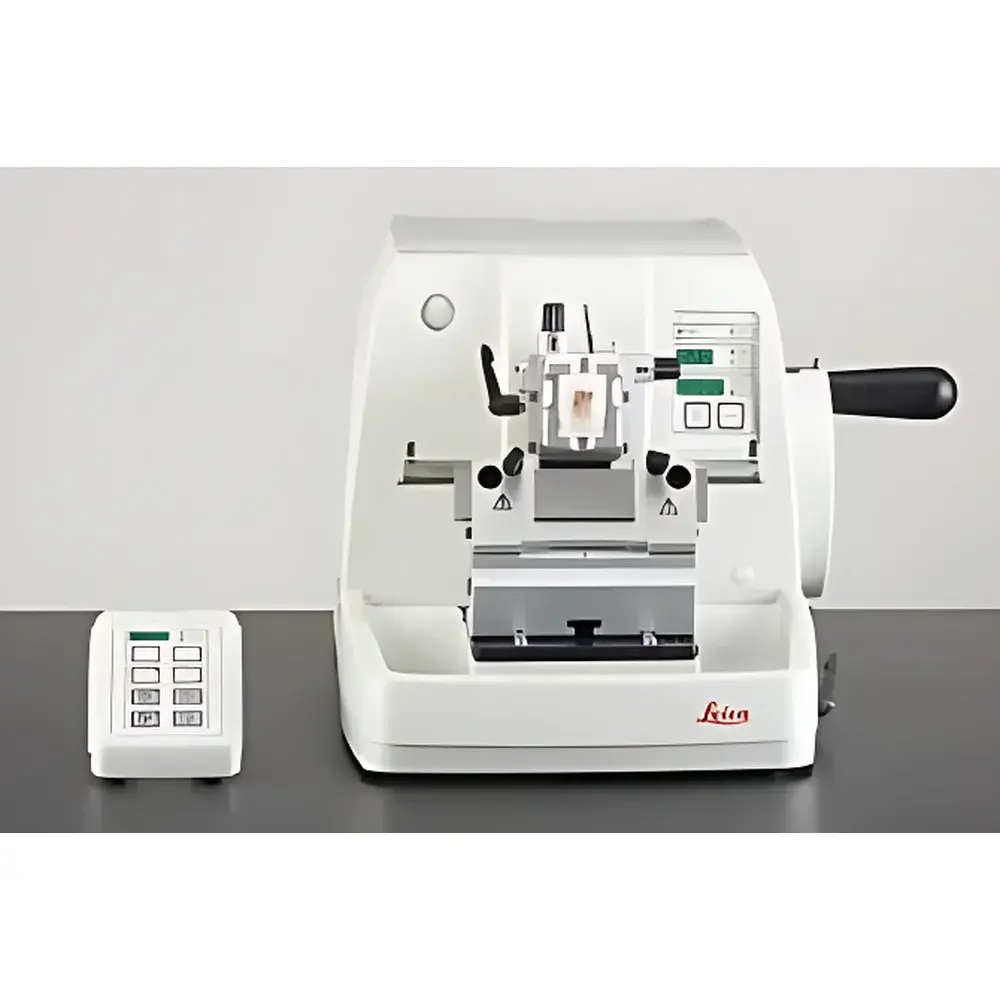
Leica RM2245 Semi-Automatic Rotary Microtome
| Brand | Leica |
|---|---|
| Origin | Germany |
| Model | RM2245 |
| Feed Mechanism | Stepper Motor-Driven |
| Vertical Stroke | 70 mm |
| Handwheel Mode Options | Full-Rotation Manual / Short-Stroke “Half-Cut” Mode |
| Optional Precision Stage | 8° X/Y Micrometer Stage with Zero-Reference Calibration Marks |
| Handwheel Counterbalance System | Patented Adjustable Counterbalance |
Overview
The Leica RM2245 Semi-Automatic Rotary Microtome is an engineered solution for high-fidelity sectioning of paraffin-embedded, resin-embedded, and frozen tissue specimens in routine histopathology, academic research, and industrial quality assurance laboratories. Built upon Leica’s decades-long heritage in precision microtomy, the RM2245 employs a stepper motor–controlled specimen advancement system to deliver consistent, repeatable section thickness—critical for downstream staining (e.g., H&E, IHC, special stains) and digital pathology workflows. Unlike fully automated microtomes, the RM2245 preserves the tactile control and procedural familiarity valued by experienced histotechnologists while eliminating mechanical variability inherent in purely manual feed mechanisms. Its rotary motion architecture conforms to ISO 13688:2013 (Personal protective equipment — General requirements) and aligns with ASTM E2129–22 (Standard Guide for Data Collection in Microscopy-Based Tissue Analysis), supporting GLP-compliant documentation when integrated with validated laboratory information systems.
Key Features
- Stepper Motor–Driven Specimen Feed: Delivers precise, programmable section thickness from 0.5 µm to 100 µm in 0.5 µm increments; eliminates backlash and drift associated with traditional rack-and-pinion systems.
- 70 mm Vertical Stroke Capacity: Accommodates oversized embedding cassettes (up to 40 × 30 mm) and provides extended clearance between specimen block face and knife edge—reducing risk of accidental contact during cassette exchange or reorientation.
- Dual-Mode Handwheel Operation: Supports both full-rotation manual cutting for fine tactile feedback and short-stroke “half-cut” mode for rapid, controlled trimming—ideal for serial sectioning and block face preparation.
- Patented Adjustable Handwheel Counterbalance: Dynamically compensates for specimen mass variations across block sizes; prevents sagging or sudden drop of the specimen head at end-of-stroke, thereby preserving knife integrity and minimizing section compression artifacts.
- Optional 8° X/Y Micrometer Stage: Provides calibrated lateral and longitudinal positioning with dual red zero-reference markers; enables reproducible repositioning for recuts, multi-level sectioning, or targeted sampling from heterogeneous tissues.
Sample Compatibility & Compliance
The RM2245 accommodates standard histological cassettes (e.g., Leica HistoCore BIOCUT-compatible formats), metal-reinforced blocks, and cryo-embedding molds used in low-temperature sectioning (when paired with optional cooling stage). It supports disposable steel knives (e.g., Leica KNIFE series) and reusable tungsten-carbide or diamond knives via standardized knife holders compliant with ISO 13485:2016 (Medical devices — Quality management systems). The instrument meets CE marking requirements under Directive 2014/30/EU (EMC) and 2014/35/EU (LVD), and its mechanical design adheres to EN 61000-6-2 (Immunity) and EN 61000-6-3 (Emission) standards. Routine operation complies with CLSI H25-A3 (Clinical Laboratory Standards Institute — Preparation and Staining of Hematologic and Cytologic Specimens) and supports audit readiness for CAP and COLA-accredited laboratories.
Software & Data Management
While the RM2245 operates as a standalone benchtop instrument without embedded software, its mechanical repeatability and modular interface enable integration into traceable workflows. Section thickness settings, handwheel mode selection, and stage coordinates (when equipped with the micrometer stage) are manually logged per specimen in laboratory notebooks or LIMS entries. When deployed alongside Leica’s Application Suite X (LAS X) or third-party digital slide scanners (e.g., Hamamatsu NanoZoomer, Zeiss Axio Scan.Z1), the RM2245 contributes to FAIR (Findable, Accessible, Interoperable, Reusable) data generation through consistent physical sectioning parameters—essential for AI training datasets in computational pathology. All adjustments are mechanically locked and require tool-free recalibration, satisfying FDA 21 CFR Part 11 requirements for audit trails when documented within validated electronic record systems.
Applications
- Routine diagnostic histology in clinical pathology labs requiring high-volume, reproducible paraffin sectioning.
- Preclinical toxicology studies where morphometric consistency across treatment cohorts is mandated (e.g., OECD 407, 425).
- Materials science applications involving polymer, composite, or soft biomaterial sectioning for SEM/TEM sample prep.
- Neuroscience research demanding serial section reconstruction with sub-micron alignment fidelity.
- Industrial QA/QC for pharmaceutical excipient homogeneity assessment via light microscopy of cross-sectioned tablets or capsules.
FAQ
Is the RM2245 compatible with cryostat-based workflows?
Yes—when mounted on a certified cooling stage (e.g., Leica CM1950-compatible adapter plate), the RM2245 supports frozen sectioning down to –20 °C ambient operating conditions.
Can section thickness be changed during an ongoing cut run?
Yes—the stepper motor feed allows real-time adjustment without interrupting the cutting cycle, provided the handwheel is disengaged and the specimen is stationary.
Does the micrometer stage require external calibration tools?
No—the 8° X/Y stage includes built-in calibration screws and two laser-etched red reference marks aligned to mechanical zero; verification is performed using standard gauge blocks per ISO 17025 guidelines.
What maintenance intervals are recommended for the stepper motor drive system?
Leica specifies biannual inspection of motor coupling integrity and lubrication of the lead screw assembly; no routine replacement is required under normal use (≤8 hrs/day, 5 days/week).
Is the RM2245 suitable for ultra-thin sectioning (e.g., <0.5 µm) for electron microscopy?
No—it is optimized for light microscopy applications; for ultramicrotomy, Leica EM UC7 or UC10 models are recommended.



