
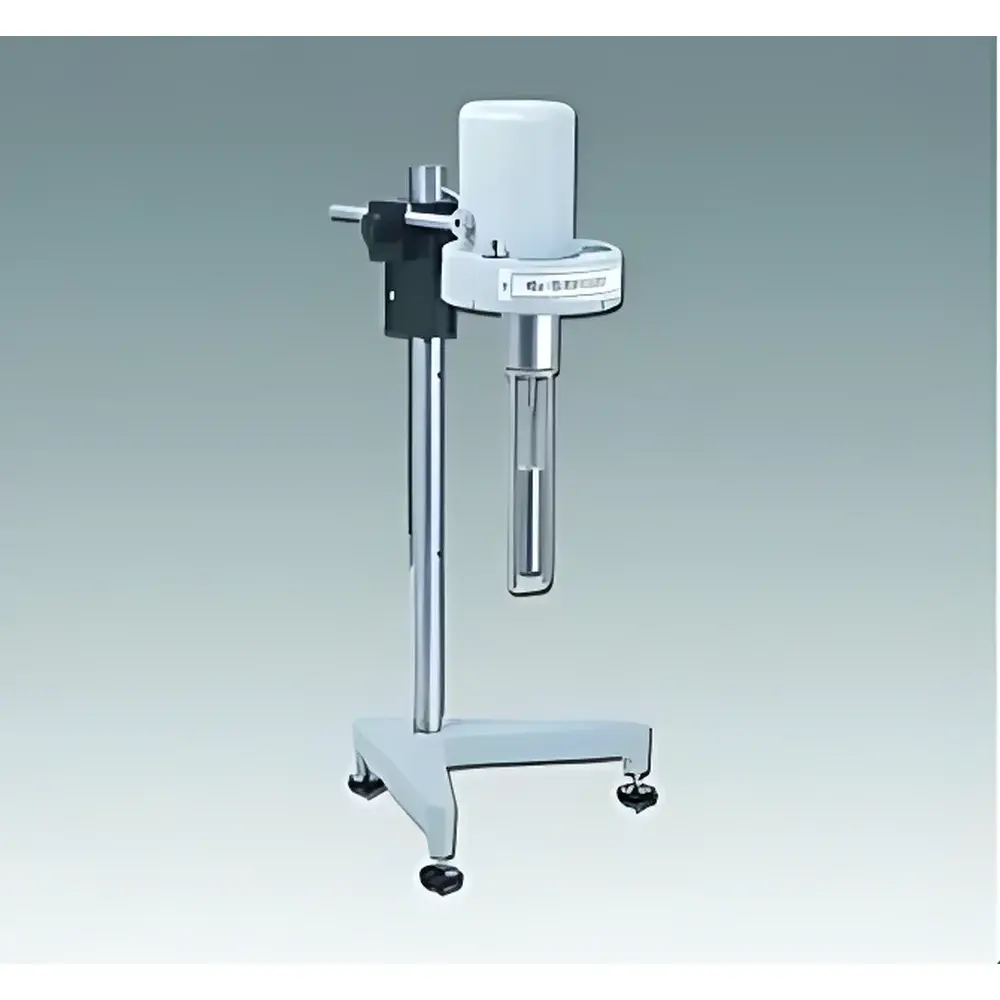
Brookfield NDJ-4 Digital Rotational Viscometer
| Origin | Beijing, China |
|---|---|
| Manufacturer Type | Authorized Distributor |
| Origin Category | Domestic (PRC) |
| Model | NDJ-4 |
| Price | USD 450 (FOB) |
| Measurement Range | 10–2×10⁶ mPa·s |
| Accuracy | ±5% (for Newtonian fluids) |
| Speed Settings | 0.3, 0.6, 1.5, 3, 6, 12, 30, 60 rpm |
| Spindle Set | LV Spindles #0 (optional), #1–#4 |
| Dimensions | 300 × 300 × 450 mm |
Overview
The Brookfield NDJ-4 Digital Rotational Viscometer is a precision-engineered instrument designed for routine viscosity measurement of Newtonian and mildly non-Newtonian liquids in quality control, R&D, and production environments. Based on the Couette principle—where torque required to rotate a spindle immersed in a fluid is directly proportional to its dynamic viscosity—the NDJ-4 delivers reliable absolute viscosity values in millipascal-seconds (mPa·s). Its fixed-speed, multi-spindle architecture provides stable, repeatable readings across an operational range spanning three decades (10 to 2×10⁶ mPa·s), making it particularly suitable for medium-to-high viscosity fluids such as lubricating greases, solvent-based coatings, pharmaceutical suspensions, edible oils, and cosmetic emulsions. Unlike capillary or falling-ball viscometers, the NDJ-4 eliminates dependence on fluid density or temperature-induced flow-time drift, offering direct, temperature-compensated (when used with optional water bath) viscosity output under standardized test conditions.
Key Features
- Eight discrete rotational speeds (0.3, 0.6, 1.5, 3, 6, 12, 30, and 60 rpm) enable optimal shear rate selection per sample viscosity class—critical for minimizing transient effects and ensuring steady-state measurement.
- Interchangeable LV spindles (#0–#4) allow seamless adaptation from low-viscosity solvents (using #0 or #1) to highly viscous pastes (using #3 or #4), with each spindle calibrated traceably to NIST-traceable reference oils.
- Universal joint drive shaft ensures coaxial alignment between motor and spindle—even when sample containers vary in height or centering—reducing mechanical vibration and torque noise during measurement.
- Digital LED display with real-time torque % and viscosity readout eliminates parallax error and supports rapid operator interpretation without external software.
- Robust cast-aluminum housing and sealed stepper motor assembly provide long-term stability in industrial laboratory settings with ambient temperature fluctuations between 10–40 °C and relative humidity ≤80% RH (non-condensing).
Sample Compatibility & Compliance
The NDJ-4 accommodates standard cylindrical sample containers (60–100 mm diameter, minimum depth 70 mm) and supports both manual and semi-automated operation. It complies with ASTM D2196 (Standard Test Methods for Rheological Properties of Non-Newtonian Materials by Rotational Viscometer), ISO 2555 (Plastics — Resins in the Liquid State or as Emulsions or Dispersions — Determination of Apparent Viscosity), and USP (Rheology) for pharmaceutical excipient characterization. When operated under documented SOPs—including spindle cleaning protocols, temperature stabilization (±0.5 °C), and calibration verification using certified viscosity standards—the instrument meets GLP audit requirements for routine QC testing. While not inherently 21 CFR Part 11 compliant (lacking electronic signature and audit trail), its analog/digital hybrid architecture permits integration into validated LIMS environments via RS-232 serial output (optional interface module).
Software & Data Management
The NDJ-4 operates as a standalone instrument but supports data export via optional RS-232 cable to Windows-based PC applications. Compatible third-party software (e.g., RheoSoft Lite, Brookfield DV2T Companion) enables time-sweep analysis, yield stress estimation via extrapolated zero-shear viscosity, and automated calibration curve generation. All measurements retain full metadata—including spindle ID, speed, timestamp, and ambient temperature—as embedded fields in CSV exports. For regulated environments, users may implement procedural controls (e.g., dual-operator verification, printed strip-chart logs) to satisfy ALCOA+ data integrity principles (Attributable, Legible, Contemporaneous, Original, Accurate, Complete, Consistent, Enduring, Available).
Applications
- Quality assurance of edible oils and margarines per AOAC 968.19 and ISO 8587.
- Routine batch release testing of architectural paints and coil coatings against ASTM D1025 and ISO 2555.
- Stability evaluation of topical ointments and hydrogels during accelerated aging studies (ICH Q5C).
- Process monitoring of adhesive formulations pre- and post-cure to detect premature gelation or solvent loss.
- Educational labs demonstrating Newtonian behavior, shear-thinning trends, and spindle selection logic in undergraduate physical chemistry courses.
FAQ
Is the NDJ-4 suitable for measuring non-Newtonian fluids?
Yes—though it reports apparent viscosity at discrete shear rates, not full flow curves. For qualitative assessment of shear-thinning or thixotropy, sequential measurements at descending/ascending speeds (with defined rest intervals) are recommended.
Can spindle #0 be used with all speed settings?
No—spindle #0 is optimized for sub-100 mPa·s fluids and should only be used at 60 rpm or 30 rpm to avoid torque overload and measurement saturation.
What calibration standards are recommended for daily verification?
NIST-traceable silicone oil standards (e.g., Cannon N47, N100, N1000) covering the 100–10,000 mPa·s range are advised; verification should occur before first use each shift.
Does the NDJ-4 require annual recalibration by an accredited lab?
While not mandatory, ISO/IEC 17025-accredited recalibration every 12 months is strongly recommended for GMP-regulated applications to maintain metrological traceability.
Is temperature control integrated into the base unit?
No—temperature regulation requires external equipment (e.g., circulating water bath or Peltier-controlled jacketed vessel); viscosity results must be annotated with measured bath temperature per ASTM D445 protocol.



