
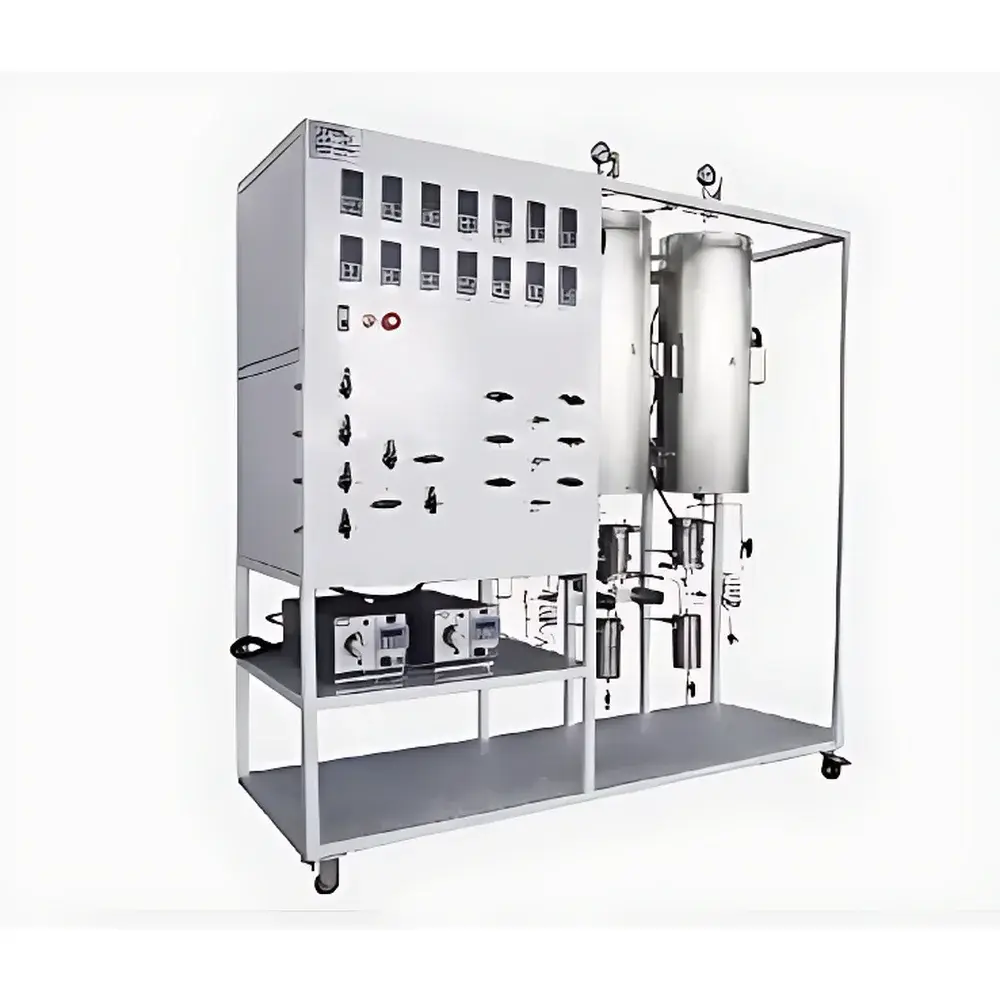
Kemi High-Temperature High-Pressure Fixed-Bed Reactor System DV-FB-600
| Origin | Anhui, China |
|---|---|
| Manufacturer Type | Authorized Distributor (Beijing HQ) |
| Origin Category | Domestic |
| Model | DV-FB-600 Multi-Function Desktop Fixed-Bed Reactor |
| Price Range | USD 14,000–21,000 |
| Reactor Volume | Small-scale (≤50 mL active bed volume) |
| Construction Material | 316L Stainless Steel |
| Maximum Operating Pressure | 10 MPa |
| Maximum Operating Temperature | 600 °C |
| Gas Flow Control | 3 × D07-11C Mass Flow Controllers (0–5 L/min, N₂-equivalent) |
| Liquid Delivery | 3 × SSI Series I Precision Plunger Pumps (0.01–4.99 mL/min) |
| Heating System | Dual Open-Type Split Furnaces (Φ20 mm × 1000 mm, 304 SS shell) |
| Reaction Tubes | 2 × 316L SS tubes (OD 20 mm, ID 9 mm, L 800 mm, rated to 10 MPa / 600 °C) |
| Backpressure Regulation | Swagelok 316 SS Back-Pressure Valves |
| Safety Systems | H₂ & C₂H₂ Gas Detectors, N₂ Purge & Leak-Test Protocol |
| Control System | Yudian Programmable Temperature Controllers (PID), Integrated Gas/Liquid Flow & Thermal Sequencing Logic |
Overview
The Kemi DV-FB-600 is an engineered high-temperature, high-pressure fixed-bed reactor system designed for catalytic evaluation under industrially relevant continuous-flow conditions. Based on the Couette-type packed-bed configuration, it enables precise control of residence time, pressure, temperature gradient, and phase contact dynamics—critical parameters in heterogeneous catalysis research, including hydrodesulfurization (HDS), Fischer–Tropsch synthesis, ammonia decomposition, and CO₂ hydrogenation. The system operates on a dual-reactor parallel architecture, allowing comparative catalyst screening or process parameter mapping without hardware reconfiguration. Each reaction zone features independently programmable heating zones, real-time pressure monitoring, and redundant safety interlocks compliant with ASME B31.3 process piping guidelines and ISO 13849-1 functional safety principles for laboratory-scale pressurized systems.
Key Features
- Dual independent 316L stainless steel reaction tubes (OD 20 mm, ID 9 mm, L 800 mm), each rated to 10 MPa and 600 °C, with flanged end connections and thermocouple ports for axial temperature profiling.
- Triple-channel gas delivery subsystem comprising three Beijing Sevenstar D07-11C thermal mass flow controllers (0–5 L/min, N₂-calibrated, ±1% FS accuracy), supporting H₂, N₂, and auxiliary gas switching via solenoid-valve manifold.
- Three high-precision American SSI Series I plunger pumps (0.01–4.99 mL/min, pulseless output, chemically resistant sapphire plungers), enabling stable liquid feed of viscous organosulfur feeds (e.g., 1% dibenzothiophene in decalin) or refinery streams.
- Two split-type open-hearth furnaces with dual-zone PID control (Yudian AI-808 series), each accommodating one reaction tube; furnace bore diameter 20 mm, length 1000 mm, external shell 304 stainless steel.
- Integrated backpressure regulation using Swagelok 316 SS pneumatic back-pressure valves with digital setpoint interface, ensuring stable upstream pressure control across variable flow rates and phase compositions.
- Comprehensive safety architecture: H₂ and acetylene gas detectors (UL 2075 certified), automatic N₂ purge sequence prior to H₂ introduction, pressure decay leak-check protocol, and emergency venting path routed through flame arrestors.
Sample Compatibility & Compliance
The DV-FB-600 accommodates solid catalysts in granular, extrudate, or pellet form (particle size range: 0.25–3 mm), with optional quartz wool or ceramic frit supports. Compatible feedstocks include hydrocarbon liquids (naphtha, diesel, model sulfur compounds), aqueous solutions, and gaseous reagents (H₂, CO, CO₂, NH₃, CH₄). All wetted components meet ASTM A269/A270 standards for seamless 316L tubing and fittings. System design adheres to ISO/IEC 17025 requirements for method validation infrastructure and supports GLP-compliant data traceability when paired with validated software logging (see Software & Data Management). Pressure vessel components conform to PED 2014/68/EU Annex I essential safety requirements for Group 1 fluid service.
Software & Data Management
The integrated control interface provides synchronized logging of temperature (±0.5 °C), pressure (±0.02 MPa), gas flow (±1% FS), and liquid flow (±0.5% FS) at user-defined intervals (1–60 s). Raw data exports to CSV or Excel-compatible formats with timestamped metadata (operator ID, experiment ID, calibration certificates). Audit trail functionality meets FDA 21 CFR Part 11 criteria when deployed with network-authenticated login and electronic signature modules. Optional LabVIEW-based custom scripting enables automated ramp-hold-cool sequences, multi-step gas-switch protocols, and real-time conversion calculations based on GC/FID or online MS input (external integration supported via Modbus TCP).
Applications
- Catalyst deactivation kinetics under simulated refinery conditions (e.g., HDS of thiophenic compounds at 300–400 °C, 3–7 MPa)
- Structure–activity relationship (SAR) studies for transition metal sulfides, zeolites, and MOF-derived catalysts
- Reaction engineering validation of microkinetic models and Langmuir–Hinshelwood rate expressions
- Long-duration stability testing (>500 h) with periodic online sampling and offline GC–SCD analysis
- Co-processing of bio-oils with petroleum fractions under hydrotreating conditions
- Screening of low-Pd or Ni-based alternatives for selective hydrogenation of alkynes and dienes
FAQ
What is the maximum allowable catalyst bed height in each reaction tube?
Each 800 mm long tube supports a maximum active catalyst bed height of 600 mm, with 100 mm pre- and post-bed inert zones for thermal stabilization and pressure equalization.
Can the system be configured for trickle-bed operation?
Yes—the liquid distributor design and adjustable backpressure control allow stable trickle-flow regime operation with simultaneous gas–liquid–solid contact, verified via pressure drop correlation against Ergun equation predictions.
Is third-party calibration documentation provided with shipment?
Yes—NIST-traceable calibration certificates for all flow meters, pressure transducers, and thermocouples are included, along with as-built P&IDs and material test reports (MTRs) per ASTM A269/A270.
Does the system support remote monitoring and control?
Standard Ethernet (RJ45) and RS485 interfaces enable integration into existing lab SCADA networks; optional VPN-secured web interface available for off-site status monitoring and emergency shutdown initiation.
What maintenance intervals are recommended for the plunger pumps and MFCs?
Plunger pump seals require replacement every 6 months under continuous operation; MFCs should undergo zero-point verification quarterly and full recalibration annually per ISO/IEC 17025 internal procedure guidance.



