
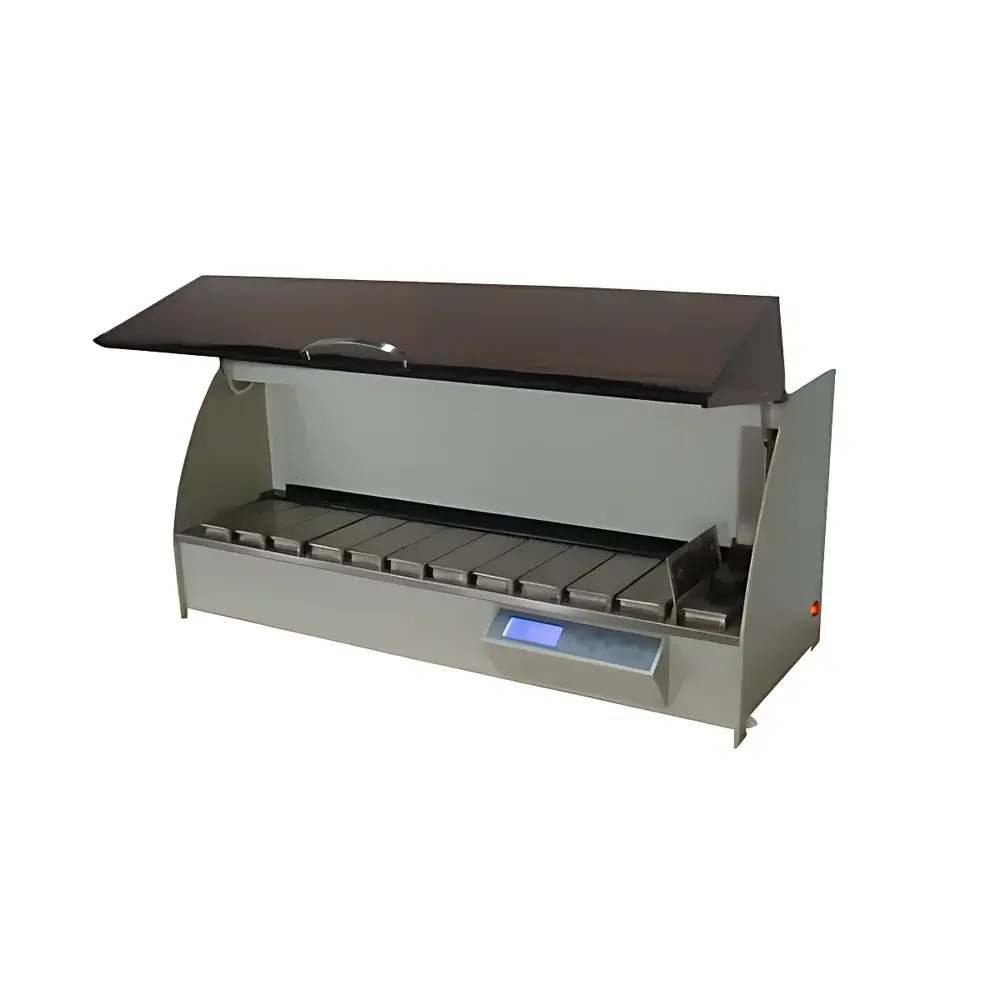
ZEEDO HS-1000 Fully Automated Tissue Dehydrator
| Origin | Zhejiang, China |
|---|---|
| Manufacturer Type | Authorized Distributor |
| Origin Category | Domestic (PRC) |
| Model | HS-1000 |
| Price Range | USD 1,400–7,200 |
| Number of Reagent Stations | 12 (9 reagent tanks + 3 paraffin wax tanks) |
| Processing Time per Station | Tanks 1–9: 0–99 hours programmable |
| Tanks 10–12 | 0–24 hours programmable |
| Paraffin Temperature Range | Ambient to 99 °C adjustable |
| Heating Method | Dry-type internal heating |
| Single Tank Capacity | 1000 mL |
| Temperature Control Accuracy | ±2 °C |
| Agitation Frequency | 2 cycles/min |
| Power Failure Protection | >6 hours continuous operation without external battery backup |
| Operating Ambient Temperature | 0–40 °C |
| Input Voltage | 220 VAC, 50 Hz |
| Rated Power | 800 W |
| Dimensions (W×D×H) | 1000 × 420 × 450 mm |
| Net Weight | 80 kg |
Overview
The ZEEDO HS-1000 Fully Automated Tissue Dehydrator is an engineered solution for standardized, reproducible tissue processing in histopathology laboratories. It operates on the principle of graded alcohol-based dehydration followed by xylene clearing and paraffin infiltration—core steps in routine formalin-fixed, paraffin-embedded (FFPE) specimen preparation. Designed for high-throughput clinical pathology labs and academic research facilities, the HS-1000 integrates precise thermal control, programmable multi-stage protocols, and fail-safe operational continuity to ensure consistent tissue morphology preservation across batches. Its fully enclosed architecture minimizes solvent vapor exposure, supporting occupational safety compliance while maintaining strict environmental containment during prolonged processing cycles.
Key Features
- Dry-type internal heating system ensures uniform temperature distribution across all 12 stations (9 reagent + 3 paraffin tanks), eliminating hot spots and reducing thermal stress on delicate tissue specimens.
- Programmable time-per-step functionality: tanks 1–9 support 0–99 hour intervals; tanks 10–12 (wax infiltration stages) allow 0–24 hour precision scheduling—enabling customization for soft tissues, dense biopsies, or large surgical specimens.
- Integrated air purification module with activated carbon filtration provides continuous internal recirculation, actively adsorbing volatile organic compounds (e.g., ethanol, xylene) to meet OSHA PEL and EU Directive 2004/37/EC requirements for laboratory air quality.
- Intelligent power failure recovery: onboard lithium-free backup circuitry sustains controller operation and motor-driven agitation for over six hours without external power—preventing protocol interruption and preserving tissue integrity during grid instability.
- Imported industrial-grade LCD interface with Chinese/English bilingual firmware (default English), offering intuitive navigation, real-time parameter monitoring, and password-protected program editing to support GLP-compliant workflow governance.
- Ergonomically optimized cabinet design (1000 mm width) accommodates standard lab bench integration, with low-noise (<45 dB(A)) peristaltic agitation and vibration-damped tank mounting to minimize mechanical interference with adjacent instrumentation.
Sample Compatibility & Compliance
The HS-1000 supports routine processing of human and animal tissue specimens up to 30 mm × 30 mm × 10 mm in dimension per cassette, compatible with standard 30 × 40 mm plastic or metal cassettes. It accepts common histological reagents—including 70–100% ethanol series, isopropanol, chloroform, xylene, and molten paraffin (56–62 °C melt point)—with chemical resistance validated per ISO 10993-5 for polypropylene tank construction. The system meets IEC 61010-1:2010 safety standards for laboratory equipment and incorporates electrical isolation compliant with EN 60601-1 for medical device environments. Optional audit trail logging (via USB export) supports alignment with CAP accreditation requirements and internal QA documentation protocols.
Software & Data Management
The embedded control firmware enables storage of up to 20 user-defined dehydration protocols, each configurable with independent temperature setpoints, dwell times, agitation frequency, and wax viscosity compensation curves. All runtime events—including door opening, temperature deviation alerts, agitation faults, and power loss recovery—are timestamped and stored in non-volatile memory. Data export via USB 2.0 port generates CSV-formatted logs compatible with LIMS integration (e.g., Sunquest, Cerner CoPath). While not FDA 21 CFR Part 11 certified out-of-the-box, the system’s password-protected parameter lockout, electronic signature fields (via optional keyboard), and immutable event history provide foundational elements for GxP-aligned validation packages.
Applications
- Routine diagnostic histology in hospital pathology departments processing 50–200 specimens daily.
- Preclinical toxicology studies requiring batch-consistent FFPE blocks for IHC, ISH, and digital pathology scanning.
- Biobanking operations where long-term archival stability depends on optimal dehydration kinetics and minimal lipid leaching.
- Research laboratories investigating tissue-specific dehydration kinetics—leveraging programmable multi-hour staging to model solvent diffusion rates in neural, adipose, or fibrotic tissues.
- Training facilities teaching standardized tissue processing per CAP checklist ANP.22220 and WHO IARC guidelines for cancer diagnostics.
FAQ
Does the HS-1000 support remote monitoring or network connectivity?
No—this model operates as a standalone instrument with local HMI control only. Networked telemetry requires third-party IoT gateways interfacing via RS-485 Modbus RTU output (available upon request).
Can the agitation speed be adjusted beyond 2 cycles per minute?
No—the agitation frequency is fixed at 2 cycles/min to optimize solvent exchange kinetics while preventing mechanical trauma to fragile specimens; this value aligns with ASTM E2912-13 recommendations for automated tissue processors.
Is paraffin overflow protection included?
Yes—a dual-level float sensor in each wax tank triggers immediate pump shutdown and audible alarm if liquid level exceeds safe operational threshold.
What maintenance intervals are recommended for the air filtration system?
Activated carbon filters require replacement every 6 months under continuous 8-hour/day operation, or after processing 500 tissue cassettes—whichever occurs first—to maintain ≥90% VOC adsorption efficiency per ISO 10121-1.
Does the HS-1000 comply with CE marking requirements for sale in the European Economic Area?
Yes—the unit carries CE marking under the Low Voltage Directive (2014/35/EU) and EMC Directive (2014/30/EU); Declaration of Conformity documentation is provided with shipment.




