
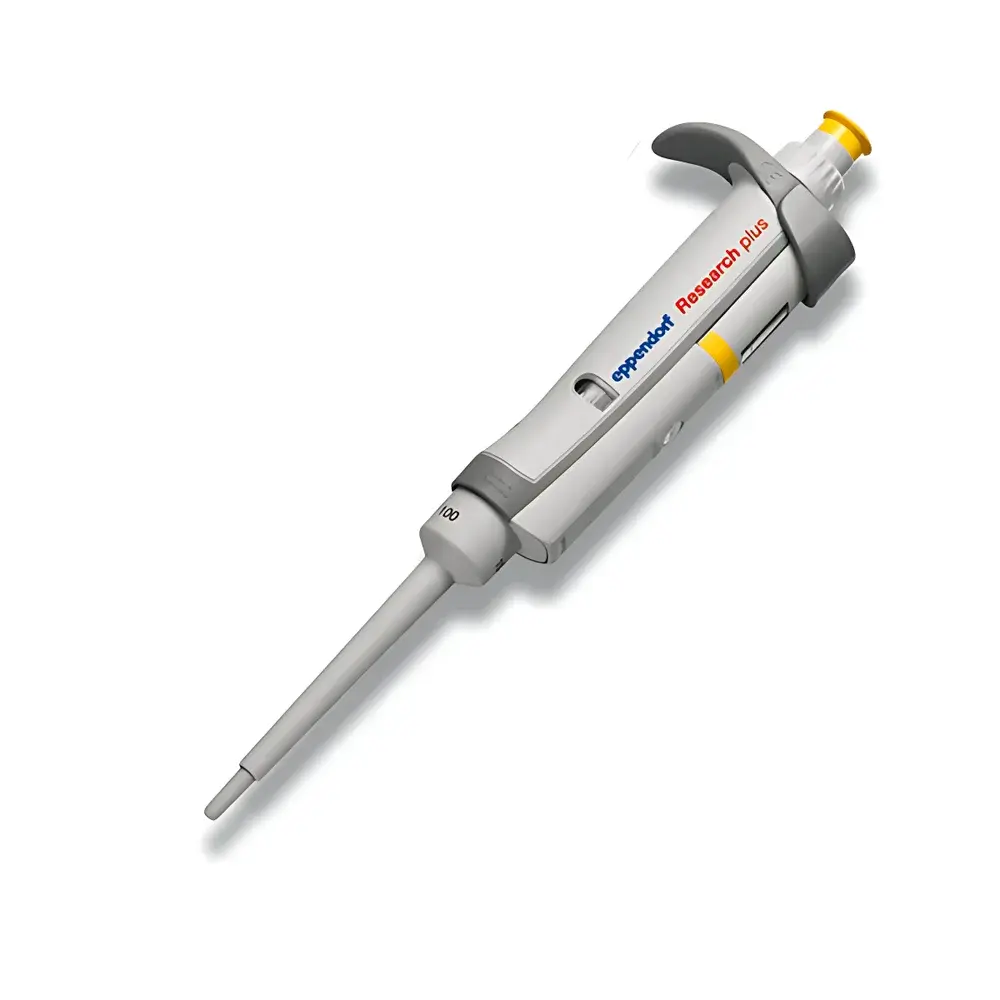
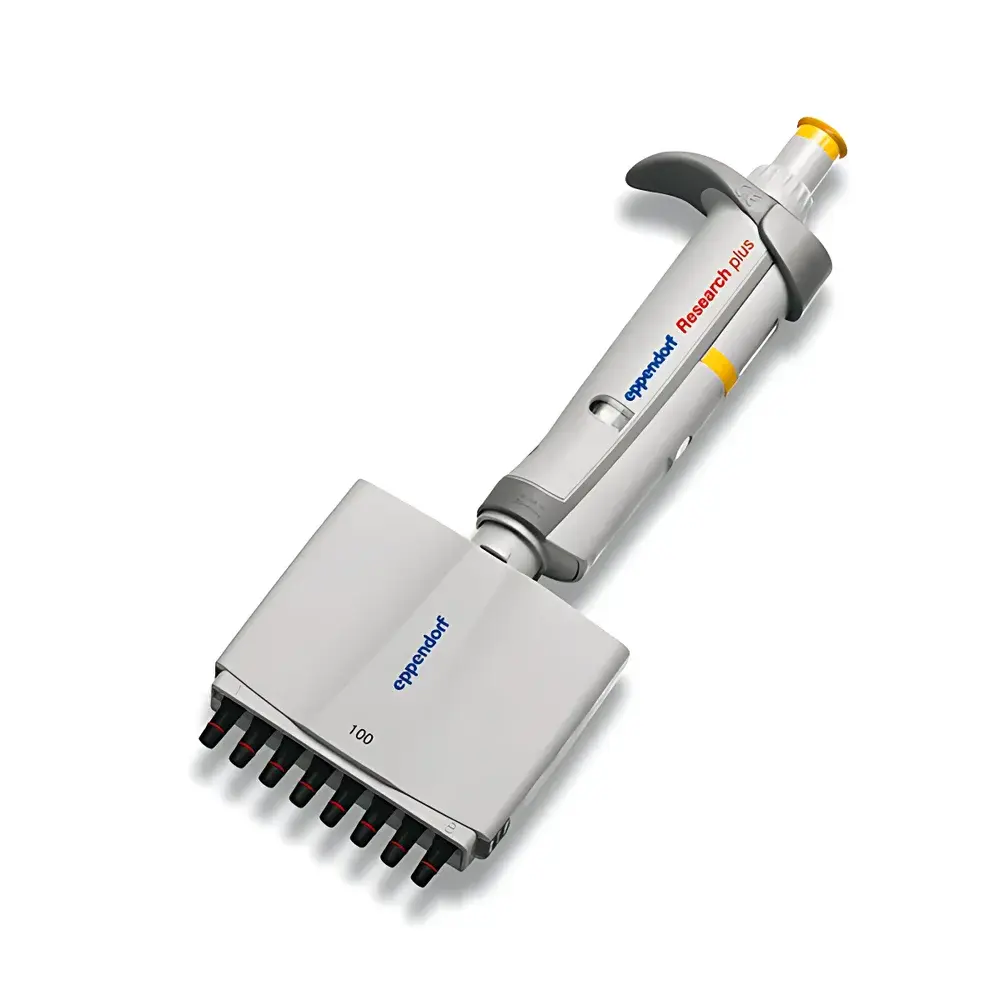
Eppendorf Research plus 0.5–10 µL Manual Single-Channel Pipette
| Brand | Eppendorf |
|---|---|
| Origin | Germany |
| Type | Manual Single-Channel Pipette |
| Volume Range | 0.5–10 µL |
| Maximum Capacity | 10 µL |
| Accuracy | ±0.90 % |
| Sterilization | Autoclavable (121 °C, 20 min) |
| Compliance | ISO 8655-2, ISO 8655-5, GLP/GMP-ready |
Overview
The Eppendorf Research plus 0.5–10 µL manual single-channel pipette is a precision-engineered liquid handling instrument developed through six decades of iterative refinement in volumetric accuracy, ergonomics, and reliability. Designed for high-frequency micro-volume transfers in molecular biology, clinical diagnostics, pharmaceutical QC, and academic research laboratories, it operates on the air displacement principle—where piston-driven air compression creates a controlled vacuum to aspirate and dispense liquids via disposable tips. Its calibration stability is validated per ISO 8655-2 (volumetric performance) and ISO 8655-5 (calibration procedures), ensuring traceable metrological integrity across daily use. The pipette’s lightweight construction (approx. 75 g for the 0.5–10 µL variant), low plunger activation force (<1.5 N for aspiration, <1.0 N for dispensing), and optimized tip ejection leverage collectively reduce cumulative musculoskeletal strain—supporting long-term operator wellness in GLP- and GMP-regulated environments.
Key Features
- PhysioCare Concept® Integration: Engineered to minimize hand and forearm fatigue through ultra-low operating forces, balanced weight distribution, and a soft-grip contour that adapts to natural hand geometry.
- Autoclavable Design: Fully disassemblable without tools; withstands repeated sterilization at 121 °C / 20 min (DIN EN 285), maintaining dimensional stability and piston seal integrity over ≥100 cycles.
- Elastic Tip Attachment System: Patented spring-loaded tip cone ensures consistent, leak-free sealing across varying tip brands and manufacturing tolerances—even after prolonged use.
- Density-Independent Volume Adjustment: Fine-tuned volume setting mechanism compensates for viscosity and vapor pressure variations, enabling reliable transfer of ethanol, glycerol, and aqueous buffers without recalibration.
- High-Contrast Volume Display: Dual-scale graduated ring with magnified numerals and color-coded volume bands (yellow for 0.5–10 µL range) enables rapid, parallax-free reading under standard lab lighting.
- ISO 8655-Compliant Calibration Certificate: Supplied with factory-verified calibration data (including gravimetric test report per ISO 8655-6), supporting audit readiness for FDA 21 CFR Part 11, ISO/IEC 17025, and EU Annex 11 compliance frameworks.
Sample Compatibility & Compliance
The Research plus 0.5–10 µL pipette accommodates standard conical polypropylene tips (DNase/RNase-free, sterile, or filtered options) and demonstrates consistent performance across liquids with dynamic viscosities ranging from 0.89 mPa·s (water at 25 °C) to 1,100 mPa·s (40% glycerol/water). It meets ISO 8655-2 accuracy specifications across its full range (±0.90% at 10 µL, ±3.0% at 0.5 µL) and repeatability criteria (≤0.4% CV). All materials contacting liquid pathways are chemically inert to common laboratory solvents (e.g., 70% ethanol, 0.1 M NaOH, 10% bleach) and certified free of detectable endotoxins (<0.03 EU/mL). Device documentation supports full traceability in regulated workflows, including electronic calibration logs, maintenance records, and change control documentation per ICH Q7 and USP .
Software & Data Management
While the Research plus is a manually operated instrument, its design integrates seamlessly into digital lab ecosystems. Each unit carries a unique serial number engraved on the barrel, enabling asset-level tracking in LIMS (Laboratory Information Management Systems) and CMMS (Computerized Maintenance Management Systems). Calibration reports are provided in PDF format compliant with ALCOA+ principles (Attributable, Legible, Contemporaneous, Original, Accurate). When paired with Eppendorf’s optional Pipette Calibration Software (v3.2+), users can generate electronic calibration certificates with digital signatures, automatic uncertainty calculations per GUM (Guide to the Expression of Uncertainty in Measurement), and export to CSV or XML for integration with enterprise quality systems. Audit trails—including user ID, date/time stamp, environmental conditions (temperature/humidity), and pass/fail status—are retained for ≥3 years as required under GLP Annex 1 and FDA 21 CFR Part 11 Subpart B.
Applications
This pipette is routinely deployed in applications demanding sub-microliter precision and reproducibility: cDNA synthesis and qPCR master mix preparation; CRISPR-Cas9 guide RNA complex assembly; ELISA plate coating with low-volume antibody solutions; microfluidic device priming; single-cell suspension dilution in flow cytometry workflows; and formulation of nanoliter-scale assay standards for LC-MS quantitation. Its robustness under repetitive use makes it suitable for high-throughput core facilities performing >500 daily pipetting actions, while its autoclavability ensures compatibility with sterile cell culture and primary tissue dissociation protocols requiring aseptic technique.
FAQ
Is this pipette compatible with third-party tips?
Yes—its elastic tip cone system maintains secure, leak-free engagement with ISO-standard conical tips from major suppliers (e.g., Axygen, Thermo Fisher, Sarstedt), though optimal accuracy is guaranteed only with Eppendorf epT.I.P.S.
Can it be calibrated in-house?
Yes—users may perform routine verification and adjustment using Class A distilled water, analytical balance (≥0.01 mg readability), and ambient lab conditions meeting ISO 8655-6 requirements. Full recalibration requires Eppendorf-certified service centers.
What is the recommended maintenance interval?
Visual inspection and functional check before each shift; full cleaning and lubrication every 3 months or after 10,000 operations—whichever occurs first—as documented in Eppendorf’s Maintenance Protocol MP-RP-001.
Does it support electronic data capture for regulatory submissions?
Yes—when used with Eppendorf’s calibration software and validated LIMS interfaces, all calibration events meet 21 CFR Part 11 electronic record requirements, including role-based access control and immutable audit trails.



