
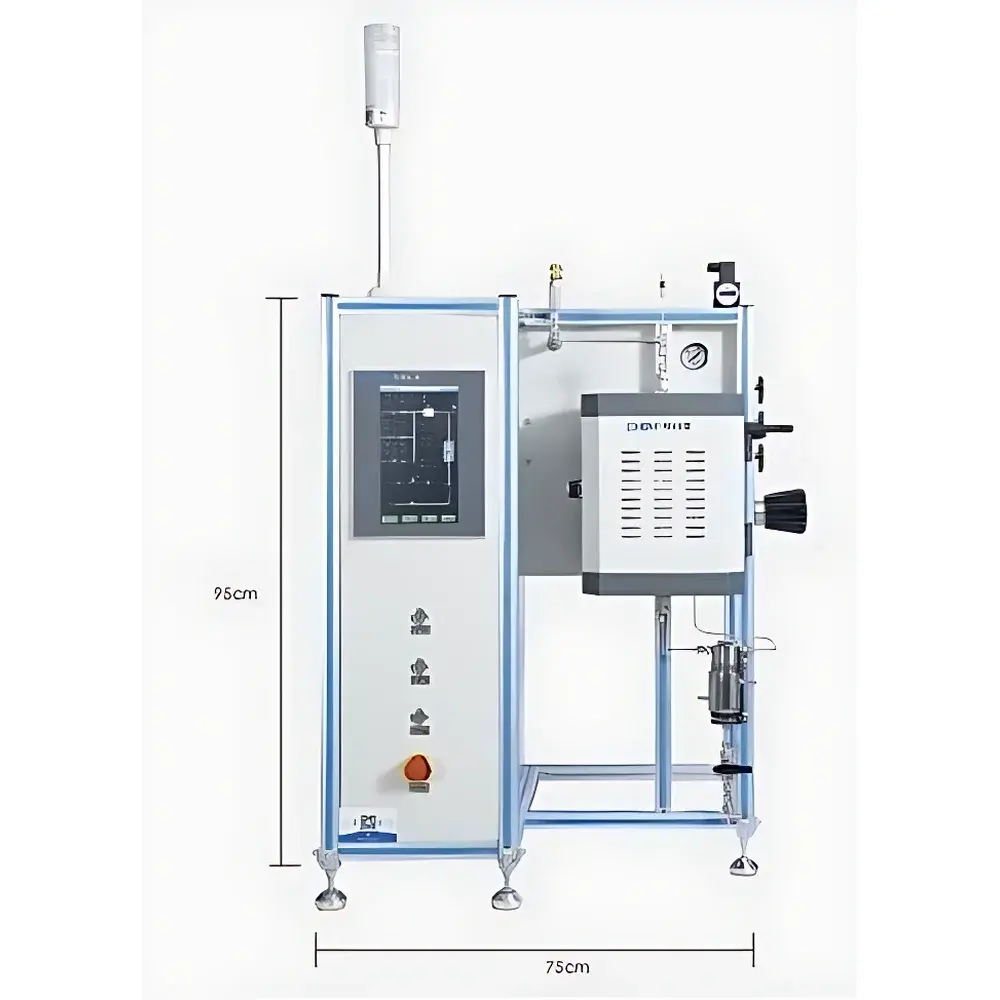
Keemi Catalyst Evaluation System – Desktop-Scale Fixed-Bed Continuous-Flow Reactor
| Origin | Anhui, China |
|---|---|
| Manufacturer Type | Authorized Distributor |
| Origin Category | Domestic (PRC) |
| Model | Continuous-Flow Fixed-Bed Reactor |
| Price Range | USD 7,000 – 14,000 (FOB) |
| Max Operating Temperature | 800 °C |
| Max Operating Pressure | 10 MPa (Note: “100℃” in source is erroneous |
| Catalyst Bed Volume | 0.5–5 mL |
| Reactor Tube Material Options | ASTM A269 TP316L stainless steel, Hastelloy C-276, Inconel 600 |
| Gas Flow Control | Multi-channel MFCs (0.005–10 SLPM, ±1.5% FS accuracy, ±0.2% FS repeatability) |
| Liquid Feed | High-Pressure Metering Pump (0–10 mL/min, up to 42 MPa, ±2% RD control precision) |
| System Dimensions (L×W×H) | ~650 × 1000 × 900 mm |
| Weight | ~180 kg |
| Power Supply | 200–240 V AC, 50–60 Hz |
| Control System | Siemens S7-1200 PLC + 10.2″ MCGS HMI with DCS-style interface (real-time P&ID visualization, trend logging, alarm management) |
Overview
The Keemi Catalyst Evaluation System is a benchtop-scale, continuous-flow fixed-bed reactor engineered for rigorous kinetic studies, catalyst screening, and process parameter optimization under controlled thermal and pressure conditions. It operates on the principle of steady-state heterogeneous catalysis, where gaseous or liquid-phase reactants flow continuously through a packed catalyst bed housed in a high-temperature, high-pressure reactor tube. The system enables precise regulation of residence time, temperature gradients, and partial pressures—critical variables for quantifying intrinsic reaction rates, deactivation behavior, and selectivity profiles. Designed for laboratory environments with limited floor space but demanding reproducibility requirements, it integrates thermally insulated heating zones, distributed temperature monitoring (±1 °C uniformity over 100 mm active zone), and low-dead-volume fluidic architecture to minimize axial dispersion and ensure plug-flow characteristics essential for reliable kinetic modeling.
Key Features
- Modular architecture supporting configurable inlet streams (1–4 independent gas/liquid feeds), enabling co-feed, sequential, or gradient experiments.
- Robust reactor construction using corrosion-resistant alloys—including ASTM A269 TP316L, Hastelloy C-276, and Inconel 600—validated for operation up to 800 °C and 10 MPa.
- High-fidelity process control via Siemens S7-1200 PLC and MCGS HMI, delivering real-time visualization of P&ID diagrams, multi-variable trend plots, and configurable alarm thresholds.
- Dual-layer safety framework: hardware interlocks (pressure relief valves, thermal cut-offs) combined with software-enforced parameter limits (e.g., max ramp rate, absolute T/P bounds) and automatic shutdown protocols.
- Expandable post-reaction handling: optional integrated quench coils, automated liquid sampling loops, and standardized GC/MS interfacing ports compliant with ASTM D7169 and ISO 15198 protocols.
Sample Compatibility & Compliance
The system accommodates solid catalysts in pellet, extrudate, or powder form (0.5–5 mL bed volume), compatible with metal oxides, zeolites, supported noble metals, and sulfided transition-metal catalysts. Gas-phase feeds include H₂, CO, CH₄, NH₃, NOₓ, and hydrocarbons; liquid-phase compatibility extends to alcohols, water, organic solvents, and aqueous solutions up to pH 2–12. All wetted components meet ASME B31.3 process piping standards. The control system supports audit-trail generation and user-level access control—features aligned with GLP compliance frameworks and preparatory alignment with FDA 21 CFR Part 11 electronic record requirements when paired with validated third-party data archiving modules.
Software & Data Management
The embedded DCS interface logs timestamped process variables (T, P, flow rates, valve positions) at 100 ms intervals, exporting structured CSV or HDF5 files for downstream kinetic analysis (e.g., Arrhenius fitting, Langmuir-Hinshelwood modeling). Trend visualization includes overlayable multi-channel plots with zoom/pan functionality and export to SVG/PNG. Optional OPC UA server integration allows seamless connection to enterprise LIMS or SCADA platforms. Data integrity safeguards include cyclic redundancy checks (CRC-32), write-once archival modes, and configurable retention policies—ensuring traceability across catalyst lifetime studies spanning hundreds of operational hours.
Applications
- Kinetic parameter determination (activation energy, pre-exponential factor, adsorption constants) for Fischer-Tropsch synthesis, ammonia decomposition, selective hydrogenation, and CO₂ methanation.
- Catalyst stability assessment under accelerated aging protocols (e.g., thermal sintering, coking, sulfur poisoning) per ISO 10012 guidelines.
- Membrane reactor performance evaluation, including permeate flux and selectivity mapping under reactive conditions.
- Reaction engineering validation of microkinetic models using transient response data (e.g., step-change experiments).
- Process intensification studies targeting space-time yield improvement and energy efficiency optimization.
FAQ
What catalyst forms are supported?
Pellets, extrudates, granules, and fine powders—provided particle size distribution ensures uniform packing and avoids channeling (recommended dp/dreactor ≥ 1:15).
Can the system be integrated with an online GC?
Yes—standardized 1/8″ Swagelok ports and TTL-triggered sampling valves enable synchronization with commercial GC systems (Agilent, Shimadzu, Thermo) for real-time product speciation.
Is remote monitoring supported?
Via optional Ethernet/Wi-Fi module and secure VPN tunneling; full HMI mirroring and historical data retrieval are accessible through browser-based client.
What maintenance intervals are recommended?
MFC recalibration every 6 months; O-ring replacement every 12 months under continuous operation; annual verification of pressure transducer linearity and thermocouple drift per ISO/IEC 17025 procedures.
Does the system support dynamic temperature programming?
Yes—ramp rates from 0.1 to 10 °C/min are programmable with overshoot suppression algorithms, enabling controlled TPD (temperature-programmed desorption) and TPR (reduction) experiments.



