
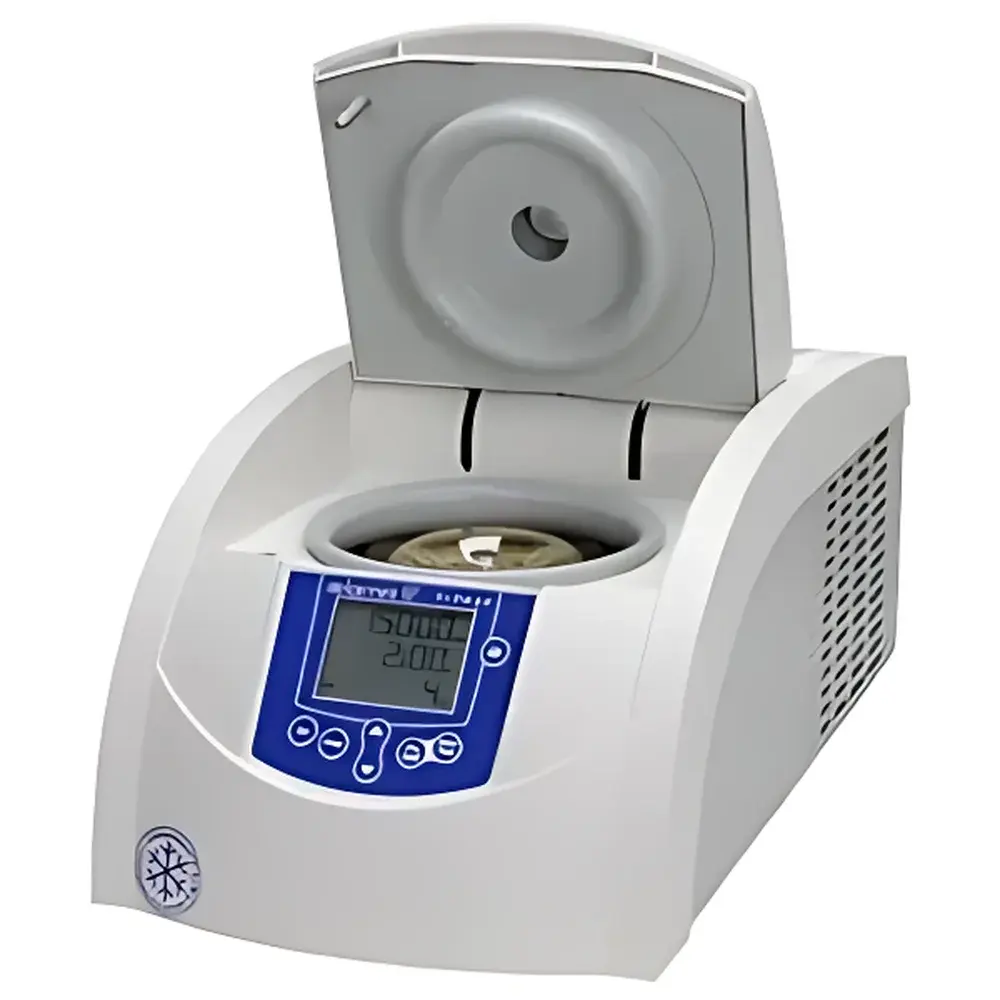
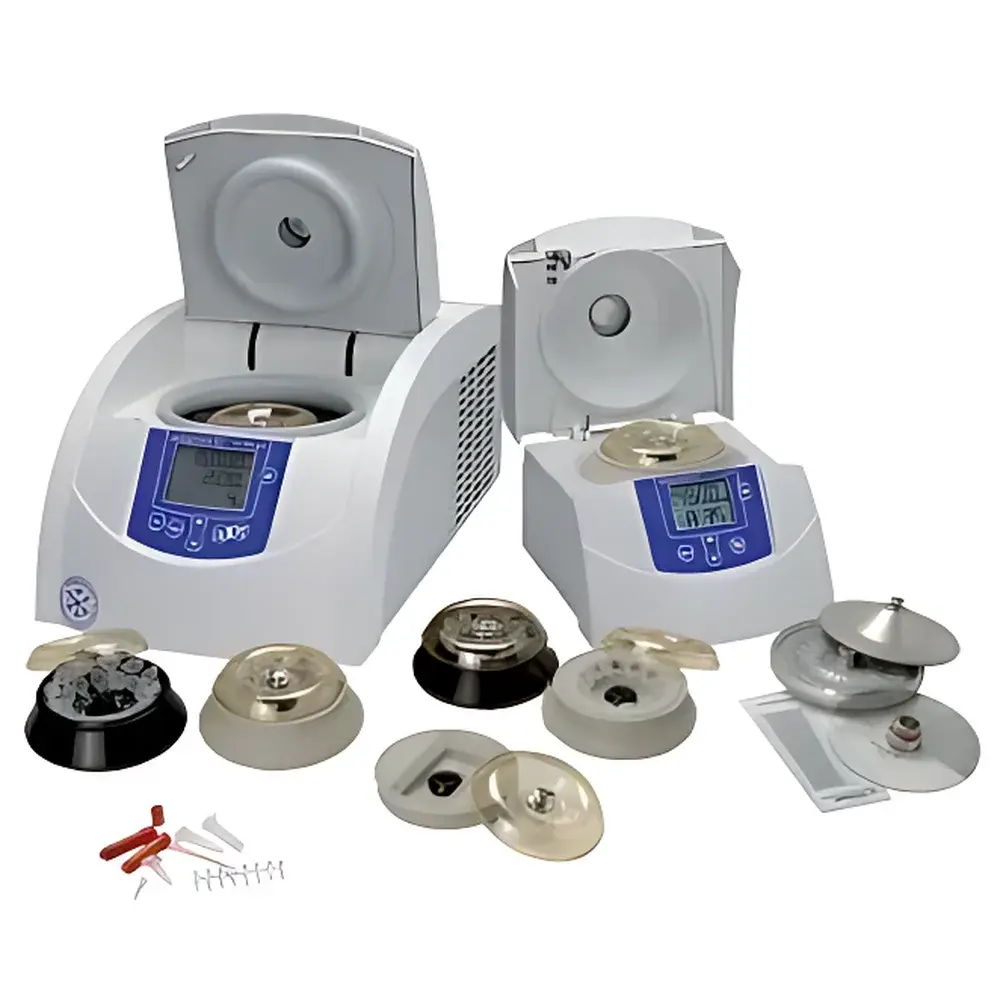
Sigma 1-14K Cryogenic High-Speed Benchtop Centrifuge
| Brand | Sigma |
|---|---|
| Origin | Germany |
| Model | 1-14K |
| Instrument Type | Benchtop Centrifuge |
| Category | Refrigerated High-Speed Centrifuge |
| Maximum Capacity | 24 × 1.5/2.0 mL |
| Speed Range | 200–15,000 rpm |
| Increment | 100 rpm |
| Maximum RCF | 16,602 × g |
| RCF Increment | 10 × g |
| Temperature Range | −10 °C to +40 °C |
| Temperature Increment | 1 °C |
| Time Setting | 10 s – 99 min 59 s (1 s increment) |
| Dimensions (H×D×W) | 236 × 515 × 273 mm |
| Net Weight (without rotor) | 19 kg |
| Noise Level | <60 dB(A) |
| Cooling System | Gas Ventilation-Based Thermal Management |
| Rotor Compatibility | Fixed-angle polypropylene & aluminum rotors (e.g., 12× and 24× microtube configurations), capillary rotors, PCR strip adapters |
Overview
The Sigma 1-14K Cryogenic High-Speed Benchtop Centrifuge is an engineered solution for laboratories requiring precise, reproducible separation of biological and chemical samples under controlled thermal conditions. Designed and manufactured in Germany, this centrifuge operates on the principle of sedimentation acceleration via rotational force—generating relative centrifugal forces (RCF) up to 16,602 × g at its maximum speed of 15,000 rpm. Its integrated refrigeration system maintains sample integrity during high-speed runs by actively regulating chamber temperature between −10 °C and +40 °C, making it suitable for temperature-sensitive applications including nucleic acid purification, protein precipitation, cell organelle isolation, and clinical specimen processing. The compact benchtop footprint (236 × 515 × 273 mm) ensures compatibility with space-constrained environments such as biosafety cabinets, clean rooms, and shared core facilities—without compromising mechanical stability or operational safety.
Key Features
- Intelligent dual-stage acceleration/deceleration profiles: Selectable “soft start/stop” or rapid ramp modes to minimize sample disturbance and tube stress.
- Large backlit LCD display showing real-time rpm, RCF, elapsed time, remaining time, and set temperature—enabling immediate parameter verification without menu navigation.
- Gas ventilation-based cooling architecture: Eliminates compressor-related vibration and condensation risks while ensuring minimal sample temperature drift during prolonged operation.
- Emergency lid release mechanism compliant with IEC 61010-2-020 safety standards for immediate access during power failure or rotor imbalance detection.
- Memory retention of last-run parameters and ten programmable user protocols—supporting workflow standardization across shifts and operators.
- Acoustic optimization: Sound-dampened housing and balanced rotor dynamics achieve <60 dB(A) noise emission at rated speed—meeting ISO 7779 requirements for laboratory ambient noise control.
- Automatic pre-cooling function: Rapidly chills chamber to target temperature prior to run initiation—reducing thermal lag and improving assay consistency.
Sample Compatibility & Compliance
The Sigma 1-14K supports a broad range of certified rotors—including polypropylene and aluminum fixed-angle configurations—for routine microcentrifuge tube formats (0.2 mL PCR strips, 0.25/0.4 mL, 0.5/0.75 mL, 1.5/2.0 mL, and capillary tubes). All rotors are CE-marked and validated per EN 61010-2-020 for mechanical safety and rotor burst resistance. The instrument complies with ISO 13485 quality management requirements for in vitro diagnostic device manufacturing environments and meets essential criteria for GLP-compliant laboratories performing method validation per ICH Q2(R2). Optional audit trail logging (via external USB data export) facilitates alignment with FDA 21 CFR Part 11 principles when integrated into regulated workflows.
Software & Data Management
While the Sigma 1-14K operates via intuitive front-panel controls, its embedded firmware supports timestamped protocol execution logs stored internally for up to 100 cycles. Data export is performed via USB interface using vendor-provided CSV-compatible utilities—enabling traceability for QC records, equipment maintenance logs, and internal SOP documentation. No proprietary software installation is required; exported files are compatible with common LIMS platforms and Excel-based analytical review. Firmware updates are distributed through Sigma’s official support portal and validated against EN 62304 software lifecycle standards.
Applications
- High-yield plasmid DNA isolation from bacterial lysates using optimized spin protocols at 13,000 rpm.
- Clinical serum/plasma separation for ELISA and mass spectrometry analysis under strictly maintained −4 °C conditions.
- Purification of extracellular vesicles (EVs) via differential ultracentrifugation steps—leveraging repeatable RCF accuracy across multiple runs.
- Preparative centrifugation of enzyme reaction mixtures where thermal denaturation must be avoided during clarification.
- Routine QC testing of reagent stability under accelerated storage conditions (e.g., 40 °C/75% RH followed by chilled centrifugation).
FAQ
What is the minimum temperature achievable during continuous operation?
The chamber can maintain −10 °C throughout extended runs; actual minimum achievable temperature depends on ambient lab conditions, rotor type, and load volume.
Is rotor imbalance detection automated?
Yes—the unit continuously monitors vibration signatures and halts operation if imbalance exceeds IEC 61010-defined thresholds, displaying error code E12.
Can the 1-14K be integrated into a networked lab environment?
It does not feature Ethernet or Wi-Fi connectivity; however, USB data export enables periodic synchronization with centralized lab informatics systems.
Are rotor certifications included with purchase?
Each rotor ships with a manufacturer-issued certificate of conformance, including serial number, material batch traceability, and burst test documentation.
Does the centrifuge support gradient centrifugation?
While primarily designed for pelleting applications, selected aluminum angle rotors (e.g., No. 12084) are compatible with sucrose or iodixanol density gradients when used with appropriate tube geometry and deceleration settings.



